
While there’s so many parties and events going on in the city, celebrations for Indigenous People are few and far between.
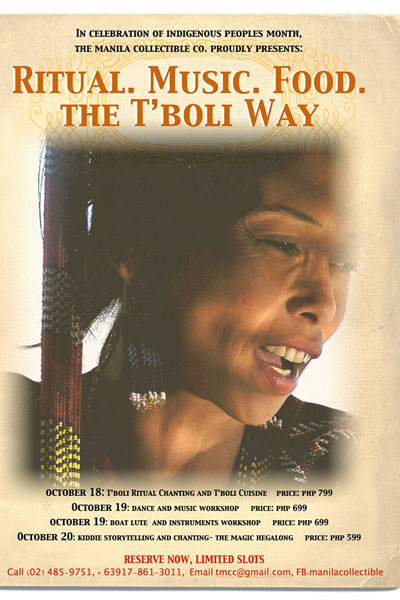
So kudos to Manila Collectible, that unique culture space in Manila, for coming up with “Ritual. Music. Food. The T’Boli Way.” All through the weekend, events honoring the indigenous people from South Cotabato will be held at the space.
“A lot of the culture is lost,” says Charisse Aquino-Tugade, who runs Manila Collectible. The space, which is just four months old, aims to educate more people about that part of our history “before 1621.” “I went to Mindanao and shit, dude, there is so much we don’t know,” Charisse exclaims. The anthropology student quickly went to work and made it her mission to educate more people.
To do that, and to celebrate Indigenous People’s Month, she organized this T’boli Festival.
Why T’Boli to begin with?
There’s no special reason why them in particular. Others weren’t available, their schedule fit best, and they’re already my friends, so it was very easy to coordinate with them.
Wow, I guess that’s already wrong thinking on our end. T’Boli! Schedules!
Yes, you know they aren’t as backwards as we think them to be. They’re educated people, they have computers and Facebook. But of course, like all societies, that depends on how well off they are, too. Oh, here’s something: please don’t call the indigenous people, a “tribe.” The most politically correct term we can use is “Ethno-linguistic.” We have more than 11 Ethno-linguistic groups.
There is so much we don’t know!
Yes, so much is lost! Traditions are skipping generations so, sayang, diba? So we took the initiative para more people will know.
Okay, let’s start with: Where are they from?
The T’boli are from South Cotabato, which is completely different from Cotabato, okay? They’re near the Tasadays—yes, totoo sila. There are real group but they were made to look much older. They’re real but the stories surrounding them are not.
What are some of T’boli’s culture will you be presenting during the event?
There will be an opening ritual, a lot of chanting and music. The T’boli’s have a lot of rituals, there’s practically one for every stage of growth. So on Friday, you’ll see how their welcome ritual is done. It usually involves a feast and a sacrifice. On Saturday, we’ll have an instructional on their dance, because their dance is very different—it’s earth-based so there’s a lot of footwork and stomping. You’ll learn here that before they dance, they touch the drum as a way to pay respect.
How about food—how is T’Boli’s food like?
Oh, they cook with a lot of fish because they live near the lake. They cook with a lot of Tilapia and shellfish. And they use these leaves to wrap the meat. You’ll see it at the event.
What are they best known for?
Their woven abaca, it’s called Tinalak. It’s very special because they invoke the spirit called Fu Dalu.
Do they have a distinct pattern that will help us identify it as T’boli weave?
No, they don’t have patterns and they don’t have templates. But, they have a type of design, it’s called Ikat which looks like tie-dye. It’s tie-resist. It’s very interesting, really because they don’t have patterns but ther weaving now looks like the weave they’ve woven 100 years ago. I think they are most famous for their weaves.
If their weave doesn’t have an identifying pattern, is there a way for us to identify them?
T’boli women are highly ornate. They have head pieces and they need their earrings—they feel very incomplete without their earrings. They have bracelets and belts that have bells on them. You know, the highly respected women are called B’oi, which is where the word “babae” comes from.
For more information, kindly visit the Manila Collectible Facebook page, or you can email them at info [at] manilacollectible [dot] com.