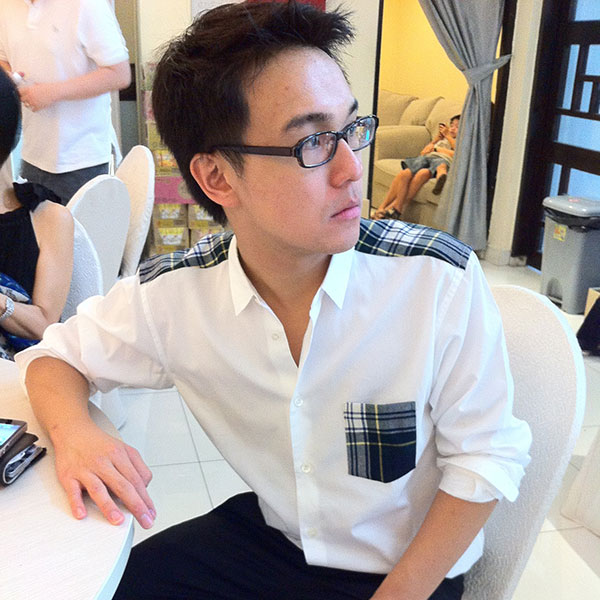

Who run the world? Pinoy nannies.
Last year, Singaporean director Anthony Chen released a touching movie inspired by his childhood nanny from Iloilo. The film, Ilo-Ilo, won top prize at Cannes, among other high-profile awards.
SEE: Coconuts chats with with Anthony Chen
This time, the nannies of 30-year-old Singaporean Bryan Koh inspired their ward “to produce a wide compilation of recipes painstakingly gathered from local cooks through meals in public markets, restaurants, carinderia (eateries), cafés and private kitchens — from Aparri town in the northern tip of Luzon mainland to Zamboanga City in Mindanao,” said one report.
The three-volume book, Milk Pigs & Violet Gold, was co-published by Holy Angel University’s Center for Kapampangan Studies, and is divided into Luzon, Visayas and Mindanao. It refers to lechon and ube. The book jackets are designed by Manny Baldemor.
Koh is a mathematics undergraduate from the National University of Singapore who took up a master’s degree in hospitality at Cornell-Nanyang Institute.
He had two nannies whose cooking he remembers fondly: Lydia Baltazar of La Union who cooked adobo, sinigang and pinakbet every week, and Evelyn Mendoza of Laguna who introduced him to fish dishes.
Coconuts Manila chats with Koh:
Good morning Bryan, what was breakfast?
A very strong milky coffee and a slice of kugelhopf.
Kugelhopf doesn’t sound Pinoy or Singaporean, where are you?
I’m in Singapore. I got it from a little German grocer near my place. It would be great if there was a place that close that sold Philippine bread, but alas…
So what was a typical breakfast when you were here doing research for Milk Pig & Violet Gold?
In Manila, I was lucky enough to stay at the house of my friend, Bianca Nunag, in White Plains. Breakfast there was usually coffee, pan de sal, sometimes some tapa. When I was on the road, which was often, it would be the offerings of the relevant regions, towns or cities. So in Batac, it was empanada and miki. In Iloilo it was batchoy and puto Manapla. In Batangas, on the way to Taal, we had these little fried buns called bonnette.
That sounds filling, how many months did you spend here in total to finish this book?
Oh gosh, I can’t remember — I made at least 10 trips over the past three to four years. Some of them were as long as three weeks.
Did you also make trips to Mindanao?
I went to Cagayan de Oro, Davao, Zamboanga. I loved them all. I will never forget Zamboanga, even if it was the shortest trip, not just because the food was amazing, the company was delightful and the people were terribly, terribly friendly — but because the hotel reception gave someone else my cellphone battery charger and it nearly ended up in Jolo. I was to be on the plane two hours later, so I was mildly frantic, ha ha.
When you were travelling across the Philippines, were there places, aromas or tastes that brought you back to Singapore?
Oh yes, especially the Chinese or, rather, Chinoy food. Things like maki mi, which is quite similar to what we call lor mee.
Did you get to try lumpia, which is similar to the Peranakan’s popiah?
Yes, both fried and fresh. Mine usually come from Spring by Ha Yuan. They’re quite lovely. I was in Batanes recently and had lumpia with dibang or flying fish in it.
Wow, you’ve really been around. Do you agree that Pinoy food, vis a vis Singaporean cuisine, is closest to the cuisines of the Peranakan — mixed race Chinese from the British Straits Setlement?
In terms of taste, no, I don’t think so. Where preparation is concerned, I see similarities in dishes like kare-kare and kakanin especially sapin-sapin, biko and kutsinta. And the lumpia and kikiam. Yes, those two are similar to our popiah and ngo hiong. They don’t taste exactly the same, but very similar indeed. And the popiah is only similar when you cook your ubod; we use singkamas.
Singapore cuisine is neatly divided into Malay, Indian and Chinese. But Filipino cuisine is more like a blend of Malay, Chinese, Spanish and American, with one dish adapting ingredients and preparation techniques from each of those cultures. Does that make it harder to market to a first-time Filipino food taster?
I suppose the blend of influences can be quite perplexing. But you see, that’s one of the things that fascinated me! It makes more sense in practice than it does in theory, but that goes for so many cuisines. Don’t forget, some of our dishes have British, Malay and Chinese influences. too. And Indian.
So what’s your top three favorite Pinoy dishes?
Well, I love dinuguan, which I must have with puto, sinigang, because that’s what I grew up on, and ginataang kalabasa. Ginataang anything, to be honest.
Have you taught yourself how to cook these at home?
Yes, of course. I cooked the dinuguan for the book in Philippines, as pork blood is unavailable in Singapore. I cooked all the dishes a few times before I put the recipes in the book.
Who were your taste-testers?
My Filipino friends, their parents and house helpers at my home in Singapore and in Casa Nunag.
Did you get it right the first time? What was the easiest, and the most challenging, dish to prepare?
Sometimes I get it right. But even if I did, I have to do it at least two to three times to be sure. I think most of the ensalada and sinigang are simple. Adobo, too. Puto is difficult. It’s long been in a thorn in my side!
It’s laborious. Can you tell us quickly how this book idea came about?
Several years ago I was a freelance travel and food journalist and thought it would be so nice if there were cookbooks on Southeast cuisine with a narrative, like a journal of sorts, running through them; not just instruction manuals or encyclopaedias or books for the academic. Something that spoke to people, had a sense of levity and yet had depth of information.
Why did you start with the Philippines?
Because I travelled to The Farm in Lipa, Batangas, to write an article for a travel magazine. I knew someone, the husband of my erstwhile househelper, who took me around after the stay. I loved what I ate — so many of it was new to me — and so I thought this was something that had to be further explored.
Now that you’ve tasted a whole gamut of Filipino food, what can you say about the offerings of Pinoy restaurants there in Singapore? Do you have favorites?
I don’t want to be too critical, but many of those fashioned after carinderias leave quite a bit to be desired. I did go to one in Lucky Plaza that had very decent inasal, so that was a joy.
I know whereof you speak. Hence, my next question: Is good Pinoy food, like what they say about Peranakan cuisine, only found at home?
Yes, you’re right. The best food I had was found in homes.
What was the best advice your nanny gave you?
Be patient!
Finally, what would you want for your last meal?
Probably a pasta, because I am drawn towards anything with carbohydrate. So a pasta, like tagliatelle, with a supremely good ragu. And a steamed golden syrup pudding with lashings of custard. I’ll make enough for four and eat it all by myself because on the next plane it won’t matter.
Milk Pigs & Violet Gold is a box set of three books, and will be available at Solidaridad, Tradewinds, National and Filipinas Heritage bookstores. To order now, send an email to milkpigsvioletgold2@gmail.com.
Photo by Dawn Koh from Bryan Koh’s Facebook.