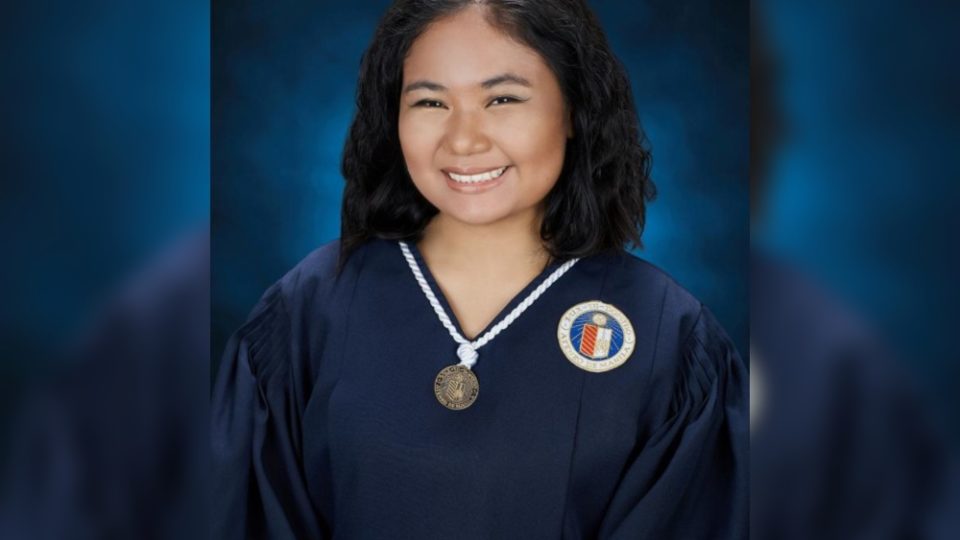

The daughter of a jeepney driver who will graduate tomorrow from the prestigious Ateneo de Manila University (AdMU) has gone viral for writing a moving essay about how poverty and inequality have affected her and her family.
Reycel Hyacenth Bendaña’s essay was posted on Ateneo’s website today, and was also posted to the school’s Facebook page, where it has since been shared more than a thousand times.
According to her post on her personal Facebook account, Bendaña, who will graduate cum laude with a degree in management economics, submitted the essay to the school when the university was choosing this year’s valedictorian. The essay was one of the requirements that students had to submit during the selection process.
In her essay, Bendaña, the president of the university’s student council, wrote how her father taught her the value of hard work, “because anything less than that would lead to complete failure.”
“I always worked harder than everyone else to get the same opportunities they had. It’s the least I can do to compensate for my lack of privilege. This is a reality of life I have long embraced: shouting as jeepney barker for my father to taking odd jobs in high school. I worked hard to be here,” she wrote.
(A “barker” is someone who calls for passengers to board a jeepney.)
She explained how, as a child born into a poor family, there was never enough food on the table and that her parents were unable to pay her school fees on time. While her classmates became aware of societal injustice by learning it at Ateneo, Bendaña wrote, she learned about it through her own experiences.
In one passage, she explains how and why she joined a protest for higher jeepney fares at a young age.
“I was seven years old when I joined my first rally. I stood with my father at the frontline of a jeepney strike that aimed to raise the minimum fare. For some, the rising price of fuel meant less profit. For my family, it meant skipping another meal; it meant more debt and more promissory notes,” she said.
In another, she lists the ways in which her family slipped through the social safety net.
“Mine is the story of a grandchild whose grandmother died because three hospitals refused to operate on her without [a] down payment, and whose grandfather tilled land that wasn’t ours for 60 years because land reform failed us,” she said.
“Mine is the story of a daughter whose father is jobless because the government phased out our jeepney in the name of hollow modernization, and even before the very policy for it was passed… Ateneo may have shown my fellow students the realities of injustice in society, but for me, it served as a refuge from my own experience of social inequality.”
Bendaña goes on to argue that her story illustrates why it’s necessary for Ateneo to continue to generously give opportunities to poor students like her. However, she notes, as long as the school “needs to be generous, it means society has not overcome bigger, deeper problems: social inequality, lack of opportunity, and the concentration of economic and political power in the families of many of my schoolmates.”
“We need a more generous Ateneo, but that is not the solution to this nation’s problems,” she said. “What we need is a country that resembles a generous Ateneo. Inequality in the Philippines means that there is a hill, and the rest is down from the hill. We must dream of something better than this. Ateneo should not be content to sit proudly on its hill and invite others into its light. It must shine its light to the darkness far beyond its borders.”
“I am extremely lucky to have been given a place here — it is my honor and duty to make things more just, to share whatever light I can, especially to those who have only known darkness,” she said.
Netizens were quick to give to give Bendaña the online equivalent of a standing ovation, heaping praise on her essay. Ditas Khouri called it “inspiring.”

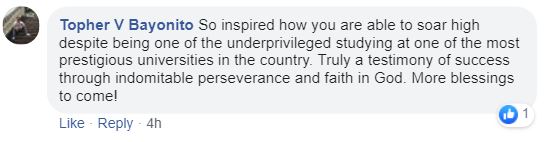
Topher Bayonito called her story a “testimony of success through indomitable perseverance and faith in God.”
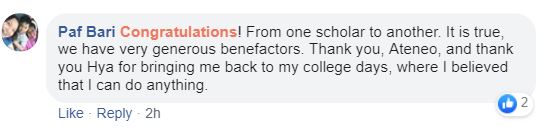
One netizen named Paf Bari thanked Bendaña for bringing her back to her own college days at Ateneo.
Have you heard of a story similar to Bendaña’s? Tell us by leaving a comment below or tweeting to @CoconutsManila.