
The Fashion Institute of the Philippines (FIP) held its annual graduation runway show at the New Glorietta Activity Center on July 25.
It presented the capsule collections of 36 students from the school’s three branches in Ortigas, Makati, and Quezon City.
Each graduate created four outfits under one of the three categories: formalwear, pret-aporter, and concept design. The show served not only as commencement rites, but also as a competition for prizes that can help start careers and businesses.
The collections were evaluated by respected designers Frederick Peralta, Albert Andrada, Francis Libiran, Jerome Llorico, and Renee Salud; fashion editors Daryl Chang of Preview Magazine, Patrick Ty of Metro Magazine, and Carmencita Sioson of Look Magazine; and representatives from corporate sponsors such as Tadashi Koshio of YKK Philippines.
[JUICEBOX_GALLERY]
The Zalora Retailer of the Year award went to Enzo Habulan. His ombre designs of orange, rust, blue, black and white will soon be available for purchase at the sponsor’s online shop.
Kevin Del Poso was hailed the Novitiate of the Fashion Designers’ Alliance Manila. His membership in the association is supported until 2015. He also received the Best in Technique prize. Del Poso had three men’s and one women’s ensembles, mostly in white.
The delicacy of sheer, crosshatched panels and curls blooming out of sleeves were balanced with dark trousers and imposing belt buckles for outfits that were unerringly masculine.
YKK, a leading manufacturer of closures, provided zippers to students upon request, with the incentive of being recognized for creative zipper use. It chose Gayle Peckley for this honor, having produced geometric silhouettes outlined with metal slide fasteners.
Kim Clark won Best in Fashion Illustration. She was selected based on the renderings submitted prior to production. Brought to life, Clark’s sketches turned out to be fluid pastel chiffon dresses with a hit of gold florals that are a foreseeable hit among brides searching for entourage outfits.
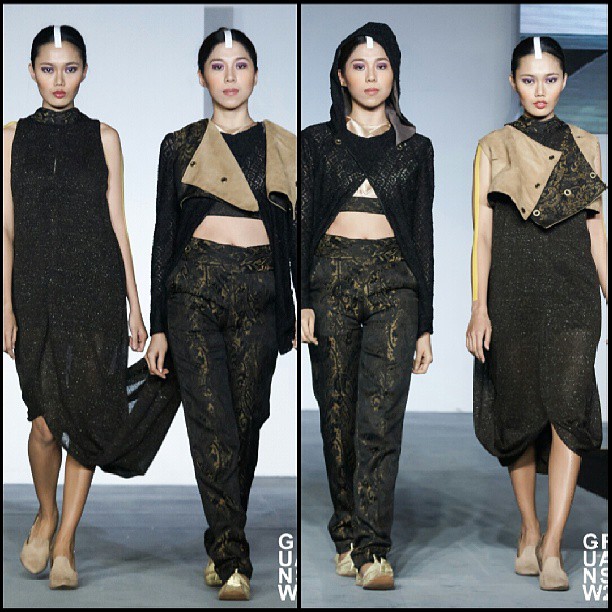
Xioti Chiu scored the most desirable prizes of the evening by showing convertible clothing. One dress had a hem that could be worn over the shoulders as a contrasting vest. Alternatively, the train/waistcoat can be lent to a second person with the main textile on view, turning the two models into Siamese twins.
There was also an eminently wearable miniskirt and jacket that were structured to echo the diamond pattern of the gold and black jacquard fabric.
As the winner of Best in Garment Construction, Chiu took home an industrial sewing machine from Triple K. To adequately assess craftsmanship, entries were evaluated in a pre-judging session on July 14. His title of Designer of the Year comes with an all-expense-paid trip to Paris, France.
The event also commemorated the school’s tenth anniversary by including both a static exhibit and parade of gowns made by teachers and alumni. Shanon Pamaong, founder and director of FIP, trumpeted former students who have recently risen to international prominence as proof of the quality of education at the institute.
He named Kermit Tesoro, whose works have been worn by Lady Gaga, Francis Libiran, who top-billed the first Canada-Philippine Fashion Week, and Oliver Tolentino, who dresses Hollywood stars for the red carpet.
According to Pamaong, technical know-how is the most important learning imparted to all FIP students. Indeed, though the graduates’ aesthetics vary widely and lapses in styling were unavoidable, most garments were cleanly sewn and finished.
It is estimated that the show’s 144 outfits together took more than 5,500 hours to stitch.
Some notable designers who succeeded in overall composition include Celine Uy, who handpainted pink blossoms on a bed of gunmetal satin in simple silhouettes. This was a clever reversal of color concept seen in Clark’s work, but equally appealing.
Yayang Bautista and Pia Gajasan both offered standout casual separates. Both their collections effectively marry sportswear elements of neon colors and quilted textures with office classics such as full but tapering trousers and sleek pencil skirts. Crop tops, leather and zippers contribute further to this fresh but very saleable perspective.
Those interested in leather garments should look to Joel Andrade and Frankie Galagnara. The sheen of hides, swinging crystals, fur, and mesh combine for the femme fatale of Andrade’s imagination. On the other hand, the material gives a distinct edge to Galagnara’s efficient urban basics.
Queensee Mojica offers a playful and lighthearted outlook on domesticity and femininity in the 1950s, tackling all the iconic elements of a woman’s wardrobe then: corset, sweetheart bikini top, flared dress with petticoat, apron. Her clothes will no doubt be a hit with those who favor the ultra-girly styles popularized by South Korean immigrants.
FIP currently operates in Ortigas, Makati, Cebu, and Cagayan de Oro. Classes follow a two-month academic term, with the next starting in September.
—
Photos: Lee San Diego