
PART 1
On Aug 23, 2016, a suspected drug user in Pasay City was killed by policemen as he was about to surrender. An amateur video captured the incident that happened after 1am. “Officer, please don’t shoot,” a woman could heard screaming. “Mind your own business,” a policeman shouts back. With gunshots in the background, the suspect pleads for mercy. “So you’re going to surrender?,” the police officer taunts him. But the 22-year-old is killed in cold blood. The incident has been dubbed “police overkill” by the media.
Eric Sison is one of over 3,000 people who have been extrajudicially killed in a war against drugs started by newly-elected Philippine President Rodrigo Duterte.
A day after this incident, the Coconuts TV team flew to Manila to attend Eric’s wake. We started at the Manila Police District headquarters in Ermita, where reporters on the crime beat gather every night for a briefing on the next day’s possible front page stories. We joined journalists from local and foreign publications and drove through a dark and apocalyptic-feeling capital city, in the middle of monsoon season.
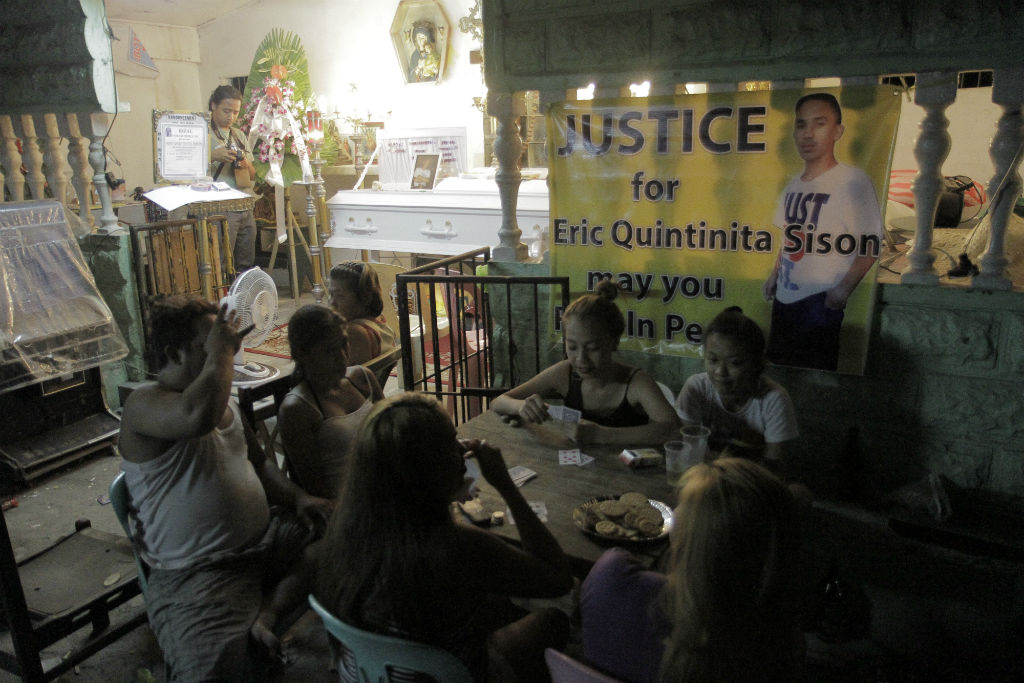
In the neighborhood where police found Eric, who made his living from driving a pedicab, we walked through the narrow alleys of a slum area and after a few twists and turns, found friends of Eric who were there to send him off. His wife and friends left food offerings on his coffin, as well as a chick, which Filipinos believe will hasten justice for those who have died violently. The slippers he was wearing when he died were propped up against the foot of his coffin, one of the few physical things his friends have to remind them of Eric.
His wife, Rachelle Bermoy, had already been interviewed by two reporters before we sat down with her. They have one child together. She said her husband never used drugs and was innocent. He had a clean record, she said, and the police had conspired to kill him.
“My husband was just a sidecar boy, he made a living by driving a pedicab,” she told us. “The police put his arm on Eric’s shoulder and said someone should go and see me at home to inform me.”
She said one of the officers had told her husband that he was going to be brought to the precinct, which got him suspicious. “If they really intended to go to our house, then they should have handcuffed him,” said his wife. “But, no. They made him make a run for it and then chased him with gunshots.”
Police later told reporters that they found drugs and a gun in Eric’s possession, but his wife said that was impossible. “My head already hurts from answering questions again and again about that gun.” After Eric was gunned down, one police officer went back to their house. “One of them came back to the house and I thought he was going to fire a gun. My son was alone inside the room sleeping. So I begged the officer, ‘Please don’t fire, my son is sleeping.’”
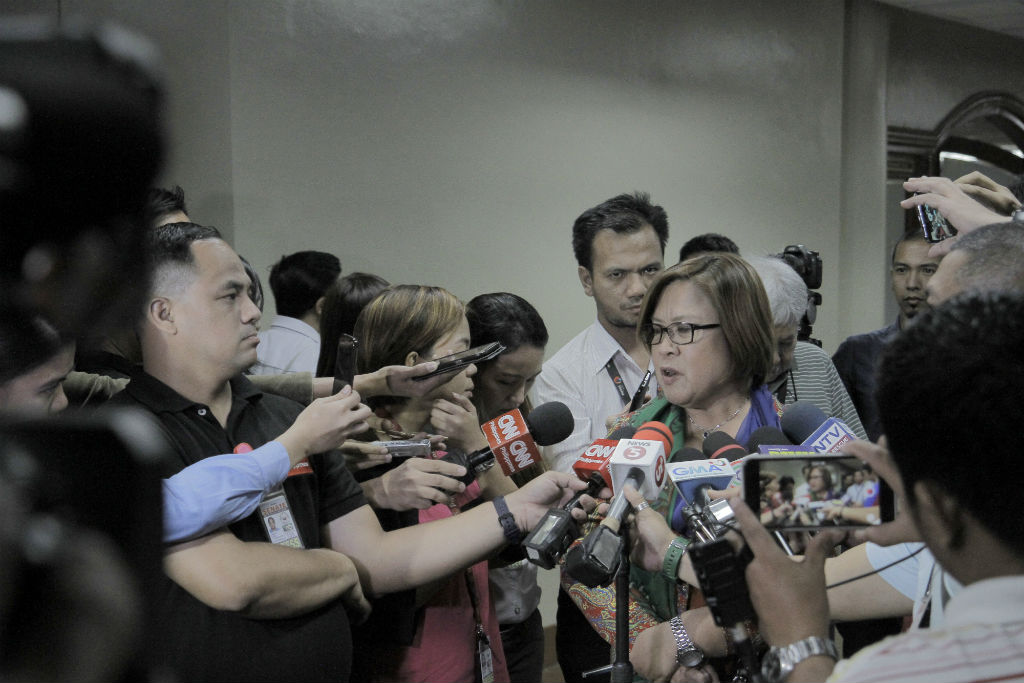
Coconuts TV asked the Philippine National Police’s spokesperson, General Dionardo Carlos, for their side of the story. “The given audio evidence can be used in the case,” he said. But he also wondered, “Can you identify whose voices those were? Are you an expert to say that is the sound of a gun? Or were they just slippers making a thwacking sound?”
He said they will have to look for experts who can analyze the evidence. A day later, three cops involved in the incident, plus their boss, were relieved of their positions a day after Eric’s death.
We also revisited the scene of the crime and asked the village chairman and some witnesses, whose identity we have to hide because they are underage, what happened that night.
“The police car stopped there and then the officer frisked him, The man asked, ‘Where is this guy from? We said, ‘He’s from here.’ The cop said, ‘We’ll taking him with us, just tell his wife to visit him [in the precinct].’ Maybe when the cop’s hold loosened, he made a run for it,” said one of the the witnesses.
According to them, Eric had a few drinks that night. He was on his feet and resting his head on a pedicab when a police officer sidled up to him and frisked him.
The witnesses claimed that the officer told him to make a run for it, and then fired a warning shot. Three cops chased him inside this interior alley, which was deserted at that time. Eric ran and managed to climb up a roof. But he ended up inside his neighbor’s house, and he died in this spot where the electric fan now stands.
The autopsy report revealed that he was shot 14 times. A witness who is now in hiding said Eric, unarmed and cowering, was shot like an animal.
Philippine President Rodrigo Duterte took office on June 30, 2016. Since then almost 3,000 people have been killed without legal process in his war on drugs. That’s about 44 per day.
PART 2

Coconuts TV went to the Philippine Senate in Pasay City, where lawmakers called on the Philippine National Police to explain the spike in drug-related deaths.
In the dark alleys of Metro Manila, dead bodies have turned up with alarming regularity.
One man, an alleged drug dealer, was dumped on the street in July, his face covered with packing tape and a placard that said, “I am a pusher.”
Another two suspected drug pushers were killed by police in June during a drug-bust operation that ended in a shootout.
A tricycle driver was gunned down by three men in Caloocan City just this August. Though his friends and family members said he was not involved in illegal drugs, a report later said that cops recovered two plastic sachets containing shabu, or crystal meth, from the crime scene.
The killing of the tricycle driver was caught on CCTV, but the suspects are still unidentified and at large.
Who is responsible for these deaths? According to General Carlos, they are four main types of kilings.
“First, there are the vigilantes that kill people and make it as appear as ‘cardboard justice’. Second are syndicates that hire gunmen to kill those who can’t remit payment within two weeks. Third are those who are doings this to cover their tracks because they don’t want the drug users to reveal them as suppliers in our Oplan Tokhang project. There are also regular crimes where it’s actually a personal fight and they make it appear that their opponent is a drug lord and they put a cardboard saying ‘Do not imitate’ to divert attention,” he explained.
International organizations like Amnesty International and the United Nations have condemned these drug-related murders, which are explicitly sanctioned by Duterte, who claims that the country is consumed by a drug crisis where addicts, many of them the poorest of the poor, are trapped in a cycle of committing crimes to sustain their habit. Meanwhile the rich and powerful make money on drug distribution.
Duterte has ordered Philippine police to shoot to kill suspects if they resist arrest.
The Philippine government’s strategy for fighting the drug menace is called Operation Double Barrel, for its two-pronged approach that targets both powerful drug lords and street level users.
Drug abuse has been a problem in the Philippines as early as October 1907, when the Opium Law was passed to restrict the sale of this pain-numbing drug. In 1972, with 20,000 drug users recorded, and marijuana as their most popular illegal substance, the Dangerous Drugs Board was formed by President Ferdinand Marcos.
That same year, Marcos put to death by firing squad a Chinese drug lord named Lim Seng who was manufacturing and selling cocaine in the Philippines. To scare Filipinos, Lim Seng’s execution was broadcast live on television.
A 2016 US State Department report, quoting statistics from the Dangerous Drugs Board of the Philippines, says 1.7-million Filipinos, or 1.6-percent of the population, are addicted to illegal drugs. But the real numbers are probably higher.
Shabu, with its cheap, strong high, is the drug of choice in the Philippines and it is massively addictive.
The Philippines’ drug problem isn’t confined to Metro Manila either. Senator Miguel Zubiri from the Mindanao region says people there have stopped smoking cigarettes. Instead they’re buying a hit of shabu for half an American dollar.
The majority of Filipinos support the war against drugs, but many are worried that Duterte is not making a distinction between drug users and drug pushers. No one we spoke to was willing to go on record to declare their support of extrajudicial killings.
But at the Philippine Senate, boxer Manny Pacquiao, a Bible-quoting devout Christian and a first-time senator, has not only praised Duterte’s drug war, he’s also declared that killing convicted drug pushers is not a problem.
In Makati, Coconuts TV talked to former Philippine senator Rene Saguisag at his home.
Saguisag has long argued for decriminalizing drugs, or at least marijuana, in the Philippines. Now 77 years old, he is a prominent and respected human rights lawyer and is one of the more vocal critics of Duterte’s war against drugs.
He criticized the president’s statements naming and shaming alleged drug lords and police officers without formal investigation, and demanded due process.
“Try these people, give them a chance to be heard. Duterte and Bato are very impatient,” said Saguisag. “To me, even if Marcos was hypocritical, at least Marcos filed cases. Here there no more trials, so what’s happening is funeral parlor owners are crying because no one is claiming the bodies. That’s because the victims are mostly poor. If you’re wealthy, they’ll invite you to Malacañang, like with generals, there are hearings. But the FIRE, AIM, READY justice is just wrong. It should be READY, AIM, FIRE.”
F. Sionil José, an influential Filipino journalist and novelist, is one of those who believe in Duterte’s leadership. He told us that this war against drugs has been a long-time coming and that Filipinos need to accept that there will be collateral damage.
“In a revolutionary situation there’s bound to be collateral damage. So we must be prepared not only for the painful process of this revolution but for the collateral damage, as is happening, and the emotional travail wherein families will be broken up, brothers will be quarreling, that sort of thing. Even friendships will be sundered because, eventually, this is just at the lower levels. But you can see it already going up. It’s going to go up! It’s going to affect our elites, the business and banking sectors. There’s also a lot of corruption in the higher levels of society.”
PART 3

One of the iconic images of Rodrigo Duterte’s war on drugs so far is this picture of a woman cradling the body of her dead husband. He was gunned down by unknown assailants in Pasay City on July 24, 2016. A sign calling him a drug pusher was left next to his body, but his wife maintains that her husband was only a pedicab driver, and one of the 16.6-million Filipinos who voted for Rodrigo Duterte.
In his State of the Nation Address, Duterte likened this image to Michelangelo’s Pieta, a famous sculpture showing the Virgin Mary cradling the dead body of Jesus Christ, and dismissed it as overdramatic. “And then you’re there, sprawled and portrayed in a broadsheet looking like Mother Mary cradling the cadaver of Jesus Christ. It’s all drama,” he said dismissively.
A picture of the incident by photographer Raffy Lerma appeared on Philippine Daily Inquirer, the only newspaper in the country that dared to put it on the front page. Raffy said there were four cases of extrajudicial killings in Pasay City that night, but he knew right away that this one was different.
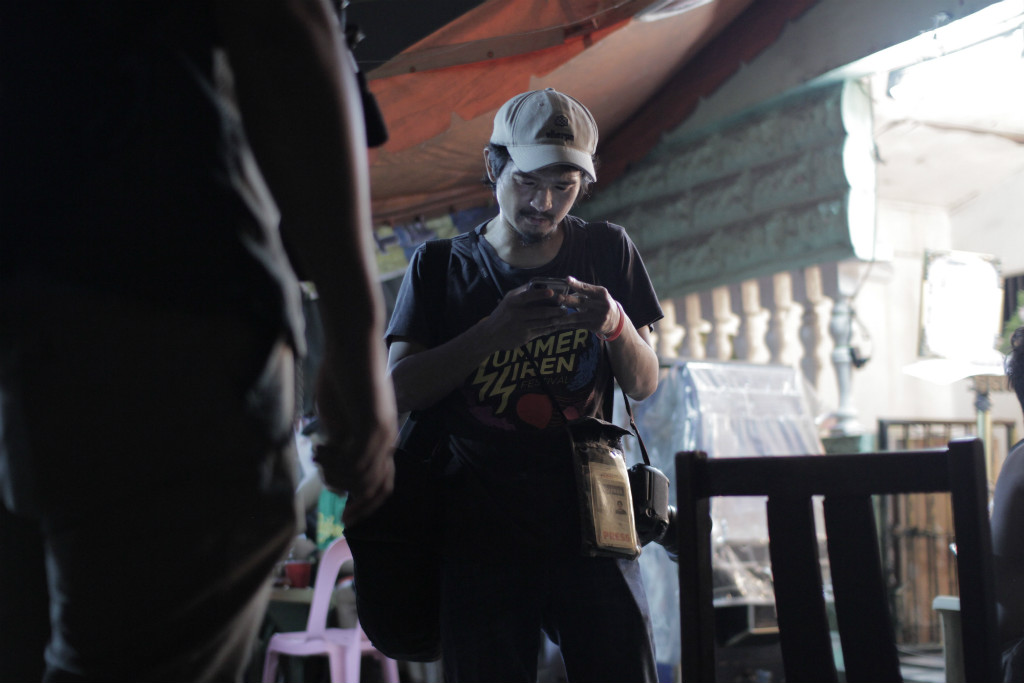
“He was the third victim of extrajudicial killings that night. When we arrived at the scene at 1:30am, I knew right away that there was something different. From afar I could see that the area was cordoned off, and the victim was in the middle, his wife was cradling his body. There were many people, many civilians, who were watching,” said Raffy, who has been a photojournalist for 15 years.
He has noticed an increase in killings in Metro Manila since Duterte assumed office. “Back in 2007 I also assigned to the night shift duty for a year. This year, in the first week alone, I covered more deaths and extrajudicial killings compared to the whole year I covered in 2007.”
In an opinion piece he later wrote for the Inquirer, he defended his photo from Duterte’s accusations. Raffy said that the moment he captured was 100% authentic and that his duty is to show reality to spur action. “Like I said in previous interviews, these are real people, these are real lives, so give them that dignity. Their right to live was taken away from them, let’s at least give their families the right to grieve.”
Philippine National Police spokesperson General Dionardo Carlos denied that there has been increase in killings. He also clarified that some of the killings reported in media are not extrajudicial killings but, actually, regular murders.
“For us, anything that happens, when a person is killed or harmed, these are cases of murder and/or homicide. That’s the basic, we follow the penal law. So those tagged as EJK, most of those are regular crimes. Did we really have a sharp increase in the number of deaths over the given period? No!”
These deaths, whether regular murders or extrajudicial killings, are creating a climate of fear and paranoia among Filipinos.
Coconuts TV found “Jeffrey,” who described himself as a “recovering addict”. He said he is glad he decided to stop taking drugs. If not he said, he would probably be one of the casualties of Duterte’s drug war. But he believes that drug users should be spared.
“Honestly I am glad. Why? Because it could have been me. I could have been killed if I didn’t make good choice. I could be one of the casualties. But I believe in redemption. We all commit mistakes, and we must be given the chance to rise again,” he told us.
Though he never killed anyone while under the influence of drugs, Jeffrey said that he had committed horrendous crimes that he is too ashamed to recall. But he knows how drug pushers and drug lords, some of them with ties to the police, operate.
“As I said, I did not kill anybody but I know of several people who did, because of drugs. There is one guy who is into police service, we used to have a “tripping session”. And then every now and he would brag about killing pushers who fail to remit money, and stuff like that. He will lure them into a certain place, enticing them, making them believe that they will just take drugs, and when they’re already in that place, they will hit the guy on the back and chop the body into several pieces, put it into a drum and pour cement. And, I don’t know if it’s true, that guy said they brought the drum to the middle of Manila Bay and dump it there. So, that’s only. There are several incidents, it’s horrendous, you know.”
How long is this war against drugs going to last? The Duterte administration had originally allotted six months to solve the problem, but such a complex issue isn’t going away anytime soon.
On Sep 18, Duterte asked for a six-month extension. He confessed that he had no idea that there were hundreds of thousands of people in the drug business. “Just give me a little extension, maybe another six months. I didn’t have that idea that there were hundreds of thousands of people already in the drug business. And what makes it worse is that they are operated now by people in government, especially those in elected positions.”
F. Sionil Jose, an influential journalist and novelist whose books about class struggles in his country, have been translated into 22 languages, warns that this is just the beginning of a Philippine revolution.
“I like to think that it is a continuation of the 1896 revolution. Simply put, it’s ideological platform is love of country and the willingness to sacrifice for it.” 6:27-6:52 “It’s basically anti-elite. And if you study our politics very well and our history, all these years government has been manipulated by the wealthy Filipinos. And remember this is the first politician that does not have the open support of the oligarchy,” said the Philippine National Artist for Literature.
Sionil said the ultimate problem is extreme poverty and inequality that so far no Philippine president has been able to solve. “You cannot develop without peace in the country, and that peace has also been disturbed so much by criminality, and much of that induced by drugs…We haven’t seen anything yet. And as I said this is not going to be done in two or three years. Just look back. The Vietnamese revolution took how many years. The Chinese revolution started in the 1920s, you see. The French revolution, maybe a shorter period. But almost all of them take years, maybe one generation.”
Lives must be lost in this revolution for the ultimate benefit of the Philippines, he said.
“One must, like I said, avoid that collateral damage and this means….that the press must be vigilant, human rights groups must also be vigilant. Otherwise the revolution will not give a damn about the collateral damage… They must continue looking after human rights so that the revolution will not kill its own children.”