
Got a tip? Send it to us at manila@coconuts.co.
Call it “aftershock real estate.”
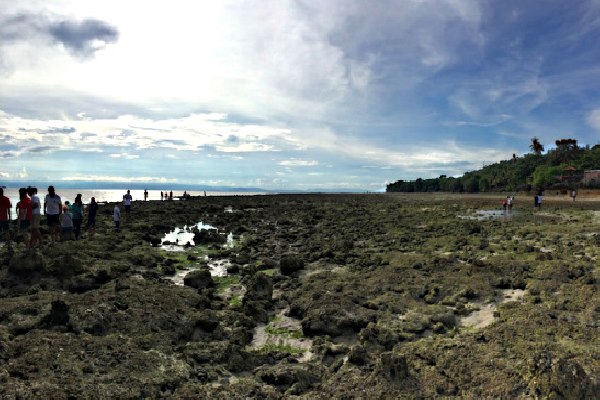
“Scientists pointed out that the heaving of the seabed more than a meter above the water during the 7.2-magnitude earthquake that hit Bohol in October 2013 has exposed a broad, flat reef covered with seagrass, corals, and other marine organisms that once lived undisturbed under the sea,” reports Inquirer.net.
The report noted: “To the municipalities of Maribojoc and Loon, which share stories of devastation caused by the quake and are contoured by the new coastal crust in the southwestern part of the island-province, the strip offers exciting ecotourism opportunities.”
However, as the report indicated “the hopes of Maribojoc and Loon have been dashed by a recent Department of Environment and Natural Resources (DENR) declaration that the strip is owned by the state and that it is a ‘geological monument.'”
The DENR describes geological monuments are sites that “show outstanding features or processes considered by geologists and other scientists worthy of conservation.”
Examples of the country’s geological monuments, as stated in the report “include the Chocolate Hills, also in Bohol; the Hundred Islands in Pangasinan province; the sand dunes of Ilocos Norte province; the St. Paul Limestone Formation in Puerto Princesa City in Palawan province; the Taal Volcano in Batangas province; and the Montalban Limestone Gorge in Rodriguez, Rizal province.”
Photo: IslandHopes.com (screengrab)