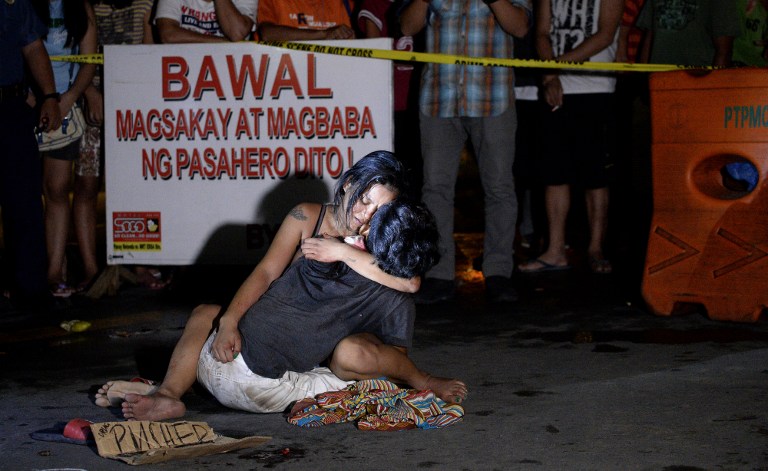

“Blood will flow like a river.”
These were the words of a 62-year-old widow from Davao City, talking to a Reuters reporter in early May, before Filipinos overwhelmingly voted Rodrigo Duterte as their next president. Clarita Alia knew what she was talking about. Four of her sons had been gunned down, allegedly by members of “Davao Death Squad,” a vigilante group rumored to have ties to Duterte.
Duterte had served as Davao City mayor for two decades, where he gained infamy for bringing peace and order in his locale through means that would not sit well with human rights advocates. He more or less confirmed his DDS connection when he quipped in an ABS-CBN News report, “Ako, ako daw death squad (They say I’m the death squad)? True, that’s true.”
Indeed Duterte has talked freely about annihilating criminals — due process be damned.
In 2009, Duterte declared in yet another one of his anti-criminality tirades, “If you are doing an illegal activity in my city, if you are a criminal or part of a syndicate that preys on the innocent people of the city, for as long as I am the mayor, you are a legitimate target of assassination.”
Duterte’s declaration (and variations thereof) horrified some people. However, there were many more who saw him as their savior — the lawmaker who would bend the laws in order to expedite the implementation of justice.
Manny Piñol, secretary of the Department of Agriculture and a close Duterte ally, has said that Duterte’s “essence and meaning of leadership” can be summed up in these words: “I do not care if I burn in hell for as long as the people I serve live in paradise.”
Well, as it turns out, paradise involves a staggering death toll. Data gathered by the ABS-CBN Investigative and Research Group show that there have been 834 drug-related fatalities from May 10 to Aug 4, 2016.
Do the math: That’s 834 people dead in 88 days. That’s an average of at least 9 people dead each day.
It’s worth noting that most of the people killed belong to the impoverished sector of Philippine society. Many of them are residents of “risky neighborhoods.” In Metro Manila, that often refers to slum areas where informal settlements abound.
Critics of Duterte accuse the government of going after the small fish and denying them of their rights.
In the right side of the tracks, things aren’t so bad.
In the gated and exclusive communities of Makati City, where business owners, politicians and the country’s old rich families live, not one single drug pusher or user has surrendered to the police. Their names don’t even come up in the local authorities’ drug watch lists.
Makati City’s police chief, Senior Superintendent Rommil Mitra, had reported that no drug pushers and users had surrendered from the city’s six exclusive villages — Magallanes, Dasmariñas, Forbes, San Lorenzo, Bel-Air, and Urdaneta. These villages reportedly submitted to police certifications signed by their respective barangay chairmen that there were no drug pushers and users monitored in their subdivisions.
This is in stark contrast to how members of the Philippine National Police operate in poorer communities.
They knock on the doors of the suspected drug pushers or addicts and urge them to surrender to the authorities. Though no outright threat is issued on the lives of the suspected drug peddlers and addicts, the fact that cops have coming knocking at their door is warning enough. It’s, “Surrender or else…”
Reacting to this criticism, the PNP announced in July that they would now be targeting high-end bars in Taguig and Makati cities in an attempt to combat the proliferation of party drugs.
Duterte has also named 158 mayors and judges suspected of being involved in the drug trade — including a judge who’s been dead since 2008.
The fact that the President himself has a list that turns out to be outdated is cause for alarm. Because if his people can make a mistake like that, it’s also possible that so have others.
What if the wrong people are named in the PNP’s drugs watch list? What if vigilantes who want to help the police end up assassinating the wrong person? What if there are corrupt cops who are using the President’s shoot-to-kill order to eliminate their former cohorts?
There have been innocent people — who were not in the PNP drugs watch list and later tested negative to drug use — mistakenly tagged as drug pushers or users by vigilantes.
One of them is 22-year-old Rowena Tiamson, whose hogtied body was found dumped by the roadside in the town of Manaoag in the province of Pangasinan, some 170 kilometers north of Metro Manila.
Tiamson had been shot in the head. A piece of cardboard was placed near her remains. These words were written on it: “Huwag tularan. Pusher (Don’t be like her. She is a pusher).”
However, the PNP confirmed that Tiamson was not on their drugs watchlist. Her family and friends also vouched for her character. Tiamson was a consistent honor student who was active in the church choir.
Around the same time that Tiamson was killed, Roman Clifford F. Manaois, 20, also lost his life when vigilantes (two still-unidentified men on a motorcycle) shot at the tricycle he was riding in Dagupan City, Pangasinan.
A Manila Bulletin report later confirmed that the possible target of the vigilantes was a man named Zaldy Abalos, who also happened to be riding the tricycle that Manaois was in.
Tricycles are often the only public transport vehicles is provinces outside the Philippines’ big cities.
In the case of Manaois, it seemed like the vigilantes assumed he was with Abalos. As the tricycle driver, who survived the attack that also killed Abalos, testified that one of the assailants still shot Manaois in his temple even after the latter was already down on the ground, as a bullet had already pierced his heart.
Manaois was not on the PNP’s drugs watchlist either. The autopsy also confirmed that he had no trace of drug use in his system.
Of course, those who support the government’s war against drugs have downplayed cases like Tiamson’s and Manaois’.
There are event those who theorize that enemies of the state are purposely killing innocent people in order to discredit Duterte. They offer all kinds of theories to make the death of innocents less horrifying.
But people are scared, especially since the drug-related murders show no signs of letting up.
Stories about the killings continue to flood the news. The manner in which the victims are mudered and dumped are similar.
A CNN Philippines report paints quite a vivid picture: “Shocking photographs published in local and international media show suspected drug dealers often bound hand and foot, shirts soaked in blood, their faces sometimes covered in duct tape, wearing crude cardboard signs proclaiming their alleged crimes. Murdered in the streets or in ramshackle, crowded rooms.”
These gruesome tales are supposed to encourage drug users and peddlers to surrender to the authorities. The fact that the Philippines doesn’t have ample rehab facilities for their care and that prisons are horribly overcrowded are other matters of concern.
Moreover, surrender doesn’t guarantee that one will live.
Take the case of drug user Lamberto Rodriguez who had already surrendered to the authorities but was still shot dead at his home in Southville 3, Barangay Poblacion, Muntinlupa City.
In a Philippine Daily Inquirer report, Rodriguez’s wife, Myrin, related that her husband had every intention of quitting his drug habit.
Police said that Lamberto’s surrender may have enraged his former cohorts.
“We’re looking at multiple angles. He could have submitted names of people also involved in drugs who could have gotten word about it. Maybe he failed to pay off a debt. Maybe he surrendered because he couldn’t pay [his supplier] anymore,” said Leopoldo Bernabe, deputy chief of the barangay police assigned to Southville 3.
For her part, Myrin, who claimed that she and Lamberto voted for Duterte, could only say in Filipino, “What’s done is done. In a way, I’ve come to accept what happened. My husband was guilty of a few sins.”
Yes, blood will continue to flow like a river. It’s not just on our hands now. The way things are going, we’re all going to drown in it.