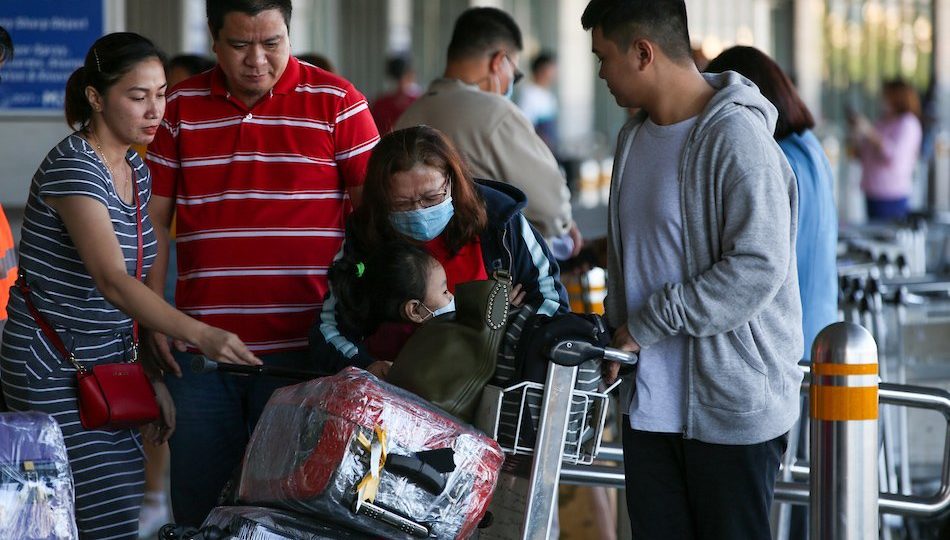

Filipinos returning to the country will soon be required to take COVID-19 rapid tests before they could enter the Philippines, Cabinet Secretary Karlo Nograles, the spokesman of the COVID-19 task force, said today.
“All arriving overseas Filipino workers or OFWs, whether land-based or sea-based, shall be required to undergo a mandatory 14-day facility-based quarantine and shall be subject to rapid antibody testing for COVID-19,” Nograles announced in today’s virtual presser.
Nograles did not specify if the measure is already being implemented but said that a memorandum has already been issued by the Department on Health (DOH) on the matter. Nograles added that the Department of Foreign Affairs (DFA) will determine which quarantine facilities the returnees will be housed in.
The DOH has said that PCR-based tests processed in labs, though they take longer time than rapid tests, have better accuracy, and are still the current “gold standard” in diagnosing COVID-19. The Food and Drug Administration has earlier said that it’s greenlit the use of rapid tests despite their 85 to 95 percent accuracy rate, which may yield false positives or negative results, citing that a faster turnaround time of up to 15 minutes is ideal compared to the 48-hour window needed by laboratories for processing results.
Read: Foreign cruise ships carrying Filipino seafarers allowed to dock in Manila despite Luzon lockdown
Meanwhile, Filipino seafarers who have completed two rounds of 14-day quarantine from their countries of origin will still be asked to take the rapid tests in the Philippines, even if they have been cleared by the Bureau of Quarantine.
The DFA has repatriated over 16,000 Filipino workers, at least 13,000 of whom are seafarers, while the rest are land-based. Overseas, 990 Filipinos have contracted the virus in 42 countries, resulting in 143 deaths.
Meanwhile, Nograles said that the Inter-Agency Task Force on Emerging Infectious Diseases (IATF) might recommend a modified quarantine to be imposed after April 30, the date that the Luzon lockdown is scheduled to end.
“We cannot totally reveal [all the findings] because the study [on whether or not to lift the lockdown] is still ongoing. What we can say is we’ve given President Rodrigo Duterte several options, which will include a modified [quarantine]…modifying in terms of geography, location.” Nograles said.
He added that provinces which do not have COVID-19 cases or have flattened the curve may be considered to have their quarantines lifted compared to areas where coronavirus patients are steadily increasing.
“Provinces [with high cases] will still need to be monitored because there is still a threat of COVID-19,” he said.
Nograles added that some businesses might be allowed to resume work, but this will depend on their ability to practice COVID-19 rules.
“There are industries which can manage social distancing, hand washing, etc. [But there are also] industries which are unable to implement social distancing because of the very nature of their business and industries. These things will be taken into consideration,” he added.
“The next ten days as far as the IATF is concerned, [will still involve] ongoing meetings to present [data] to the president on what to do after April 30. The president wants the IATF to continue discussions, so we can give him more options that he can take a look at,” Nograles said.
In the meantime, the task force said it is focused on conducting more tests. Though the official did not quantify a target, Health Secretary Francisco Duque earlier said that the agency plans to test up to 10,000 people daily.
“We will have wider mass testings especially in the NCR [National Capital Region]… and then while we’re expanding testing, we will see in the next 10 days how many more infections…we hope to increase recoveries and decrease deaths,” Nograles said.