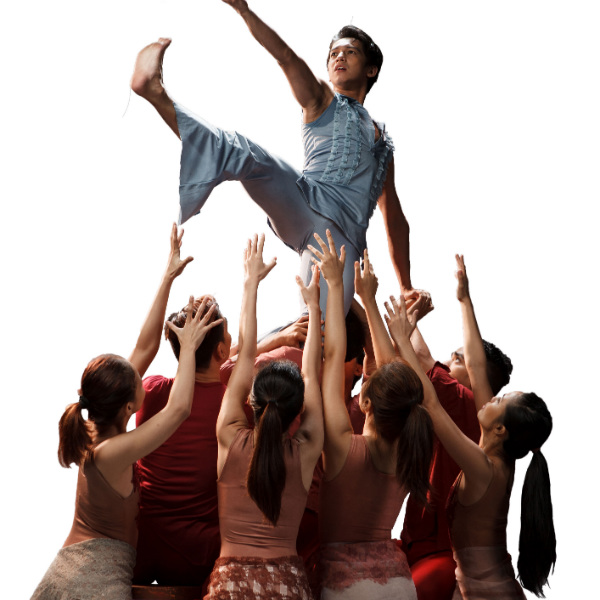

As part of the celebrations marking Apolinario Mabini’s 150th birth anniversary, Ballet Philippines, the resident ballet company of the Cultural Center of the Philippines, re-stages Agnes Locsin’s La Revolucion Filipina. The production features original music by Ryan Cayabyab and libretto by Dennis Marasigan.
The ballet is entirely choreographed by Locsin, former artistic director and resident choreographer of Ballet Philippines, and Gawad CCP awardee for Dance in 2012.
This is the fourth re-staging of the the ballet masterpiece after it premiered in 1996, a hundred years after the Philippine Revolution. The story revolves around the sublime paralytic Mabini (which is alternately played by Sonny Locsin and Jean Marc Cordero) and his role in the revolution.
In the play, Locsin gives new light to the paralytic hero by enabling him to dance, so as to capture his anger and angst, and as well his love and unyielding passion for his country. She did not want to use a lot of props in the play, and so it will rely on body movements to conjure images.
What is interesting about La Revolucion Filipina is its use of neo-ethnic style—a combination of Filipino ethnic and folk dance elements that Locsin is famous for. She went all over the Philippines to study the different tribal dances. She says she wanted to incorporate in the play the footwork of some tribes, which includes flexed feet with the toes up.
A lot of reading and researching went through the tedious process of the play, Locsin says. Prior to this, she knew little about the life of Mabini, except perhaps from school textbooks which she jokingly said did not offer much. She had to do a lot of background research on Philippine history, and even sent her performers to places like Kawit, Cavite, for them to understand the hero’s milieu.
Soon enough, she fell in love with Mabini.
Of course she could not have done the play without the help of Marasigan, who provided the libretto of the ballet. Marasigan did not hesitate when Locsin asked him to write for a ballet with Mabini as the central character.
“Agnes had been clear that she wanted to start the ballet by looking back at how the Filipino nation came to be,” he says. “Thus, I went ahead and submitted to her a three-page scenario describing how various waves of alien cultures transformed the native inhabitants of the archipelago.”
If there’s one thing Locsin always looks for in creating dance movement, it’s logic, and that is what sets her works apart from other ballet pieces. “Movement has its own vocabulary and its own logic,” she says.
Although La Revolucion Filipina is heavily informed by research, she says the dance movements came at a “moment of inspiration.”
The greatest challenge of the play, she says, was the dialogue. Because dance movements are silent, the tendency of the audience was to look up at the speaking characters.
Paul Moralas, artistic director of Ballet Philippines, says it’s important for every Filipino people to revisit history for us to have a better understanding of it, especially in light of the hero’s 150th birth anniversary.
“We must experience history again to have a deeper understanding of it,” Morales says. “Moreover, this is our way of figuring out where we stand now and where we are headed to as a nation.”
The artistic and creative teams are also composed of Mio Infante (set designer), Virgilio “Katsch” Catoy (lighting designer), Victor Ursabia (costume designer), Annette Cruz-Mariano, Judell de Guzman-Sicam and Lugnasin (Restagers).
Agnes Locsin’s La Revolucion Filipina runs from July 25 & 26 (3pm & 8pm) and July 27 (2pm & 6pm) at CCP’s Tanghalang Nicanor Abelardo; www.ticketworld.com.ph, +63 2 8919999. PHP412-PHP2,575.