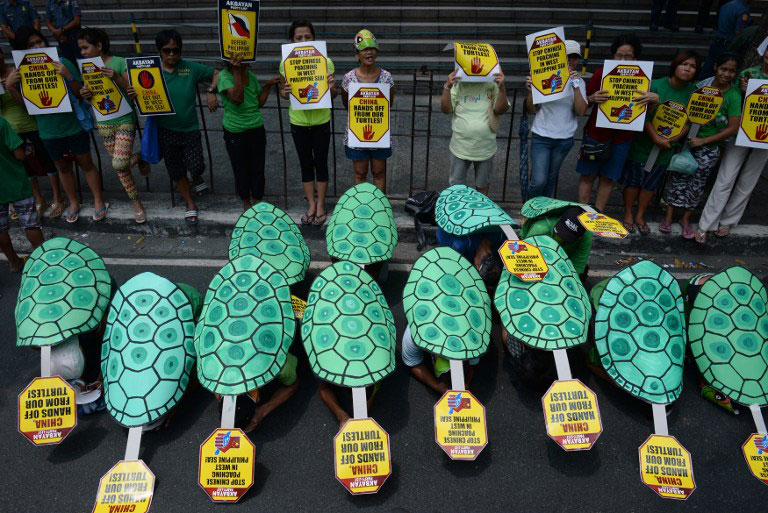

Several hundred Filipino and Vietnamese protesters united in a march in the Philippine capital on Friday, demanding that China stop oil drilling in disputed South China Sea waters.
Filipino riot police blocked the entrance to a high-rise building that houses the Chinese consulate in Manila’s financial district as around 200 protesters marched on the office.
The street action, which remained peaceful, came after deadly riots in Vietnam that Hanoi said were triggered by China’s deployment of a deep-sea oil rig in a part of the South China Sea.
The protesters, some wearing green cardboard cut-outs of turtle shells, carried placards that read “Vietnam-Philippines join hands to kick off China”, “China Stop Bullying Vietnam and the Philippines” and “We Support Vietnam”.
The Philippines this week filed criminal charges against nine Chinese crew members of a fishing boat seized by Filipino police in the disputed waters for collecting hundreds of protected giant sea turtles.
The protesters also chanted “Paracels Vietnam”, referring to the South China Sea island chain where the Chinese oil rig is deployed.
Filipino politicians joined members of Manila’s Vietnamese community at the demonstration.
“We are here to protest what China is doing against Vietnam. We need to call on the support of local and international friends,” Arya Nguyen, one of about 60 Philippines-based Vietnamese who joined the protest, told AFP.
“If they (the Chinese government) can do that to Vietnam, they can do it to everybody,” echoed Janicee Buco, a Filipina representative of a community group called Vietnam Filipino Association.
Buco said the Vietnamese who took part were Philippines-based descendants of Vietnamese boat people who fled with the aim of being resettled in the West after the Vietnam war.
The protesters said they felt aggrieved over China’s recent moves to assert its territorial claims over most of the strategic and resource-rich waters, including the oil-rig deployment that Hanoi said triggered ramming incidents involving Vietnamese and Chinese vessels.
Like the two communist rivals, the Philippines, Brunei, Malaysia and Taiwan also have claims to the sea, which overlap those of China and Vietnam.
Manila also accused Beijing of illegal land reclamation on a reef that Filipino officials said could be used to build China’s first airstrip in the disputed waters.
Manila from time to time arrests Vietnamese fishermen for poaching in Filipino coastal waters, but bilateral ties are otherwise cordial.
Both nations have overlapping claims to the Spratly Islands in the South China Sea, but there has been little tension over those as they work together through ASEAN to contain China’s territorial ambitions.
Meanwhile, in Vietnam, one protester is dead and 100 were hurt in anti-China riot.
A riot at a steel plant in Vietnam left one Chinese worker dead and over 100 injured, as Beijing vowed Thursday it would protect an oil rig in disputed waters at the heart of the unrest.
Long-simmering enmity between the communist neighbours has boiled over in Vietnam with protests in major cities and mobs torching foreign-owned factories after China deployed an oil drilling rig in waters also claimed by Hanoi.
A top Chinese general said his country would continue to man the rig, despite the worst anti-China tensions in Vietnam in decades.
“What we’re going to do is ensure the safety of the oil rig and ensure the operation will keep going,” General Fang Fenghui, chief of the general staff of the People’s Liberation Army, told a news conference after talks at the Pentagon with his US counterpart General Martin Dempsey.
His comments came after worker demonstrations spread to 22 of Vietnam’s 63 provinces, according to the Vietnamese government, which called for “tough measures” to bring the escalating situation under control before alarmed foreign investors pull out of the country.
Hundreds of Chinese nationals have fled across the border into neighbouring Cambodia, according to police there, amid fears that a wave of patriotic fervour initially encouraged by Hanoi is getting out of hand.
The unrest is “a very disturbing development and has certainly created the impression that in Vietnam (things) were verging out of control”, said Professor Jonathan London at City University of Hong Kong.
Vietnam’s communist regime, wary of public gatherings that could threaten its authoritarian rule, has in the past alternated between tolerating anti-China rallies and violently breaking them up.
Experts say Hanoi has allowed some public protests to go ahead recently as a means of expressing extreme discontent with Beijing. The pair have close economic ties but often fraught diplomatic relations.
The deadly riot broke out Wednesday at a steel mill owned by Taiwanese group Formosa Plastics in Vietnam’s central Ha Tinh province, following earlier violent protests in the south, where more than a dozen plants were set ablaze and hundreds of protesters detained.
Workers began “attacking some Chinese workers and damaged offices and equipment”, Formosa said in a statement.
One Chinese worker was killed and at least 149 people were injured, local official Dang Quoc Khanh said.
China accused Hanoi of acting in concert with the protesters.
The violence in Vietnam had “a direct link with the Vietnamese side’s indulgence and connivance in recent days with some domestic anti-China forces and lawbreakers”, Beijing’s foreign ministry spokeswoman Hua Chunying told reporters.
China lodged “a solemn protest” with Vietnam, the official Xinhua news agency said.
It also said the Chinese Foreign Minister Wang Yi condemned the violence in an urgent phone call with Vietnam’s Deputy Prime Minister and Minister of Foreign Affairs Pham Binh Minh, urging Hanoi to take measures to stop the violence.
Earlier, Xinhua said that about 10 Chinese remained unaccounted for after rioters attacked four Chinese companies in Ha Tinh province, citing a Chinese manager.
Story: AFP
Photo: Ted Aljibe/AFP