
Widely seen but hardly read, the Baybayin script (once inaccurately referred to as “alibata”) continues to surge in novel popularity as more Filipinos rediscover the old writing system, once mainly used in the Tagalog language before Spanish colonization replaced this with the Roman alphabet.
Although baybayin has since fallen out of usage, Filipino scholars have attempted studies on the script over the years.
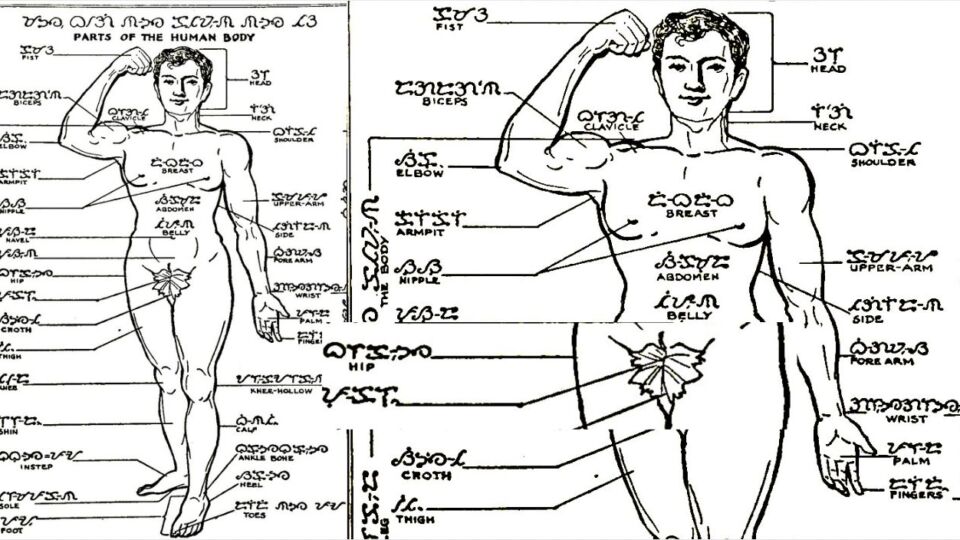
Take this illustration posted by historian Ambeth Ocampo, taken out of a 1950s book on baybayin.
The graphic identifies parts of the human body in its Tagalog terms written in baybayin, with its corresponding English translation.
Yet being a product of its time, one part was curiously left out without being translated.
“BAYBAYIN is our pre-Spanish writing system, not ‘alibata’ that are the first three letters in Arabic: alif (A), baa (B), and taa (T). This illustration from a 1950’s baybayin book teaches the Tagalog names for parts of the body in baybayin. Modesty dictated that one part is left without translation,” Ocampo wrote on Facebook.
The illustration of the naked male figure depicts a leaf covering the penis.
Baybayin enthusiasts identified the area referred to as puklo — yet another term that is largely unfamiliar among many modern-day Tagalog speakers.
“Any place still use puklo? I haven’t heard it in ours,” one wrote.
“Puklo is one of the many words in Hiligaynon for women’s private parts,” another shared.
The Filipino dictionary identifies puklo as referring to the end of the stomach beside a man’s genitalis, or the groin area.