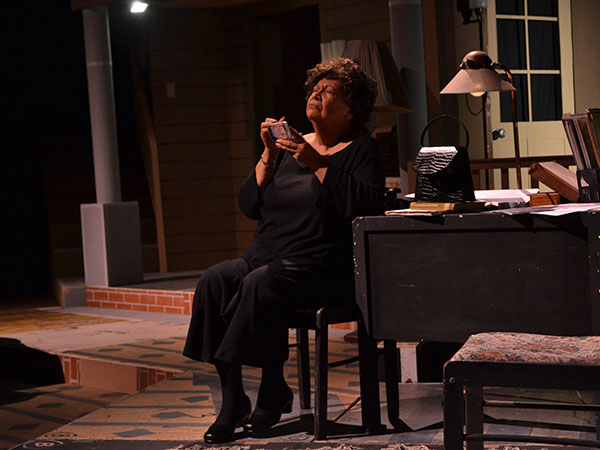

Tracy Lett’s Pulitzer Prize-winning August: Osage County brings to mind great American plays like Arthur Miller’s Death of a Salesman, Edward Albee’s Who’s Afraid of Virginia Woolf and Tennessee Williams’ A Streetcar Named Desire — it is the story of a feisty geriatric woman named Violet whose husband, Beverly, suddenly disappears after he hires a young Native American woman to take care of his wife and their house.
Despite Violet’s mouth cancer and thanks to her drug addiction, she still has enough energy to berate all members of her family, which includes daughters, Barbara, Ivy, and Karen.
Each daughter has her own problem: Barbara is trying to cope with marital separation; Ivy, a dutiful daughter, is in love with her “first cousin” and Karen is engaged to a rich and handsome yet perverted three-time divorcée. Add to that mix Violet’s equally pernicious sister, who arrives with her husband.
This dysfunctionality makes the play sound like it’s a Mexican telenovela, except this all takes place in the US of A.
Set in Oklahoma, August: Osage County begins with Beverly (Leo Rialp), an alcoholic poet, quoting TS Eliot: “Life is very long…” He notes that Eliot was wise to write down those words despite it stating the obvious.
Several days after Beverly disappears, a body is found in the river. Barbara, being the eldest daughter, is tasked to identify the body, much to her dismay. At the wake, Violet enters Beverly’s library and spends a moment alone, blaming her dead husband for all her troubles and reproaching him for leaving her, and pops more pills.
The play reaches a climax during the memorial dinner where Violet lets out several truths that hurt, and Barbara is nearing the end of her patience and understanding.
Director Chris Millado says that the dinner scene “was the most difficult scene and [he did not] think he could direct it.” Instead, he let the cast do the scene and “plug the holes” the matriarch was making.
The growing tension among the family members over dinner, however, was hardly palpable, largely because the view of Violet was blocked from several angles and several actors had their backs facing the audience; the dining table was too small and placed on the far left of the stage.
As the stars of the show, Baby Barredo (Violet) and Pinky Amador (Barbara) displayed a full grasp of the sometimes tenuous relationship between a mother and her daughter. Barredo was splendid as the emotionally malevolent mother and it was easy to empathize Amador’s role as a tired mother and daughter.
Tami Monsod (Ivy) and Liesl Batucan (Karen) were also notable. Underneath Batucan’s lively performance of a flighty woman in high-heeled shoes and summer dress is a clear understanding of human frailty and suffering.
Sheila Francisco is equally fantastic as Violet’s sister, Martie Fae Aiken, easily shifting from a sprightly sister and aunt into a condescending mother and wife. Francisco and Richard Cunanan (as Francisco’s onstage husband) swept away the audience when the latter had enough of his wife’s spiteful blabbering about their son, played by Noel Rayos.
Angeli Bayani’s role, as the housemaid who appears in the prologue and at the end of the play, comforting Violet, is also worth praising, especially for her underacting.
Just like this long play, real life is episodic, and there are things, especially mistakes, that are buried by time, but will someday be uncovered. And this truth — mistakes and all — will always haunt you until death.
When asked what they learned about themselves while staging this play, Amador reflected that “Family is still important at the end of the day. We may hurt each other. We may messed up. But you know what? Family is still there. Even if we walk out, we still come back.”
August: Osage Country runs till 16 March (Friday, Saturday and Sunday shows only) at OnStage Theatre, Greenbelt 1, Ayala Center, Makati. Go to TicketWorld for tickets.