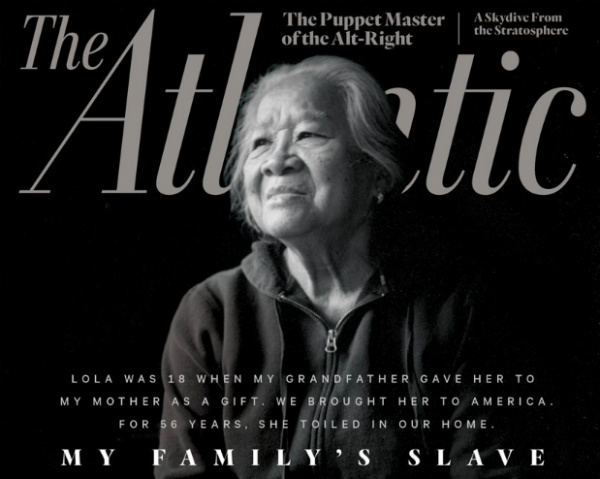

Filipino American Alex Tizon spent his life telling stories as a multi-awarded journalist for the The Atlantic among other publications, but took his darkest story to the grave.
This gripping story was about “Lola”, the Tizon’s family slave in the Philippines, who they took to America and kept in servitude for decades.
It’s one of the most powerful pieces of writing you’ll read this year, perhaps ever.
18-year-old Eudocia Tomas Pulido was given to Tizon’s mom as a “gift.”
“To our American neighbors, we were model immigrants, a poster family. They told us so. My father had a law degree, my mother was on her way to becoming a doctor, and my siblings and I got good grades and always said ‘please’ and ‘thank you.’ We never talked about Lola. Our secret went to the core of who we were and, at least for us kids, who we wanted to be,” Tizon wrote.
Tizon writes about Lola’s life who stayed with his family even if she had to endure verbal and physical abuse from Tizon’s parents.
Atlantic editor in chief @JeffreyGoldberg on June cover story from Alex Tizon: https://t.co/YUjdADzQHP pic.twitter.com/McYGr7gl8S
— The Atlantic (@TheAtlantic) May 17, 2017
“She’d had none of the self-serving ambition that drives most of us, and her willingness to give up everything for the people around her won her our love and utter loyalty,” Tizon described Lola.
The story was published posthumously on The Atlantic’s website on Monday night (Manila time.)
“This was his ultimate story,” said Tizon’s wife, Melissa. “He was trying to write it for five or six years. He struggled with it. But when he started writing it for The Atlantic, he stopped struggling. He wrote it with such ease.”
Tizon was a professor at the University of Oregon School of Journalism and Communication. He wrote a book called Big Little Man.
You may read the whole piece here.
Photo: The Atlantic