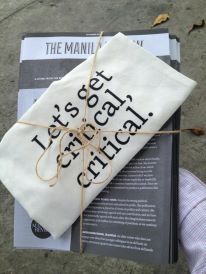

“Let’s get critical, critical,” the tote bag that comes with some issues of the Manila Review, a new publication that will try to raise the level of discourse in the Philippines, says gamely.
That reference to Olivia Newton-John may be the easiest thing to get about the Manila Review, which “will serve as a living record of changes in politics, the humanities, the sciences, and their intersections.”
Inspired by the London Review of Books, the Paris Review, and the New York Review of Books, the Manila Review has spurred conversation since it was launched in Quezon City in December. With the gravitas of promising to “to circumvent self-enclosed literary cabals and raise the level of criticism in the Philippines,” it was inevitable that not everyone in those conversations would be friendly.
Human Rights Watch researcher Carlos Conde, a former journalist, was quick to point out that the Review may have taken too much inspiration from its Western counterparts. The logo, he said, looked a lot like that of the Paris Review. Other critics, on Twitter and Facebook and on the Manila Review’s website, were even less charitable. Among the comments on a review of independent cinema in the Philippines scored it for allegedly resorting to the dreaded “kahipsteran.”
To be fair, other people on the thread did try to get a decent discussion going and there are positive comments too. Reader MollyPasko says of a review of a collection of love stories published by the University of the Philippines Press: “The power of one review!! This review made me want a copy for Christmas! Gah!!!” Another reader, Eric Forbes, calls an essay on the dynamics of book reviews in the Philippines an excellent opinion piece. “I enjoyed reading it tremendously!,” he says.
We ask Manila Review editor-in-chief Lisandro Claudio and managing editor Mara Coson to hold our hand as we get to know the Manila Review—and the role of the public intellectual better.
—
The Manila Review is meant as a space for public intellectuals. What is a public intellectual, and what is their role in a society that seems averse to criticism?
LC: Resil Mojares once said that an intellectual, by definition, is a public intellectual. So the term is a bit redundant. Intellectuals obviously direct their commentary at audiences. But I guess the difference between your regular smart person and a public intellectual is the recognition. Various publics recognize certain individuals as a public intellectuals.
So people shouldn’t claim to be public intellectuals, and that’s not just a modesty issue. Public intellectuals influence public debates because they provoke and inspire.
Of course, there’s a delicate balance here. On the one hand, a public intellectual should be intelligible, and (their) arguments should be convincing. On the other hand, however, (they also need) to shock people—to say things that may not be immediately acceptable. A public intellectual balances common sense and originality and does so with style.
I don’t think our society is averse to criticism. There’s a lot of it. The issue, as always, has been the ability of people to deal with content that’s foreign to them. It’s because we’re a highly nationalist country. The easiest way to dismiss a cultural text is to claim that it “doesn’t deal with Philippine realities.”
That’s how a lot of critics dealt with (author and Manila Review editor) Miguel Syjuco’s book Ilustrado, for example. “Ay, Fil-Am novel yan.” Never mind that it was actually about the Philippines. Maybe it was a different Philippines from the Philippines of the critics. But it was the Philippines nonetheless.
I think once we realize that there are plural versions of the Philippines and, more importantly, that defining Filipino is not the end all and be all of cultural production, we’ll start thinking more maturely.
Who are you writing for and about? How do you choose which issues matter? To whom are they supposed to matter?
LC: We did not really set out to target a market. MR is, after all, not for profit. We have a diverse masthead with different interests, and we talk about issues that we feel need to be talked about. We also try to keep MR as diverse as possible. There’s something for everybody. So history junkies will get history reviews, music fans will get music reviews.
We’ll branch out into other fields as we mature. For instance, I’d love to find a great science writer who can write for a wide audience.
My personal hope, however, is that MR becomes a kind of living intellectual history. When people look back decades from now and ask, “What was the cultural landscape like in 2013?” hopefully they can turn to old issues of MR and get partial answers.
How would you describe the state of criticism and discourse in the Philippines pre-MR?
LC: We really have a chip on our shoulder about defining “Pinoy.” I think we shouldn’t be so concerned about static identities. This obsession turns criticism into a matter of who and who doesn’t fit into those identities. This is an exclusionary process, and it precludes us from dealing with a text’s artistic merit.
I’m not saying this is a problem with Philippine criticism as a whole. Neither am I saying that a small publication like MR can solve this problem. But we need to ask new questions: What if culture just happens to be what is lived and practiced by people in a certain place? What if our goal should be to wrestle with culture as it progresses instead of defining it? What if culture isn’t based on a unifying national identity?
How will you keep from replicating the “self-enclosed literary cabals” that the Manila Review was made to circumvent?
LC: We’re going to engage people who hate us. MR, as expected, has gotten some flak. We want to hear from them, and we want our readers to hear from them also. We’re taking letters to the editor seriously. We also want to publish a lot of reaction articles. If you want to complain about anything you’ve read on MR, you don’t need to do it via private channels. Tell us about it, and let’s try to have great conversations.
How will the online and print editions play against each other? Is the website supposed to be a repository for articles in the print edition? Will discussion on the website influence how the next print edition will come out?
LC: The print edition was just a way to promote MR. We’re primarily an online publication. We’re in talks now with publishers who want to print some of our material, but that’s all I can say right now. But, yeah, discussions should feedback into the content. That happens naturally if you have an open mind. I promise we’ll have open minds.
MC: We ran a print edition of The Manila Review only for our first issue mainly as a means of getting the word out, bringing ourselves along to someone’s coffee break, and tapping those who might prefer to first be acquainted with us offline. But for a small publication like us, run on Artisteconect and our own pockets, luckily, growing in an online space is definitely makes more sense in terms of reaching people and having people reach out to us. So we’ll stay there for a while.
Will there be an “offline” component as well? Like, say, Coffee and Criticism in some coffee place. Social Issues and Shots, that sort of thing, to spur discussion and get people together to talk?
LC: I’d like that to happen eventually, yes. But we’re such a small operation that we can only produce a website in the meantime. I’m actually overwhelmed by the response we’ve gotten. I thought this would be a boutique publication, with a small but dedicated readership. Given how many people have requested for the print issue, that might not be the case.
MC: At the moment, while we do focus on building discussions, we don’t have plans to take these discussions offline for the simple reason that we’re too new to be able to spend our resources on it. At the moment, we’re focused on building a solid readership online.
How will you bring MR to the mainstream? Is that even a goal?
LC: I don’t think we’ll ever be as popular as, say, a major news website. And we probably won’t be read in salons the way lifestyle magazines are. So, no, we’re not aiming to become really big. Besides, all of us have day jobs, and this is something we do on the side. Mara compares MR to an indie band.
But do we want to connect with a broad audience? Sure. And the way you do that is through clean, accessible writing.
MC: It would be overly ambitious to expect The Manila Review to survive in the mainstream. Although we welcome the idea, it’s not our primary goal. Our goals include being accessible, bringing in great pieces, and, in spite of the naysayers, surviving for a very long time. If that puts us in the mainstream then it’s more of a consequence than a goal.
I know it’s a bit early to tell, but how has MR been received by the public?
LC: Surprisingly, the older literati have been quiet. We’ve been criticized by younger writers, mostly literature and creative writing folks.
But I’m a bit unclear at this point as to what they think we did wrong. Somebody said we were reproducing the patronage that we’re against. I’d like to know more about what they think. I’m a historian and full-time academic, so I really don’t know many people from literary and creative writing circles. Maybe there’s something I don’t see yet.
But then there’s also been a lot of support. Lots of amazing writers want to write for us. There really aren’t many venues for long-form essays in the Philippines. So, I think, even people who may not like our content, are generally appreciative of the fact that we’ve given space for longer essays.
MC: Just as you can look at anything from multiple perspectives, we’ve had our share of supporters, haters, and people who don’t care. But that’s natural. On a more positive note, some recognize The Manila Review as one of several new publications fulfilling this need for critical thought, and the reception was warmer than we expected.
If I were low brow (and I am), what do I need to join the discussion? What can regular guys bring to the table?
LC: Just join the conversation. I think people will find that MR is not as high brow as it seems. As I said, we’ll try to talk intelligently about everything, even cultural products that may seem trashy. You’ll see MR diversify and mature in the coming months.
MC: I want to dispel the notion that we’re snooty, high-brow, and difficult to engage. We carry a range of different topics, and people who visit our website will definitely be able to have a go at something. Not everyone behind The Manila Review is an academic, and this is definitely not a publication only for academics.
Authors, as well as their topics, are close enough at hand for readers to engage with, and questions that start with how and why, no matter how specific or general, are questions The Manila Review definitely welcomes.
—
The Manila Review can be accessed online at themanilareview.com. It is now on its second issue.