
“Somewhere, buried beneath the wreck of its current condition—one of urban catastrophe—is the city that has a tight claim on my heart, a beautiful city by the sea, an island-state of hope in a very old country.” — Suketu Mehta, ‘Maximum City: Bombay Lost and Found’
THE CITY OF METRO MANILA is strange terrain for me. I left for Los Angeles with my mother and younger brother when I was six and this is my first time back. I have few memories of living in the Philippines. I can count on one hand my memories of my early life in Makati, where my parents tell me we lived.
I can’t actually recall getting on a plane to go to California, only walking through the airport in Tokyo, one hand on my mother’s skirt and the other clutching onto my little brother’s hand. I remember playing with my Transformers action figure, a Decepticon named Soundwave, completely oblivious that I was crossing an ocean and starting a new life.
As far as I was concerned, we simply walked to the United States from the Philippines. Twenty-five years later I find myself back in the city where I was born, starting a different chapter of that life. When I arrived, after the initial shock and questioning of what had I gotten myself into wore off, I was struck by the city’s extremes: the always-present rubble on roads upturned by construction, high-rise residential condominiums and shantytowns, extravagant shopping malls and trash.
Growing up on the West coast of the United States, in a small but well-known suburb called Silver Lake has had a lasting impact on me. Before it became known as another gentrified, hipster neighborhood of Los Angeles, it was home to immigrant families like mine, but also struggling actors, musicians, artists, and writers.
When I walked the streets of my old neighborhood, I had a deep sense of it belonging to the city. I felt its long history with the movie industry. It was common to see people filming down my block and, when I was a kid, it was always a source of pride to see my neighborhood on the big screen. Silver Lake was home to many early motion picture studios and appeared in many classic films, like Laurel and Hardy’s The Music Box.
City planners saw the possibilities of valuable residential developments and invested in proper sidewalks, streets, and underground utilities. Developers in the 1920s and 1930s were encouraged to build in the surrounding area because actors and directors lived and worked in the area.
My neighborhood understands its place in Los Angeles’ history, preserving locations that appeared in those early films. It values what has made it special.
One of my earliest childhood memories is walking to school with my mother and brother. I wonder if her walking us to school gave her a chance to figure out her life in America with two young children, away from the only home she had ever known at that point.
Every afternoon, walking home from school, I could hear the sound of a musician practicing the trumpet. My friends (a group of Asian and Latino kids) and I often walked to the park or to the reservoir. None of us had cars at the time, so we regularly caught the bus on Sunset Boulevard if we wanted to spend the afternoon at the mall in Glendale or to hang out by beach in Santa Monica. There was no place we couldn’t go.
Los Angeles is shaped by its past, not fragmented like Manila.
LAST YEAR I WENT WITH SOME FRIENDS to the Filipino performance artist Carlos Celdran’s walking tour of Intramuros. He spoke passionately about Manila’s history and it forced me to think about the city, how it was built and affected by the past. I started to understand what it had gone through and what had been omitted by my history books in the United States.
Metro Manila, as we know it today, was a city imagined by colonialists who designed it to suit their needs for imperial expansion; when their projects failed, the city was left to its own devices, shaping itself according to impulse. It expanded, and continues to expand, organically, reacting as a living organism struggling to survive on the edges. It is a mega urban bubble that is growing non-stop and I fear it is unsustainable.
Manila is reactionary in how it spreads and how we deal with it as people. We react to its flooding, its density, its boundaries and the unrelenting traffic, mostly by being stuck or caught in it. Sometimes it feels like Manila is reacting to its need for more, racing to develop itself to catch up with the first world; space is limited and rapidly dwindling and so housing for the city’s growing populations is a major problem resulting in informal settlements.
In the short time I’ve been here, I’ve seen buildings crop up like weeds in what sometimes feels like overnight; settlements vanish in a blink of an eye as if swallowed up by the city. The government has tried (and is still trying) to temporarily fix the issue of settlements with a relocation fee for settlers to move, but where will they go?
From my apartment I have a view of the Marikina River; across it is one of these settlements. After my first few mornings in Manila, I wrote to my friend Amit who had just returned from a trek through India. I told him about the irony of living in a high-rise apartment across a shantytown.
He replied that life in third world, developing nations are a combination of awe-inspiring beauty and devastation. I thought about the poverty we were confronting, unlike any either of us had ever seen, he in India and me in the Philippines. I come face to face with it everyday.
I live in a condominium complex above a mall called Eastwood City, developed by the Megaworld Corporation. I started a graduate program at the University of the Philippines, Diliman, and though the campus is 5km away, public transportation requires an indirect, roundabout commute that takes at minimum an hour and a half. A taxi will take 10 minutes, but the expense adds up. I even thought about walking to the Katipunan jeepney terminal, halfway between my apartment and the university, but there are long stretches of road with no sidewalks.
To catch a jeepney on the C-5 highway, I walk past the glitzy exteriors of the Eastwood Mall (complete with its blinding, neon digital screens and billboards several stories up), a surreal reminder of the strangeness of my new neighborhood. The jeepney barkers yell for me to get on, the taho (silken tofu) man at the corner bellows to call center workers (some of whom are just starting their shift), while Metro Manila Development Authority officers shout at the buses, cars, and taxi cabs to keep the traffic moving. Mornings in Manila are a constant din, the hustle and bustle of a burgeoning city.
I clamber onto the jeepney and squeeze between passengers who have been waiting for it to fill up. When I took my first jeepney, the driver made fun of me, repeating my destination by mimicking my American accent.
The jeepney takes me as far as Cubao where the LRT 2 station is, where Megaworld is building yet another shopping center and more condominiums. It has rapidly gone up and I imagine it will be done this year. It looks like it will resemble Eastwood, once described by my friend visiting me as more America than America.
“You live in Asia, but your apartment is above a mall, there are three Starbucks within walking distance, and a Johnny Rockets on the corner. More American than America,” she said laughing.
I was dumbstruck at the accuracy of her statement. The more I thought about it, the more I realized that where I grew up was a vastly different reality than this capitalist American fantasy embodied in Manila’s numerous megamalls and condominium complexes. Silver Lake is a stone’s throw from Downtown Los Angeles. We lived on a hill, not above a mall.
Once on a jeepney coming home from campus, a child got on and passed out envelopes to all the passengers. Carefully scribbled on the envelopes was a note in Tagalog explaining that the money would be used for food. I stared blankly at the floor.
On that very same route on a different day, we passed a mountain of trash on the street, beside it was a wooden cart with a naked baby sitting inside. The jeepney stopped to let out passengers and I watched the child’s parents pick through the garbage.
Most of the time I feel like an outsider, an observer watching the city rush by. Manila is unconcerned about my innocuous problems. It has bigger things to deal with. I live in an apartment with running water and electricity, a fridge stocked with organic produce and locally-sourced yogurt, high-speed internet and a wi-fi connection. I have nothing to complain about.

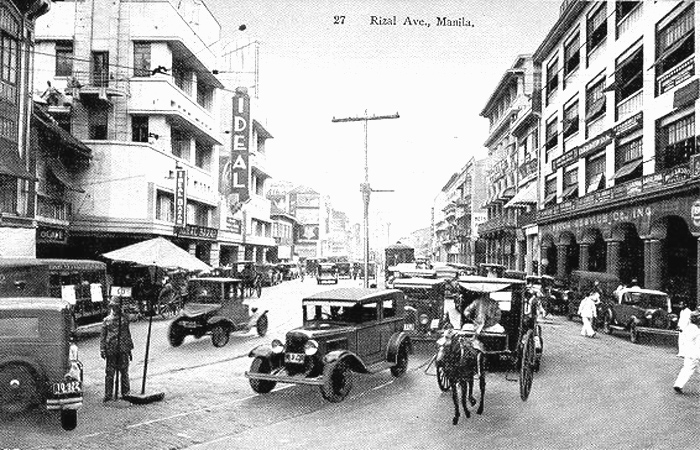
THE SECOND WORLD WAR SAW THE DESTRUCTION of Manila from both the American bombing of military targets and the actions of Japanese troops, and the city has never truly recovered. This colonial past is complex and layered, a city controlled externally by multiple foreign powers and their imperialist goals. To walk through the walled city of Intramuros is to see Spain’s attempt to create a model of the urban city, yet one that displaced entire ethnic communities, like the Chinese, to exterior ghettos.
The United States followed with their practiced colonialism through architecture. Daniel Burnham, the famous Chicago architect who designed some of the most well known American cities like Washington D.C., Chicago, and San Francisco, drew up plans for Manila, plans that to this day were never realized. As Filipino scholar Gerard Lico writes, infrastructure and urban planning were forms of control introduced by these colonial powers, none of whom managed to keep a permanent hold on the Philippines.
When they withdrew, they left Manila to make sense of itself, grappling with the aftermath of post-colonial inferiority. Instead of a history preserved and celebrated, we have Manila’s architectural heritage crumbling under the Pacific sun. When heritage finally falls into ruin, it is replaced by hyper-realized copies of an America that has little to do with what I felt in Silver Lake.
These simulacrums of architecture are pockets of affluence that simulate a shallow sense of other people’s history. A Venetian-inspired mall complex in McKinley Hill even offers gondola rides in fake canals. Empty spaces are found and filled up, by one of two or three real estate monopolies or squatters.
Manila closes more and more into itself. There is no time to think of the city, to breathe or reflect, because the city’s inhabitants are occupied (literally) with building and piling on, with further segregating the city, creating barriers that cut people off from one another.
When I first arrived in Manila, I used Google maps to calculate the distance between the apartment I was renting and the two closest university campuses. Google could measure the physical distance between two points, but lacked any usable navigational directions. Now, it can now tell you what time to catch the LRT or MRT trains, but there is no information on jeepneys (the now ubiquitous mode of public transportation left over from the American military occupation), so instead of telling you to take one to the Cubao MRT/LRT hub, it will instruct you to walk however many kilometers to the train station.
It has no concept of the boundaries that may prevent you from walking, the gated communities you must pass through or the guards who will stop you; it just assumes you have free access to your city. For now, Manila’s boundaries are accepted as status quo; there are places you can’t go.
IN MANILA, THE EVER-PRESENT construction sites and development of more megamalls and luxury condominiums continue to push the edges of consumerism, displacing the rest of the city that cannot afford this hyper-American lifestyle of decadence where more is not just more, but never enough. When a city allows racial, social, and economic inequalities to build up, eventually there comes a point where it will come crashing down, like the incident at the Payatas landfill in 2000 when the ever-growing mountain of trash collapsed and killed 300 people in Quezon City, Metro Manila.
As inequities build up, boundaries and limitations become sharper. Though the shopping malls of Makati, the central financial district, are open to the public, more often than not, there is a distinct difference in the economic and social status of those who shop in malls like Greenbelt and Market Market (both owned by the Ayala Corporation) or those that walk in Ayala Triangle Gardens versus Rizal Park.
Greenbelt mall shoppers often live in gated communities that keep them safe and separate from the rest of the city. Outside visitors to these neighborhoods must receive permission from residents—confirmed via telephone by the gate guards—and surrender their identification card. It is an experience similar to visiting a jail, except you cannot tell who is locked up and who is free.
Those who must walk Manila (not everyone does) acquire awareness of its fragments and fractures, its stories and struggles. The French philosopher Michel de Certeau writes, “Stories about places are makeshift things.” The stories about Metro Manila—the city’s text that we read, though heartbreaking—are not devastating because in the very act of walking there is an impression of possibility, creation, and more importantly, change.
Nothing is permanent and things can be made better. A broken, disorganized, confusing city can be fixed. A place that was once unfamiliar can become familiar.
“THE EVERYDAY HAS a certain strangeness that does not surface,” not unless you dig it up with your hands, which implies going beyond your car window, outside of your jeepney route, away from your gated walls, far from the cloud of your employer’s air conditioning.
You walk and become part of the crowd and the city. The smells of frying fish balls, sewage run off, diesel fume and trash waft across you; the shouting of the jeepney barkers ring in your ears. All of that is Manila, as is the Peninsula with its cavernous golden ceilings and afternoon high tea, as are the beautifully manicured parks in the highly developed financial district of Makati City.
All of it must be considered together, not separated or ignored.
To be a flâneur in Manila is to engage in a contact sport. It is dangerous, yes, perhaps. It is not for the faint of heart. It is not for those who refuse to suffer or feel at all. Manila is heat and rage and smoke and crime and kindness and jaywalking and bribery: staggeringly human in all its proportions, all adrenaline and misery; commiseration and most importantly, it is a herculean exercise in tolerance.
De Certeau writes that “the ordinary practitioners of the city live ‘down below’, below the thresholds at which visibility begins.”
These ordinary practitioners are the ones who touch the city and walk in the forgotten spaces. It is in the act of walking, like Baudelaire’s flâneur, that one reads the city. It is from walking the streets of Metro Manila, and reflecting on my life in Los Angeles, that I have come to understand its nuances. Manila is misunderstood partly because I think it doesn’t understand itself yet. It’s a city with an old soul but a young heart. It has so much potential and I want others to see that.
And like me, it’s trying to figure itself out. It would have been different had I moved to a city I had no connection to, but I have a history here that has been waiting for me to come back to.