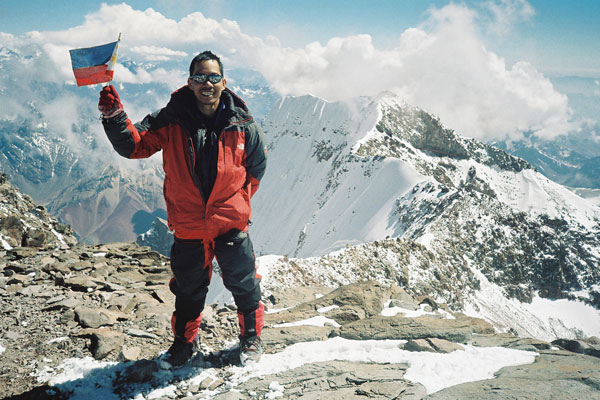

Romy Garduce, the only Filipino mountain climber to ever reached the seven summits of the world, has published a book about his adventures, entitled Akyat! A Filipino’s Journey to the Seven Summits. Below is an excerpt from the book, which Coconuts Manila is reprinting exclusively.
*May 18, 2006 (Night time) Camp 4, South Col, Mt. Everest, ~26000 ft above sea level
The night was cold, windy, unimaginably miserable. Even inside the tent the numbing temperature, the piercingly cold wind, the thin air didn’t allow us to sleep or rest properly. I was still tired from the hike and didn’t seem recharged a bit. The airstream’s constant howling and whistling demoralized even the most veteran climbers among us. Simple acts like eating or putting on one’s boots became unusually hard and tricky. Even breathing became difficult.
For seven weeks now, we had been within sight and shadow of Mt. Everest, my team of four climbers decided to go for the summit rather than wait for another day. My Sherpa lead guide, two Sherpa videographers and I were on the final stage of the trip. I told myself, “Tonight’s the night!” Either I join the ranks of the very select who had reached the top of Everest or I go back down, defeated but alive.
After a few hours of sleep, we dressed up and put on our gear. At Past 8:30 p.m., I stepped out of the tent in full gear. I peed, my last for the next 20 hours. There was no one outside but me. Most tents were lit from inside. That meant the other climbers were awake, their torches switched on. They were all preparing for what was ahead. Or maybe they were awake but still waiting for better weather.
READ MORE:
INTERVIEW: Romy Garduce on climing all seven summits, not having sex in the mountains, and more
With the unfavorable wind, all the climbers seemed half-hearted in aiming for the summit. The conditions were far from ideal: a constant 50 kph wind above 26,000 ft with air temperature of -30C and sinking on this dark, starless night. Their indecisiveness was contagious. I doubted and worried, too.
After another hour of preparing our gear for the climb’s final leg, my team seemed ready for the assault. Despite the temperature, I couldn’t feel it from the excitement. Or was it anxiety?
I did a last round of gear check, then shouted with forced confidence as if my team and I were in a losing battle, “Ready? Let’s go!” The oxygen masks muffled my words that were blown away by the hissing wind, testing my resolve to march for the peak.
The wind continued to blow from the southwest, the bullets of snow hitting our faces.Like soldiers, we marched on and on, my small group leading the way. I couldn’t tell which of the teams were marching with us or how many there were. We all stayed focused on our climb and simply avoided socializing.
We trudged one step at a time, our path feebly lit by the head torch. Glancing behind, I saw that people had started to march behind us. My Sirdar Sherpa helped build the trail and fix rope lines, but with this weather, he himself couldn’t navigate and find the starting rope line in the icefall above Camp 4. Our head torches were about as bright and useful as lighted match sticks. With the weak light, it was near impossible to find our way.
Below us, the train of climbers’ lights began to fade. Some teams decided to abort their climb. I couldn’t tell how many, but it seemed like we were the only ones going for the summit. I looked back at the retreating climbers, wondering if we should do the same. Filled with doubt, I asked myself, “Will I just tire myself out and lose the chance to reach the summit?”
I shook my head, took a deep breath and concentrated on simply moving my feet. We were on our own when we realized that we were lost. We had wasted more than an hour just walking laterally on the first part of the icefall, desperately looking for the starting rope line. The rope line would’ve confirmed that we were on the right track at the same time that it offered good protection from a fall when we were clipped on to it.
I felt hopeless, thinking, “Here we are at 27,000 feet in the middle of the night, tired, cold and miserable, lost in the middle of an icy hell.” Thoughts of a previous disaster played in my mind. Jan Krakauer’s Into Thin Air described the place where climbers got lost and died of exhaustion and hypothermia. I knew that we were in the zone already.
The ugly feeling of imminent surrender crept over me. I expected something worse to happen , something that would force me to give up. The summit was no longer the prize I had in mind. The only thing that mattered was getting ourselves out of our predicament. My main thought was full of self-blame: “Why did I even attempt a climb in this weather condition?”
Suddenly, my Sirdar found it! We planned on changing oxygen tanks at the Balcony. That meant five hours of climbing at the very least from where we were. It would be a disaster if we ran out of oxygen before reaching that point. We had already wasted an hour or so of air looking for the rope line. Worse, the path was too steep, the snow too loose to make a fast ascent. I was tiring fast. So were the Sherpas.
But a welcome break occurred. The wind died down for awhile. Soon we reached the Balcony or the start of a very exposed ridge section. The rising sun warmed me with hope and cast a bright light on the mysterious mountain. I saw the southeast ridge very clearly; it was long, winding and seemed to extend endlessly upwards.
Up and up the southeast ridge we climbed. Then the wind started to blow again. Our reprieve was short-lived. Whatever warmth the sun had given us was quickly stolen by the wind that seemed intent on also stealing our summit success. Meanwhile, I couldn’t clearly see with my left eye. Everything was a blur of shapes and colors. I imagined my optic nerve freezing and my going blind. Whether my blurred vision would worsen or improve as I went up, that I had to find out.
After walking on for what seemed like forever, we reached the South summit, only three or so hours away from the true summit. I could see Hillary Step from a distance, and beyond that, the last and final steps to the pinnacle. I was beyond exhaustion; I had been climbing for nearly10 hours since leaving Camp 4.
I tried to catch my breath, dreaming of the journey’s end. It was then that Sirdar Sherpa whispered, “The weather is getting worse. We may need to turn back.”