
Go (coco)nuts! Share this story with your friends.
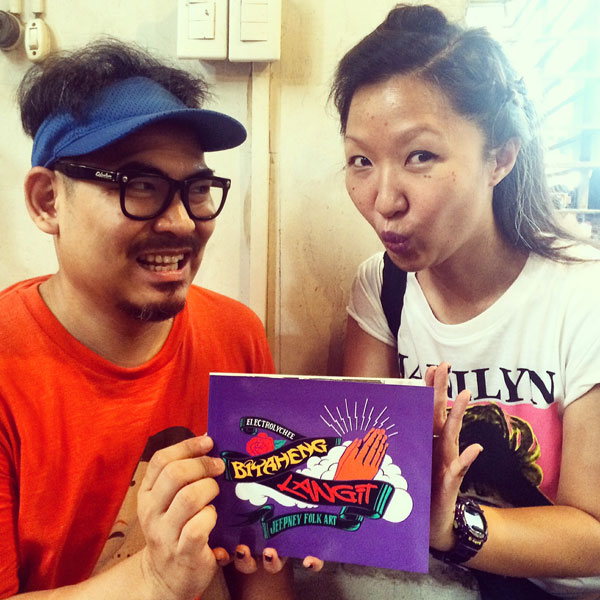
At Ink Fest on Saturday at 10a Alabama in QC, graphic design duo Marcus Nada and Bernie ‘Bru’ Sim aka Electrolychee premiered —and sold out — their book Biyaheng Langit: Folk Jeepney art.
It’s a collection of 184 jeepney religious images supplemented by three interviews, that the duo has amassed over the course of four years. “It started in 2010. We were driving by the National Museum,” shares Bru, “when we saw the image. Sabi ko, ‘Marcus, tingnan mo yung mukha ni Jesus, parang naka-smirk, ang yabang niya.’ Tawa kami nang tawa.”
They tried to take a photo but the smirking Jesus started to move, and they started to move, too. Ever since then, the two have been unconsciously drawn to jeepney art, perhaps trying to look for the smirking Jesus.
While he remained elusive, the smirking Jesus sure showed them the way. Electrolychee jumped at the thought of putting out a book on jeepney art. About time, actually — the last published book on Jeepney art was way back in 1979.
A book on jeepneys. What a great idea!
Jeepney art is very charming. It’s charming and funny, and may range. Ang daming art sa jeep. It’s so rich in imagery and in meaning. You really have to stop and appreciate it, and give credit to the people who made it.
Why focus on religious images?
First, kasi if we tried to cover every kind of image on the jeep, masyado broad. Also, yun kasi yung unang image na nakita naming na tawa kami nang tawa. We were driving by the National Museum tapos may mukha ni Jesus na naka-smirk siya sa isang jeep. Sabi ko, ‘Marcus, tingnan mo si Jesus, parang naka-smirk. Ang yabang niya.’ We tried to take a picture pero umaandar na yung jeep, umaandar na rin kami. Ever since then, napapatingin na rin kami sa mga images ng ibang jeep. Hanggang ngayon nango-ngolekta pa rin kami ng images.
So this is a picture book—
There are articles here, too. We did the research. We talked to a religious art scholar, Father Abaño who is the UST museum director. We asked him if this is considered religious art. Nakakatawa, when we showed him the prints, sumimangot lang siya, ha ha. We interviewed a jeepney craftsman who make these stickers. We asked an artist, si Mark Justiniani, who is a CCP 13 Artist Awardee, what he thinks of the jeep and jeepney art.
At which point did you feel that there was something here?
Beginning pa lang, na-plant na sa utak namin that this is a good project. We collected photos and then after a year, tsaka kami lumapit sa mga publisher. It’s published by 5 ports.
The cover—
That’s a legit vinyl jeepney sticker, made by kuya Joemer, who is from Quezon.
Ah, so the book is purely on jeepney art in sticker form?
Yes. In the beginning, we would also shoot airbrush art, but then soon after, we decided vinyl decals na lang, or vinyl stickers.
Why is that?
Because that’s our aesthetics. They’re more graphic than airbrush, which have softer textures. Besides, mas luma ang vinyl stickers. Usong-uso siya in the 90s, while airbrush, nitong 2000s lang. While shooting, we noticed, nawawala na siya. But the jeepney craftsmen, they’d tell us, dahan-dahang bumabalik ang stickers kasi pangmatagalan siya. Airbrush can fade kasi, pero uso talaga siya ngayon.
What is it about religious images on jeeps?
Most would say it’s a talisman. It’s an expression of belief. Kongkreto mag-isip ang mga Pilipino: If I put this image on my jeep, it will bless me. Nandiyan siya, babantayan niya ang jeep ko. There’s a direct correlation. Interesting kasi tagos pa rin ang folk religiosity ng Pilipino. Religion is still a big influence, but I don’t think people really understand it. The reason why people grab on to folk religion is because of ‘biyaya.’
How difficult was it to take photos of the jeepneys?
Marcus: Enjoy lang talaga. Iba’t ibang tao ang makakausap mo. Ang sarap lang rin marinig yung mga kuwento nila.
Bru: May jeepneys na friendly, may ibang sobrang wary — bakit pinipikturan? Baka daw pang black mail. May iba humihingi ng pera, so kami naman nagbabayad ng pamasahe. We’d go to terminals, we’d go on road trips. Umabot pa nga kami sa mga probinsiya.
Marcus: May mga biyahe dito na hindi namin sinasadya. Tipong, ‘okay, today pumunta tayong Batangas, bitbit lang ang camera, kung ano na lang makita dun.’ May mga jeep na hindi tumitigil, so at one point, we’d position ourselves at opposite ends of the road para kung malagpasan ako, makukuha naman niya. May mga stake outs din. Titigil kami, park, picture. May isang beses, baba kami sa ditch. Kung hindi ka guerilla, maraming images dito ang hindi makukuha.
Is there a particular look that’s really popular in certain places?
We cannot generalize, kasi hindi naman lahat from the same artists. May ibang ayaw ang may design ang jeep nila kasi mahal. May iba naman, iba ang gustong design. And also, iba-iba rin yung route ng mga jeep.
But like Marikina, that’s a city popular for its patok jeeps.
But patok refers to size, diba? Malaki siya and express lang ang mga biyahe. Though, maraming airbrush jeeps duon kasi [malapit lang] sa Rizal. May airbrush artist kasi sa Rizal.
But there’s one artist we talked to, napapansin daw niya, sa may Pureza area, maraming dumadaan dun na jeep na ang gaganda ng lettering. More than the place, I think it’s better to look at the specific design. There’s one artist that we always seem to catch on different jeepneys, and we know siya lang yun kasi ang galing niya gumawa ng mga mata. It’s unfortunate hindi na naming siya nahanap kasi these artists don’t sign their work.
Where are the sticker artists located?
We only found two sticker artists. One is in Sta. Mesa, and the other si kuya Joemer who is from Quezon. Siya yung gumawa ng cover ng book.
Can you tell us a few things you learned while doing this project?
Ever noticed why the faces are orange? Kasi there are no flesh-toned vinyl stickers. Also, they’re tourist-savvy. I look Korean so tingin nila sa kin, foreigner.
Before, Sarao rolls out 30 units of their famous jeeps a month. Now, they’re down to 1-2 a month. And finally, magagaling ang mga jeepney craftsmen natin. They’re all self-taught and they’re working artists. They don’t sign their work and they don’t have the luxury of enjoying what they’ve done. Kayod lang talaga ito for them, but when they find out that people appreciate it, they’re very happy.
Do you think jeepneys should be banned?
Since the 70s pa nilang gusto tanggalin ang jeepneys. But it’s such an iconic symbol of identity. Nag-research din kami — we contacted urban planners from UP and ang assessment nila, kailangan ma-formalize yung industry. Kung sabihin, ganito ang engine, dapat ganun talaga yung engine. Pero syempre, maraming lusot-lusutan diyan. Puwude naming mag-exist sila. Okay na vehicle ang jeep. Feeling namin, hindi siya mawawala kasi siya yung pinakamurang mode of transportation. Kailangan lang ng maintenance, and i-profesionalize.
Biyaheng Langit (PHP850) will be available in December at your leading bookstores. Follow Biyaheng Langit on Facebook for more details.