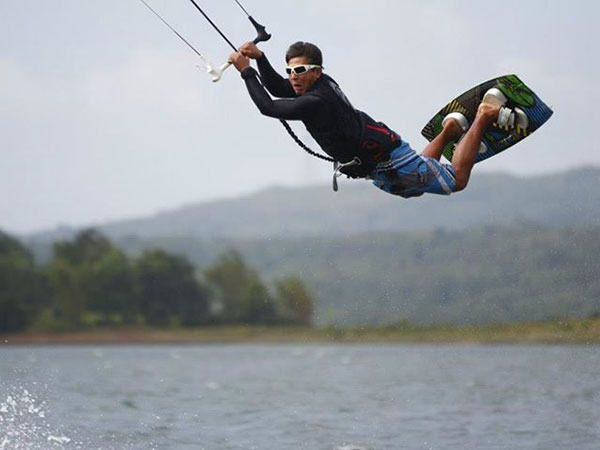

1. Kiteboarding
While heading to the beach during the months of December to February may sound counter-intuitive, there are a growing number of people flocking to the shores not for the sun — but for the wind. Catch our drift? We’re talking about kiteboarding, of course.
BEST FOR: Those who want to harness the whims (and wind) of Mother Nature
THE PITCH: It’s a different way to experience water-based board sports. Wakeboarders have their bag of flips, spins, and stunts, but they’re either pulled by a boat or a motorized towline. Kiteboarders, however, harness Mother Nature for propulsion, and can pull off their own big air tricks with the right conditions.
Jay Ortiz, IKO level two instructor at the Manila Kiteboarding School and incumbent president of the Philippine Kiteboarding Association, has these friendly words of warning, “On your first ride time just stops. It just stokes you. I have to warn students that this sport is addictive!” It’s a growing one as well, with the International Kiteboarding Association campaigning for inclusion in the 2020 Olympics.
If you’ve always wanted to represent our country in sport, this may be your chance.
HOW WE ROLL: While the sport can have it’s “extreme” angle, the learning curve isn’t steep. A beginner course lasts only three days, enough time to learn how to ride either side of the board and, more importantly, understand the theories and safety aspects of the sport. It isn’t as physically demanding as it appears, either. The kite pulls on your harness, and your arms are just there to steer and control the kite. This sport gives your legs and core muscles a workout.
INVESTMENT: PHP19,000, inclusive of license and use of equipment. “The wind is free,” Ortiz says.
LET’S DO IT: You can kiteboard at Soloviento Resort in Lake Caliraya, Bulabog Beach in Boracay, Balesin Island, and also Aman Pulo in Palawan. Ortiz sums it all up, “You will always be looking for wind. Luckily it’s easy to travel with your gear. Your kite, bar and harness will fit in a backpack, and your board is not oversized luggage. With our 7,000+ islands, there’s always wind somewhere.” For more information and hookups, you can look up the Philippine Kiteboarding Association and the Manila Kiteboarder groups on Google or Facebook.
Jay Ortiz’ five tips for budding boarders:
1. You have to commit if you want to learn this sport
2. You have to have patience to wait for the wind at times.
3. If you like to compete and travel this is your sport
4. If you’re not competitive, you can still enjoy the sport and hang out with similar outdoors-oriented people.
5. Quit your job and become an instructor!
Photo courtesy of Jay Ortiz
2. STAND-UP PADDLE BOARDING
We’re lucky to be a country that has more than 7,000 islands, with matching shorelines to boot. It’s only natural, then, that water activities like surfing, kayaking, kiteboarding — and now, stand-up paddle boarding — are riding the crest of the popularity wave.
BEST FOR: Those who want a serene sea-borne state of mind.
THE PITCH: For starters, stand-up paddleboarding, or SUP, gives you a higher vantage point and relatively unobstructed view of the waters below — as compared to, say, on a banca or surfboard. Pips Brown, a recreational paddleboarder, expounds, “Through clear waters one can observe the colors of the coral, fish, and the undulating seaweeds.”
Unlike surfing, where you use the waves as your primary means of movement, SUP uses a paddle for propulsion. This makes it “a more efficient device to explore larger areas of reef, which makes it popular with snorkelers and tourists alike,” Brown says.
It’s easier to balance on an SUP than a regular surfboard, which makes it perfect for beginners. There’s a fitness component to all of this, of course. “It is one of the most fun full-body workouts because your upper body works to keep you moving forward while you lower half works to keep you stable and standing,” Brown points out.
HOW WE ROLL: More resorts now have SUP boards for rent, and it doesn’t take too long for you to get the hang of it. The boards are thicker and wider than a surfboard, which make them easier to balance on. SUP lessons don’t take too long, and you can find yourself paddling happily in less than an hour. Keeping your balance is key, and your core will definitely get a workout. If you get tired, you can opt to kneel on the board, or jump in the water for a quick cooling dip. Yoga and other core exercises are a great way to prepare yourself for SUP (and in fact, some people practice yoga ON the boards, in the water).
INVESTMENT: As far as equipment is concerned, it would be prudent to just rent the boards from the resorts, as the ones being sold locally are a bit pricey — thanks in no part to the shipping costs of such large items. A Starboard SUP, for example, can cost upwards of PHP30,000. A popular alternative, says Brown, is “an inflatable SUP, which works just as well, and is easier to transport, they fold up and fit in the the trunk of a car.” Now that sounds like a bright idea!
LET’S DO IT: SUP rentals are easy to come by: Kapuluan Vista Resort in Pagudpud, Plantation Bay in Cebu, and various resorts in Boracay. You can also bring your own board to La Union, Zambales, and other popular surf spots. SUP boards work well in calm waters, and can be used to explore rivers and waterways, as is done in Bohol by SUP Tours.
Pip Brown’s five tips for SUP starters
1. An old windsurf board and a canoe paddle are inexpensive and easy ways to learn the basics of balance and paddling.
2. Keep your toes pointed forward, knees slightly bend, and back straight.
3. At the end of your stroke, turn your paddle slightly outward to keep your board pointed straight.
4. Be aware of the wind, since your body can act like a sail—you may go farther than expected!
5. Jump in the water to cool off and rest, until you’re ready to paddle again!
3. Trail running
Running on a treadmill doesn’t take you anywhere. Doing the same laps on a track or loops around your village can be repetitive and…boring. Change things up. Get away from the city, tackle some challenging terrain, and get rewarded by some stunning vistas with trail running.
[[{“type”:”media”,”view_mode”:”media_original”,”fid”:”47226″,”attributes”:{“alt”:””,”class”:”media-image”,”height”:”450″,”typeof”:”foaf:Image”,”width”:”600″}}]]
Photo courtesy of Ige Lopez
BEST FOR: Those who still enjoy a bit of “Noche Buena” — even if the Yuletide Season is done
THE PITCH: Breathing in fresh air, devoid of carbon monoxide, is certainly reason enough to run off-road. Triathlon and running coach Ige Lopez cherishes the challenges and rewards of the sport, “Mountain running and distance trail running will always top my list of challenging races, as they require mental focus, speed and strength.What’s rewarding for me would be to see the mountains, rivers, trails, fresh air and astonishing views.”
Trail running doesn’t mean you’re going full-tilt all the time, though. The variable conditions off-road means you have to walk certain sections — particularly rocky bits, mossy roots, sand dunes, or even a river crossing. We doubt your village park can beat that.
HOW WE ROLL: While you can certainly run maintained, smooth tracks on your trusty pair of running shoes, Lopez says equipment choice is still dictated by the terrain. As the trails get more technical and gnarly, your feet need protection from debris as well as traction in the aforementioned variable conditions. A good trail shoe can “make or break your trail experience,” Lopez explains.
INVESTMENT: A decent trail running shoe costs around P4,000. Check out specialty running stores such as Second Wind and Runnr, as their sales staff are well versed in the nuances of shoe fit and running. Other pieces of equipment, such as hydration packs (around PHP2,500), can be helpful if your runs are longer than 5km, and a GPS is essential if you’re exploring, or tracking your progress.
You must also put in a bit of work, aside from your regular road-running routine. You have to learn to run with a quick foot turnover, a relaxed body, and cross train your mountain muscles — your glutes, quadriceps, hamstrings, calves and core. Lopez also recommends progressing your trail runs, “start with flat trails, then move to more hilly terrain. Start with dirt roads, then aggressive mountain trails.”
LET’S DO IT: Near Metro Manila, there’s the La Mesa Forest Reserve, Timberland in Rizal, and Nuvali in Santa Rosa. The more challenging (and rewarding) trails can be found in the mountains of Makiling, Arayat, and Batulao, as well as Pico de Loro. Trail running solo has its share of risks, luckily there are several organizations you can join: the Pinoy Ultrarunners, Philippine Association of Ultrarunners and the Philippine Skyrunners Association hold regular group runs.
Ige Lopez’ five tips for trail-running first-timers
1. ALways be alert as terrain changes a lot on trails.
2. Learn to trust your shoes.
3. Quicken your turnover to anticipate terrain.
4. Don’t put your weight fully on each step/
5. Enjoy the view!
4. Mountain biking
Ever wanted to feel like a kid again? With the wind in your face, leaves crunching underneath you, and the whooping of your companions behind (okay, maybe in front of) you? Then hop aboard a mountain bike, and start pedalling.
BEST FOR: Those who enjoy getting dirty, with a few scrapes along the way.
THE PITCH: Cycling is a low-impact cardio workout that burns calories, and taking it off-road just ups the fun ante. Just like trail running, you are also subject to the variables that Mother Nature throws your way: roots, rocks, river crossings make MTB rides two-wheeled adventures. Edmund Mangaser, owner of All Terra Cyclery, adds that “There’s also the gratification you get in customizing your bike — a more comfortable saddle, tires with a more solid grip, or even just a splash of color here and there can make your bike ‘feel’ faster.” Hey, as long as you’re pedalling and smiling, that’s a good thing in our book.
INVESTMENT: As with most sporting equipment, you tend to get what you pay for with MTB. While there are some eye-poppingly shocking prices out there, most people can start out just fine with an MTB that’s priced at around the PHP30,000 mark. “Bikes at this price point benefit from the ‘trickle down technology’ of the more expensive models,’ Mangaser shares.
Besides, most components — particularly the brakes and drivetrain, are items that wear out, and will eventually have to be replaced, or better yet, upgraded. You also have to invest in a helmet, tools, and padded cycling shorts (don’t worry, you can wear them underneath casual, athletic, or even board shorts if you’re modest).
Mountain bikers tend to be a friendly bunch as well, and they love to chat and hang out as much as they ride. New riders are always welcome additions to a group, and any good bike shop can hook you up with fellow dirt heads.
LET’S DO IT: Surprisingly, there are a number of rideable trails inside Metro Manila. The Fort Bonifacio Army Trail, Heroes Trail beside the Libingan Ng Mga Bayani, and the Camp Aguinaldo trail are popular destinations for riders old and new. There’s also the La Mesa Forest Reserve, the trails in Timberland in Rizal, Nuvali in Santa Rosa, Laguna. Subic, Tarlac, Baguio and Sagada are other popular trails. You can head to any bike shop and inquire about group rides also, and can log on to the local websites www.pinoymitbiker.org and www.philmofo.org for loads of dirty info.
Edmund Mangaser’s five tips for MTB newbies:
1. Ride a proper-fitting bike. This does wonders for comfort, efficiency and of course fun.
2. Always wear a helmet, bring water and a basic toolkit that includes a pump and a spare tube.
3. Look ahead. The faster you go, the further ahead you must look.
4. Look where you want to go. The bike tends to follow your line of sight.
5. When in doubt, dismount. If you are not comfortable riding a technical section, or if the climb is too steep, it’s perfectly fine to walk it — and ride it another day.
5. Kalis Ilustrisimo
Every Sunday morning, a close-knit group of martial artists gathers in Luneta Park. Under the watchful eye of Grand Master Tony Diego, these practitioners learn from him, and each other. Welcome to the world of Filipino Martial Arts, and specifically, Kalis Ilustrisimo.
BEST FOR: Those with the Force strong in them
THE PITCH: Kalis Ilustrisimo literally means the “sword of Ilustrisimo”. It is named after the clan who developed this fighting art more than 200 years ago. Grand Master Antonio “Tatang” Ilustrisimo learned eskrima (a Filipino martial art that uses sticks, knives and other weapons) at the age of seven, and over the course of his travels and adventures (like being a guerilla fighter in World War II), developed the refined combat system that now bears his name. His legacy continues with Grand Master Tony Diego. It’s a truly Filipino martial art, one that is revered and respected around the world.
Like all martial arts, Kalis Ilustrisimo develops in you a sense of discipline and self-control. Peachie Baron, one of the closest students of Grand Master Tony Diego, adds that it sharpens the mind and improves focus “because KI’s orientation is with bladed weapons, speed and accuracy are pushed to the limits because one false move could be fatal.” KI’s techniques can also be applied to various weapons, everyday objects and even your bare hands. It isn’t all about fighting, though. KI also develops in you a heightened awareness with your surroundings, and an ability to assess if a situation is potentially dangerous or not.
HOW WE ROLL: Learning Ilustrisimo is dependent on your ability “to comprehend and understand the system,” Baron says. Being a close-knit group, new members have to be sponsored by current practitioners. If itsounds like they’re protecting a national treasure — they are!
LET’S DO IT: KI trains every Sunday, 10:30am at Luneta Park. They also have Tuesday, Friday and Saturday sessions at their facility in Manila. One-on-one training can be arranged by schedule. Look them up on www.facebook.com/kalis.headquarters.