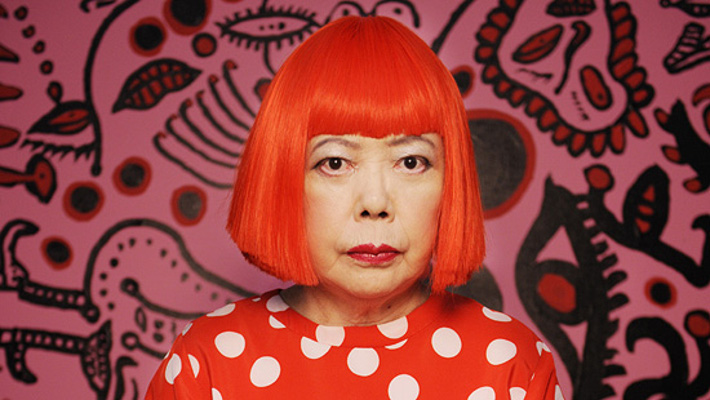

The I Love Kusama exhibit at the Ayala Museum opened on July 16 as part of its Collectors Series.
It features Yayoi Kusama’s works from the collection of Lito and Kim Camacho, and it is filled with awesome style moments.
The hypnotic prints and paintings combining her trademark dots and infinity nets remind me of the two-year-old trend of head-to-toe patterns. The metallic sheen of dresses covered in flowers and gold or silver paint is irresistible to those with a penchant for extreme ornamentation.
[[{“type”:”media”,”view_mode”:”media_original”,”fid”:”18743″,”attributes”:{“alt”:””,”class”:”media-image”,”height”:”784″,”style”:”display: block; margin-left: auto; margin-right: auto;”,”typeof”:”foaf:Image”,”width”:”600″}}]]
Photo: Ayala Museum
Then there are her collaborations with Louis Vuitton, Wacoal and Graf Decorative Mode No. 3, which gave the world concrete fashion products – bags, coats, underwear, bandanas.
For a garment-fixated person like me, it would be easy to appreciate only this aspect of Kusama’s pieces, but thankfully the museum and Japan Foundation-Manila brought art critic and curator Akira Tatehata for a lecture about the artist and her career on August 10.
Tatehata is the president of the Kyoto City University of Arts and the director of the Museum of Modern Art in Saitama.
Tatehata started with the most readily-observed themes of Kusama’s work – obsession and repetition. Stemming from hallucinations of dots, nets and petals taking over her surroundings and herself, which Kusama experienced since childhood, she began drawing these motifs to overcome the anxiety of seeing them constantly.
He pointed out several clever effects of her technique: by varying the sizes of each circle and grid opening, and the color of the background and the lines, depth is created. Additionally, movement, both vertical and sideways is produced.
The style also explores the idea of self-obliteration, where one’s identity is invalidated because of sameness with the environment. In the exhibit, this is most clearly illustrated by the Statue of Venus Obliterated, which greets visitors upon entering the showcase on the ground floor gallery.
[[{“type”:”media”,”view_mode”:”media_original”,”fid”:”18741″,”attributes”:{“alt”:””,”class”:”media-image”,”height”:”1237″,”typeof”:”foaf:Image”,”width”:”600″}}]]
Photo: Ayala Museum
Although the notion of melding with the universe in its infinity sounds positive, perhaps for Kusama it was not completely positive because of her mental state.
This leads us to another recurring subject – the artist herself. Narcissism is prominent in her work possibly because of the need to assert her individuality amid the crippling visions. This is evident in the large photographs where she is seen posing with her sculptures.
She also has numerous cartoony self-portraits. Even her pumpkins are a representation of herself. In nearly all of them, she still dons dots.
Tatehata proclaims Kusama’s genius in her ability to create novelty, interest and meaning using the same patterns over many decades. He says this not only with respect but also with affection.
One endearing story was when he thought he was being shortchanged with a hurried concept. “I commissioned her to do an artwork for a show, and in five minutes, she called her assistant to buy her 2,000 mirror balls from a factory in China. I asked her to sleep on it first, but she insisted that’s it.”
The balls were released one by one into the canal. At the end of the day, Tatehata understood the brilliance of her idea when he saw the sunset reflected on the mirror balls pooled together.
Arrogance is said to be common among exceptionally gifted people. As one who declared “I am going to conquer this city” while atop the Empire State Building in New York, Kusama certainly displays that kind of bravado.
But Tatehata says that instead of being the insufferable genius, Kusama’s obsessivecompulsive disorder provides her a line of communication with the world. Her struggles with mental illness have yielded artworks that bring the public to an understanding of her identity.
[[{“type”:”media”,”view_mode”:”media_original”,”fid”:”18742″,”attributes”:{“alt”:””,”class”:”media-image”,”height”:”800″,”typeof”:”foaf:Image”,”width”:”600″}}]]
Photo: Ayala Museum
Because of this, Kusama is now more comfortable to reach out to society through design partnerships such as those for merchandise. These items are given their own section in the museum’s third floor. The Louis Vuitton collaboration is particularly apt because of its own heritage of repetition in the Damier and Monogram motifs.
The artist is also moving toward a more figurative style, adding faces to her roster of repetitive patterns.
Kusama’s meditation on narcissism and self-obliteration is acutely relevant in today’s fashion world, where vanity is widespread but often empty. Here’s to the hope that her message touches every clotheshorse who covets the stylish stock on view.
—
The I Love Kusama exhibit was one of the activities celebrating the 40th Year of the ASEAN-Japan Friendship and Cooperation and the Philippines-Japan Friendship Month.