
Go (coco)nuts! Share this story with your friends.
Ever the dutiful son, he accepted the responsibility thrust upon him, albeit with a degree of trepidation — or resignation — as he was faced with very little choice. “My plans, as arranged by the powers that be, call for at least a year at the Business School,” he would write to a friend in 1949, “this is none of my doing.”
Zobel stayed on at Ayala for close to 10 years as managing partner, ably overseeing subdivision developments and the organization’s personnel department, while on the side designing the company logo and a few advertisements. His heart and passion truly lay in art, and this was evident in how, immediately after work or whenever he had free time, he would take up the brush to paint, painfully torn between family responsibility and his yearning to be an artist.
“The worst difficulty, here as everywhere, is finding time. Typical of this is that for two weeks now I have been holding a set of sketches for a second painting, the canvas is all primed, but I’ve been literally unable to touch it,” he writes in another letter, dated 1951, to Jim and Reed Pfeufer, an American couple he befriended while a student at Harvard.
Born in 1924 as Enrique Francisco Fernando Zóbel de Ayala y Montojo Torrentegui Zambrano in Ermita, Manila, he was taught the rudiments of art by the artist Fernando Amorsolo, who enjoyed the patronage of Don Enrique. He took up medicine at the University of Santo Tomas, but was bedridden for a year in 1942 due to a spinal condition. During this time he did nothing but sketch and read. This period made him realize that he was destined to be an artist. In 1946 he left for Manila for Harvard University, where he graduate magna cum laude with a degree in history and literature.
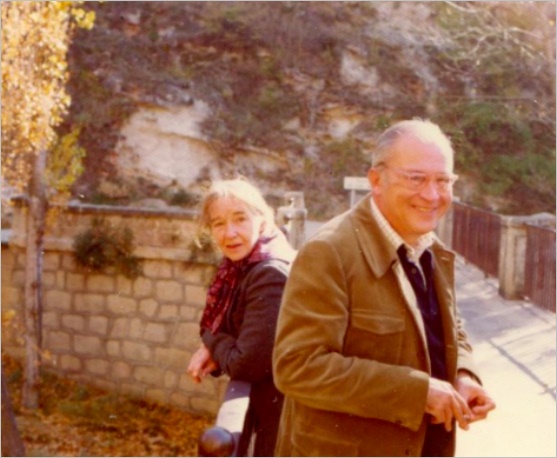
The story of Fernando Zobel the artist would not be complete without mentioning the Pfeufers and their children, who would have a most profound and deep impact on his life. This crucial chapter in his life takes us to late 1940s Cambridge, not too distant from Harvard, and the quaint and markedly bohemian home of the Pfeufers on 52 Walker Street Place – worlds away from the genteel yet strict and patrician millieu Zobel grew up in.
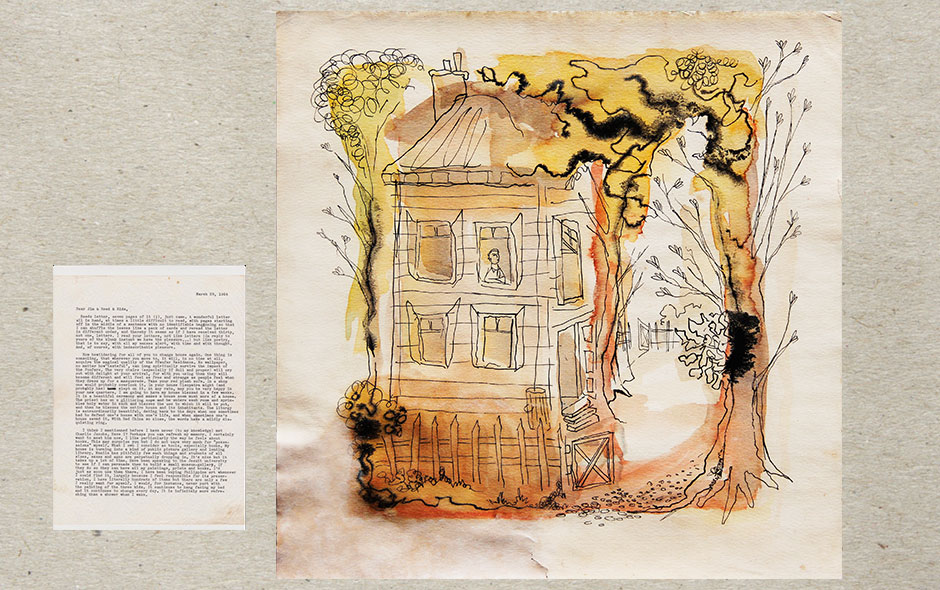
MARCH 25, 1954: ‘How bewildering for all of you to change house again. One thing is consoling, that wherever you move to, it will, in no time at all, acquire the magical quality of the Pfeufer Residence.’
He and the Pfeuffers would exchange letters over 40 years, written in longhand or typed, in yellow pad or letterhead.
Far from wealthy, the Pfeufers were simple, liberal-minded folk who reveled in art. This was reflected in their abode where walls and other surfaces were either adorned by numerous works of art or were painted on by directly Reed, an active member of the so-called Boston School of artists, whose paintings Zobel admired and whose parents were artistically inclined themselves.
As such, similarly-minded individuals – intellectuals and free spirits – and largely Harvard students like Zobel gravitated towards the Pfeufer household that served as safe haven and hangout, where its inhabitants were allowed to speak their minds. One can easilly imagine, then, how and why Fernando quickly grew fond of the Pfeufers, resulting in a lifelong friendship that was both nurturing and enriching.
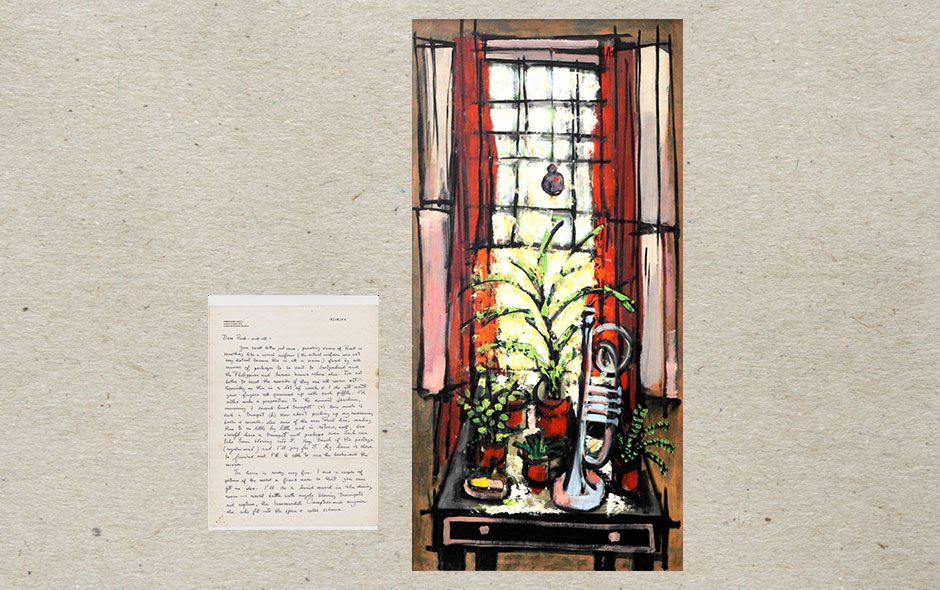
APRIL 18, 1952: ‘How about packing up my remaining books & records, also some of the ones Paul has, mailing them to me little by little and in return, well, Joe should have a trumpet and perhaps even Eric can take turns blowing into it.’
So much so that even after he had graduated from Harvard, Fernando made it a point to return to Boston occasionally in the early and mid-50s (he also worked for a time as an assistant curator at the graphic-arts section of Houghton Library) and later in Rhode Island where the Pfeufers relocated. It was during these visits that Fernando took the occasion to draw and paint the Pfeufer couple and their children.
A personal letter by Zobel to the Pfeufers from Madrid (he resigned from Ayala in 1960 and moved to Cuenca, Spain, to paint full time) allows us a glimpse into this loving relationship: “I just got Reed’s lovely letter. I read it through once, as one does with letters, quickly; to see what it said. And then I read it again, slowly. It is a wonderful letter. It started many things off in my mind and I wonder if that is because of the letter or because I like you all so much that I feel I have left some important part of myself behind when I left you people.”
And, of course, the feeling was mutual and very much shared by the Pfeufers.
Eric Pfeufer, son, now in his 70s, says as much: “I was just taken in by this miraculous person who just came and arrived and then became so close with the family. It was just a completely comfortable friendship.”
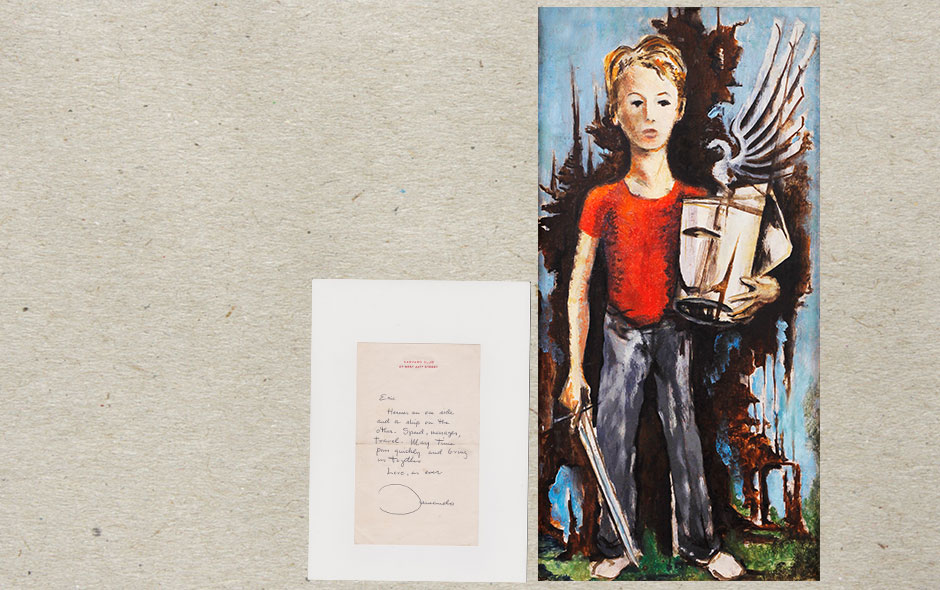
UNDATED (LETTER TO ERIC): ‘Hermes on one side and a ship on the other. Speed, messages, travel. May time pass quickly and bring us together.’
So how, exactly, did Jim and Reed Pfeufer influence – or should we say radically change – Fernando Zobel’s art and his worldview? It was Jim, at that time head of the Graphic Design Program at the Rhode Island School of Design, who facilitated Zobel’s entry to RISD.
“Through my good friend, Mr. James Pfeufer, I have heard that your committee on admissions has favorably considered my application as special student,” writes Zobel to Mr. Charles A. Dunn Jr., director of admissions, on July 1, 1954. “I am genuinely grateful to the members of the entire committee for helping me out in my fix. Although my stay at the Rhode Island School will necessarily have to be pitifully short, I expect to make a very full and valuable use of its facilites during that time. As Mr. Pfeufer can corroborate, I have been planning on this for the past two years and I’m very excited at the prospect.”
It was during his brief stay at RISD – studying engraving techniques alongside painting, drawing, and architecture – that Zobel discovered the works of Mark Rothko, eminent American abstract expressionist painter. “I was astonished,” he declared, after his first encounter with Rothko’s artpieces left his almost breathless.
From that transformative moment was born his landmark series of abstract works: the Saetas, produced by way of using a surgical syringe.
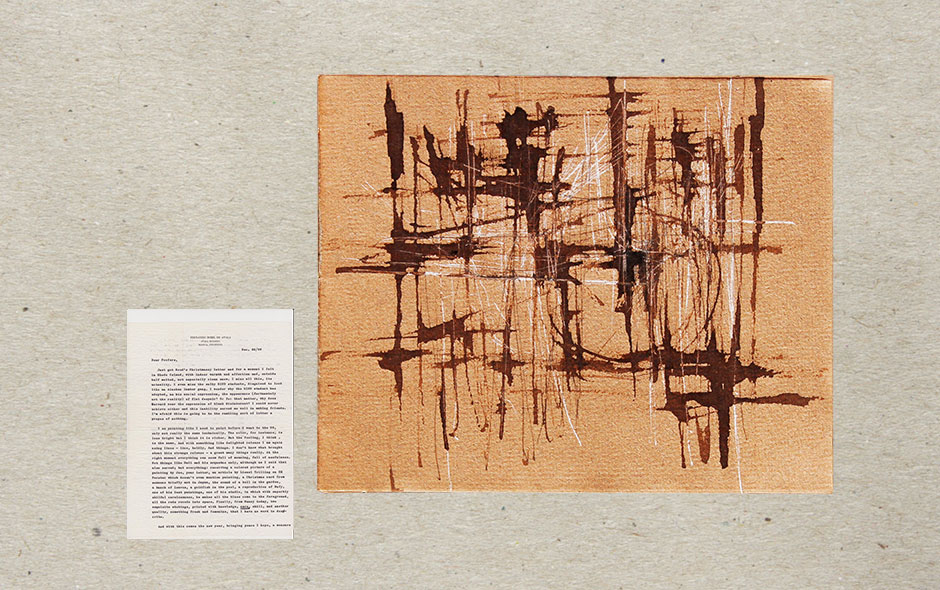
DECEMBER 28, 1956 (ZOBEL’S SAETAS SERIES): ‘I am painting like I used to paint before I went to the US… I am again using lines — line, boldly. And things. I don’t know what brought about this strange release — a great many things really.’
Leafing through the letters sent by Zobel to the Pfeufers between 1945 to 1981 shows not only the depth and affection that existed between the parties, but that they kept in constant contact with each other even in their advanced age. The Pfeufer couple, in fact, visited Zobel in Cuenca in 1974 (at this juncture he was already busy with the Museo de Arte Abstracto Español which he helped create) while their two sons – Eric and Joachim – spent time with him for months at a time before Fernando’s untimely death in 1984 at the age of 60. “He was a generous man,” Eric fondly recalls.
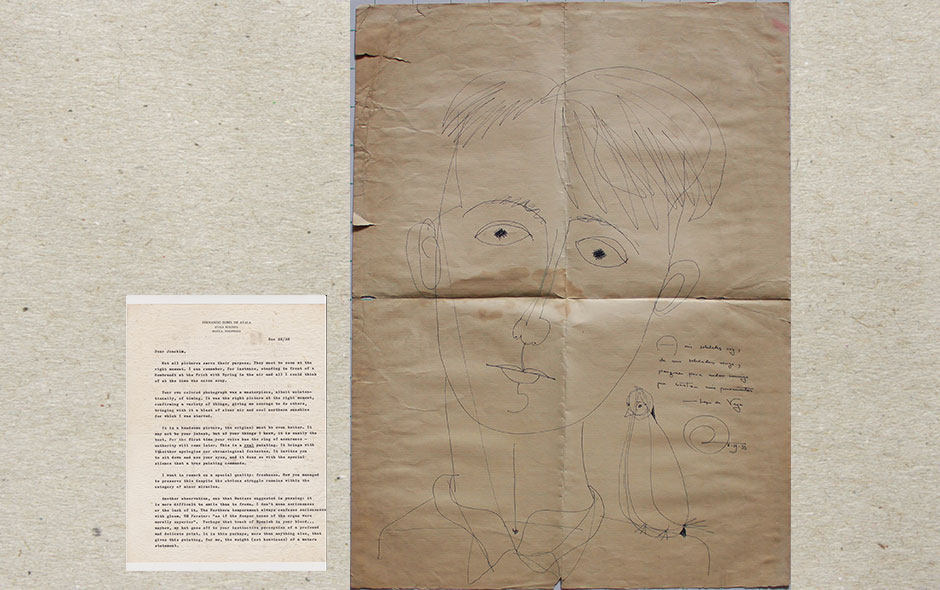
DECEMBER 26, 1956 (LETTER TO JOACHIM): ‘For the first time your voice has the ring of assurance — authority will come later… I want to remark on a special quality: freshness. How you managed to preserve this despite the obvious struggle remains within the category of minor miracles.’
With the subsequent passing of Reed and Jim, the administration of the Pfeufer estate was left in the care of Eric. And it was to his most pleasant surprise that, while perusing through the files left behind by his parents, a slew of original Zobel works – prints, on paper, and in notebooks – resurfaced, including a major Saeta. Add to these the pieces that were aleady in his possession: portraits of himself, his brother Joachim, and his folks in oil; and an outstanding early work and exhibition piece from the fifties entitled “Nothing III”/“Seated Man,” among others.
Naturally, Eric was overjoyed by the discovery, in large part because he was not aware that his parents had actually kept flat files of Zobel’s works, some of which – the prints in particular – were executed in the Pfeufer studio under Jim’s careful tutelege. Here again, we see how the presence of the Pfeufer’s in Fernando Zobel’s life was truly instrumental – and transformational. It was a friendship that thrived not only due to a shared passion for art, but because of a pure and intense love that was shared between them.
A selection of these works, roughly 70 pieces, will be exhibited this month and put under the hammer in February.
“The Jim and Reed Pfeuffer Collection: A four-decade friendship with Fernando Zobel” runs from Jan 19 to Feb 6 at Leon Gallery (G/F Corinthian Plaza, Paseo de Roxas Avenue, Bgy San Lorenzo, Makati; www.leon-gallery.com). Works from the collection will be auctioned on Feb 6, 7pm, at Makati Diamond Residences (Legazpi Street, Bgy San Lorenzo, Makati City).
Main photo: Reed Pfeufer and Fernando Zobel