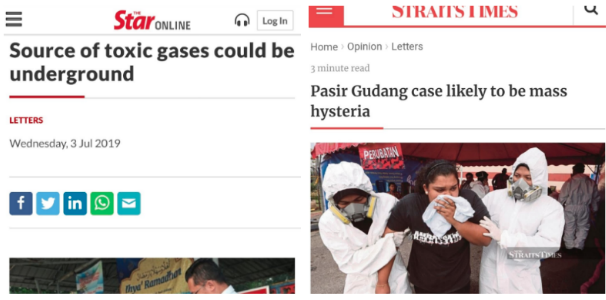

As the environmental situation in Johor’s industrial Pasir Gudang area continues to leave scores of residents complaining of malaise, two of Malaysia’s biggest newspapers had separate takes on the matter yesterday.
Two set of letters today (3 July) from The Star and NST, by Prof Datuk Dr Wan Ramli
and Datuk Dr Looi Hoong Wah.The Star: Source of toxic gases could be underground
NST: What toxic gases? *Likely* a mass hysteria. pic.twitter.com/wQ830WOtQ7— Shahnon Salleh (@shahnonsalleh) July 3, 2019
On one hand, The Star ran a letter to the editor from a respected scientist and lecturer, Professor Datuk Dr Wan Ramli, that supposed that the source of the toxic gases was coming from underground.
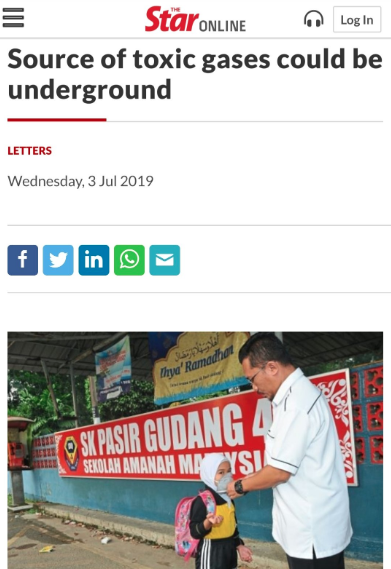
Dr. Wan had been tasked with offering a risk assessment for industry in the area, initially intended to be used for only light to medium product factories. However, he reveals that lack of tenancy resulted in heavier industries moving in, including a proposed chemical plant.
Advising against its establishment years ago, he indicated that any accidental release of gases would adversely affect nearby residential areas.
Paid for his work, developers quickly hired another company to show that there was no risk of accidental gas release, and to quote his letter to the editor: “The rest is history.”
He goes on to offer his take on why school children are being poisoned by the hundreds, and it’s a good read – so check it HERE.
On the other hand, another local paper, New Straits Times, has offered up their own letter to the editor opinion piece, from a doctor, with far less evidence, but ample amount of headline-grabbing attention: It’s just mass hysteria.
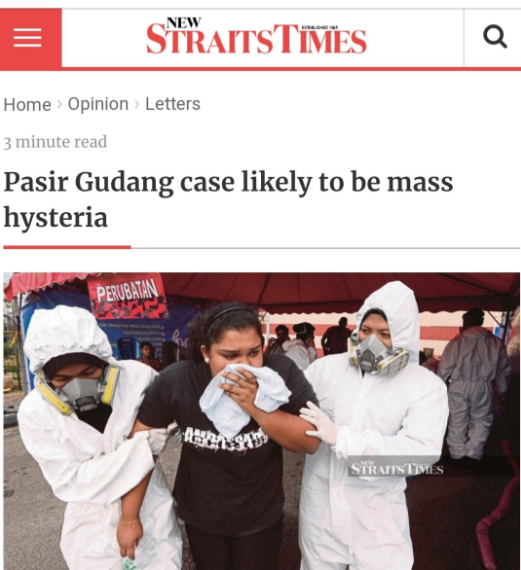
The NST-run article goes on to suggest that hundreds of school children, and nearby residents are merely the victims of the same kind of mass hysteria that had 16th century Alsatians (technically part of the Holy Roman Empire at the time) dancing for days on end, some to their deaths.
Datuk Dr Looi Hoong Wah incorrectly stated that the only individuals affected were schoolgirls [Ed. Note: Offensive, inaccurate and beside the point – but go on], and that symptoms of “mass hysteria among school girls is common.”
“This phenomenon is more common when the environment is restrictive and the atmosphere is oppressive as is often endured by schoolchildren.
“It is not life threatening, except if convulsions happen as this may cause a blockage in the respiratory tract,” he concluded in a letter short enough to write on a Post-It, with little evidence to back his points.
Right.
Let’s look at the evidence, shall we?
Since March of this year, hundreds have fallen ill and required medical attention in the Pasir Gugang area, and an illegal dumping of toxic waste was earlier found to be the culprit of the first wave of illness.
Most recently, the same symptoms have cropped up, but authorities have not been able to find the source of what is causing all of the illnesses.
Tempers have reached a fever pitch, with residents attending a town hall meeting on July 1, where one father’s speech over his son’s illness and need for constant medical attention made the rounds on social media.
This is not hysteria: This is real life for the good people of Pasir Gudang, and chalking it up to a bunch of kids seeing Abigail Williams practice witch craft (Salem Witch trials, y’all – get up on your history!) is just dismissive, mean and fails to actually recognize the source of these mass epidemics.
While we’ll never know what made the people of Alsace, France dance until they died, or others accuse their neighbors of witch-craft, several modern-day theories have been put forward.
One theory looks at a “stress-induced psychosis” after centuries of starvation and dodging the bubonic plague that caused the mass psychotic illness. Another points to a poisoning of the local wheat supply with toxic and psychoactive substances. Villagers were inadvertently ingesting home-brewed LSD, and then dancing themselves silly, as one would.
In short, give the people of Pasir Gudang what they deserve, something that past historical occurrences cannot be granted – a fully transparent investigation into the heavy chemical industry waste management in their backyards. N
Sekian.