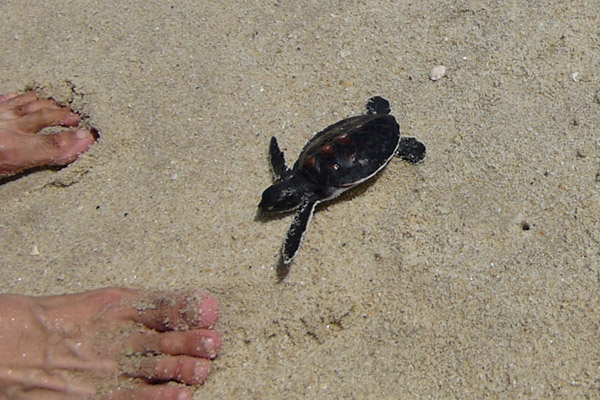

Activists say one of Malaysia’s few marine turtle nesting beaches is being threatened by planned industrial development near the Tanjung Hantu Permanent Forest Reserve in Perak.
Recently, the Perak state government approved plans to build a liquified natural gas plant and a steel coil mill within the confines of the Tanjung Hantu reserve, allowing for the development by degazetting 60 hectares of land previously off-limits to any construction or commercial use.
Activists say the industrial plants will not only cut into the reserve land, but will drive away nesting turtles from Pasir Panjang, the last marine turtle beach in Perak.

“Although not very large in terms of area size (about 2720.79 hectares from the original size between 4000-4700 hectares) [Tanjung Hantu and neighboring Segari Melintang Permanent Forest Reserves are] one of the few forests left in the locality that is still somewhat intact and unfortunately, under-researched,” Nurul Salmi, a professor with Universiti Sains Malaysia (USM), told mongabay.com.
Of the two companies involved in the development project, Maegma Steel will be constructing the steel coil mill, while Atigas Technology will be building the liquified natural gas plant. Campaigners against the project argue that the actual impact of the developments, including roads and workers’ housing, will stretch beyond the degazetted 60 hectares of land and encroach into other parts of the two forest reserves and the Pasir Panjang turtle beach.
According to Salmi, both the Tanjung Hantu and Segari Melintang reserves are remnants of a vanishing forest type in Malaysia, which contain two endangered dipterocarp tree species: Shorea glauca, currently listed as Endangered, and Shorea lumutensis, listed as Critically Endangered and only found in Malaysia. The forests are also home to charismatic, and threatened, mammals.

Tanjung Hantu is classified as an environmentally sensitive area under Malaysia’s National Physical Plan (NPP), which means that the area is only reserved for tourism development. However, this hasn’t stopped the Perak government from already degazetting a portion of the forest to make way for the natural gas plant and steel coil mill.
Last year, activists told mongabay.com that such degazettements of Permanent Forest Reserve have become commonplace since the election of Zambry Kadir as head of Perak state. In Malaysia, with a few exceptions, the heads of each state have sole power over degazetting protected forests.
“The Menteri Besar can choose to degazette a [reserve] unilaterally, opting to disregard advice from the State Forestry Department, environmental NGOs, and even going against rulings made by Federal Government. The decision is taken at State Executive Council meetings, and proceedings of these meetings are treated confidentially,” Rahman told mongabay.com last year.
Malaysia has the world’s highest deforestation rate, according to a new Google-powered deforestation monitoring tool. Between 2000-2012, Malaysia lost 14.4 percent of its forests or 4.7 million hectares, an area larger than Denmark.
An online petition has been set up asking Prime Minister datuk Seri Najib Tun Razak to call for a review of the Tanjung Hantu industrial development plan. It currently has over 82,000 signatures, and the origanizers are calling for more support.
Check out the petition and pledge your support here.

Photos: Nadine Ruppert
Story: mongabay.com