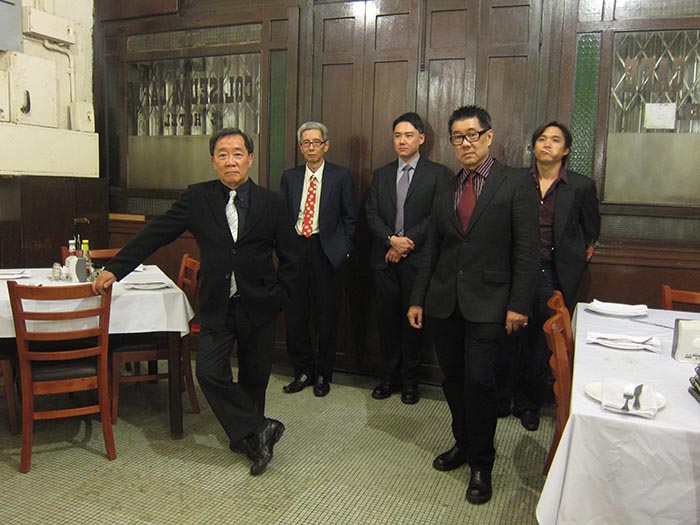


Let’s get this out of the way first: Take Me To Dinner revolves around a motley band of contract killers. You’ll need to file that away from the get go, because everything which transpires in this movie bounces off that premise into tangents, and doesn’t dwell too much on the mechanics of contract killing. This isn’t an action movie.
Patrick Teoh plays one of these contract killers; his character, Edward, has been in the game long enough that it’s become a fact of life for him, and one that takes more than than it gives. He’s found a reason to move on from the confines of his profession in the form of a love interest, Jennifer (Susan Lankaster, making a welcome return to the big screen). That decision, and all its implied repercussions, puts Edward at odds with the rest of his crew – equally battle-hardened pros Manny (Thor Kah Hong), Ted (Ben Tan), Hamm (Ng U-En) and quiet young buck Elijah (Michael Chen). To mark Edward’s departure from the world of murder for hire, he requests that the old gang get together for one last dinner, and over the course of that final evening as peers, and through the flashbacks to Edward’s relationship with Jennifer, the movie leads us to where all relationships inevitably go: not where we’d like them to, just a few more steps from satisfaction.
Edward’s relationship with his crew of homicidal pros is one borne out of years of not being able to trust anyone else, and even between them trust is never doled out fully: the movie lands a few great points on how work brings strange bedfellows together and makes unlikely life-long friends of them. Each member of the team has his own rather distracting personal affectation: one sits sneering quietly reading the same comic book over and over; another has a degree in medieval languages; one is gay; another is a casual homophobe. These idiosyncracies sometimes helps the narrative move along, but not always. I found myself once too often waiting for the other shoe to drop scenes after a particular distinguishing trait was pointed out, to no real payoff onscreen.
But the characters work well with each other, giving the audience a feel that they have been through quite a bit and have grown to be each other’s family after years of placing not much value in the lives of other human beings. These are your best friends from the office who you don’t meet for badminton or teh tarik on the weekends, but who still know you better than your girlfriend. All the characters feel worn in, and the history they share is palpable on the screen: their reactions to each other are a balance of we’ve-been-through-this-a-thousand-times-already and muted surprise at a revelation couched in familiarity with someone’s unpredictability. You believe these people have been through some harrowing shit.
Speaking of girlfriends … Jennifer is the Yoko Ono to this movie’s Beatles, the promise of happier, more carefree days after a career entered grudgingly and out of ill intent. Friends at work find it hard to remain friends when the common ground is lost. Edward and his crew, especially wizened curmudgeon Manny and calculatingly ambitious Hamm, find themselves increasingly at odds as people when the one thing that kept them together is about to be stripped away. You want what’s best for your mate, but friends don’t let friends leave the company, because if they do, they stop being friends.

Take Me To Dinner was made on an independent budget, and unfortunately it shows in places. Far be it from me to condemn the use of shaky cam in movies, but some shots in Dinner look like the production had no choice in the matter, and the movie lost my attention at these moments. A trip through downtown KL in a luxury car felt decidedly less luxurious because the camera was bouncing every which way at every turn, even as the characters played off each other with ease; the lack of establishing shots in some scenes added a sense of claustrophobia that seemed less a narrative tool and more a hampering limitation. There were times when I would close my eyes for a few moments and just concentrated on Patrick Teoh’s dulcet tones to guide me through a visually rough patch, and I was still able to follow the story – even better, in fact. Thankfully, workshopping actors doesn’t take up too much of a production budget, and I suspect writer-director Gavin Yap did this extensively with his cast before the cameras started rolling.
Watching Take Me To Dinner, I couldn’t shake the feeling that it might have worked better as a stage production: the film takes place in all but a few locations, the driving force of the narrative is overwhelmingly the dialogue and interweaving character arcs. But as a moving picture it does the best it can, despite the limitations its budget might have imposed on it and whatever stylistic decisions it might have originally wanted to make, and the ones it ultimately did.
No matter the format, this is still a provocative examination on what makes and breaks friendships, the fragility of relationships, and how in the end, everything ends with unfulfilled hopes and broken lives and everybody gets their just desserts. The actors pull this movie through, and their world-weary interpretations of what was on the page help transcend what might have been one-note tics and gimmicks to give each character a sense of place within themselves and between each other. Patrick Teoh commands the screen effortlessly, and the entire cast rallies around him gleefully. You should give this movie a shot, if only to see how a solid ensemble cast should work, and to whet your appetite for an improving Malaysian indie film industry that deserves as much encouragement as it can get.
Take Me To Dinner is playing at selected Golden Screen Cinemas.