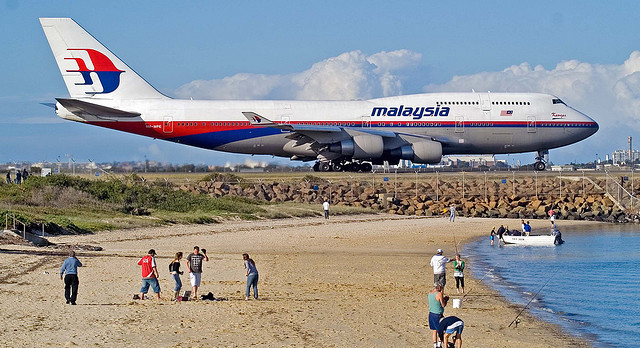

the country’s flagship carrier, Malaysia Airlines, continued its struggle with the bottom line when on Tuesday its published earnings report put it at a loss for the fourth straight quarter in the last three months of 2013.
The airline reported a loss of RM343 million for the quarter ending December 31 2013, compared to a gain of RM51 million in the same time period in 2012.
This brought Malaysian Airlines’ totall losses for 2013 up to RM1.17 billion, almost three times the amount lost in 2012, when the company hemorrhaged RM433 million amidst an aggressive cost-cutting campaign.
The company’s report said the fourth quarter losses were causd by a depreciating ringgit, unrealised foreign exchange losses and finance costs.
The carrier was also affected by “intensified competition”, causing the revenue for last year’s fourth quarter to rise by less than one per cent, to RM3.9 billion.
“Going into 2014, Malaysia Airlines expects the business environment to remain challenging with high fuel prices, volatile foreign exchange and intense competition impacting yield from both existing as well as new entrants into the market,” it said in a filing to the stock exchange.
For the full year 2013, the airlines’ revenue was 15.1 billion ringgit, up 10 percent from 2012 as the number of passengers rose almost 30 percent.
However, expenditure also increased by 10 per cent to RM14.9 billion year-on-year due to high fuel prices.
“Within this growing market place, Malaysia Airlines had to expand capacity in order to remain relevant as a key player”, said Malaysia Airlines Group Chief Executive Officer Ahmad Jauhari Yahya. “The full year performance of making a bigger loss in 2013 compared to 2012 demonstrates the challenges brought on by intensifying competition leading to lower yields for all players.”
Analysts have blamed a combination of stiff competition, poor management, change-resistant unions and government interference for the carrier’s poor performance.
In 2012, the carrier admitted it was in “crisis,” forcing it to implement a cost-cutting campaign centred on slashing routes and other measures.
In 2011, it chalked up a record 2.5 billion ringgit loss.
Photo: Justin Griffiths / Flickr
Source: AFP