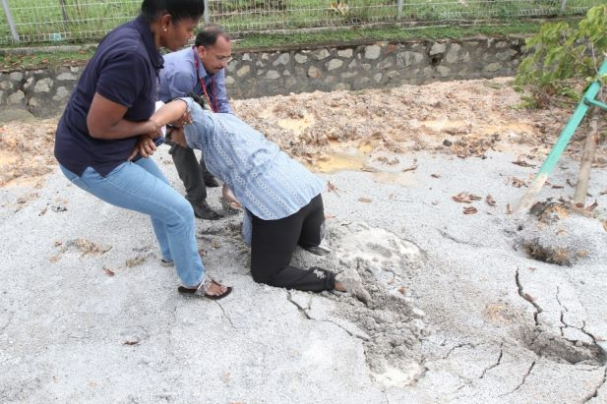

Selayang Municipal Councilor P. Mariammal S. Ponnusamy, one of seven (!) women recently elected to the Selayang council, found herself scrambling for dear life after an on-site visit to the scene of a burst pipe took a turn for the terrifying.
Having arrived to Jalan Desa to inspect the pipe herself after a series of complaints from residents yesterday, the ground suddenly collapsed below her feet, sucking her into waist-deep quicksand.
Luckily, both her personal secretary and a Star Metro reporter were on hand to pull her to safety when the accident occurred at 11:30am.
Relaying her experience, Mariammal was “visibly shaken,” and lost her shoes to the ordeal.
“It was the most terrifying three minutes of my life! Every time I struggled, I could feel myself being sucked back in and it got deeper and deeper. Thank God, I was not alone, Premah (her personal secretary) and Edward (the reporter) saved me,” she said.
Residents allege that the ground had become soaked with water over the last three days; however, when the Selangor water authority was informed, they paid little attention to their complaints, and the area continued to become waterlogged.
The area has now been cordoned off while engineers and the water company get to the bottom of the issue.
Reader, if you’re anything like us, these types of tales often pique our curiosity: Exactly what are you supposed to do when you get stuck in quicksand?
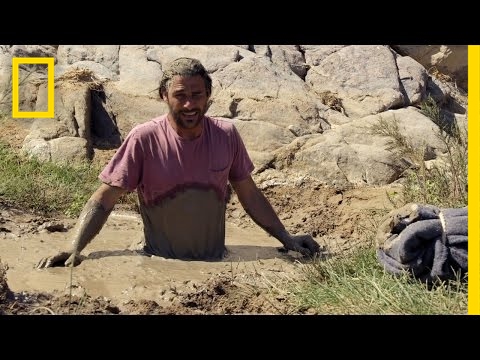
Well, first of all let’s understand one thing – “quicksand” isn’t always actually sand. In fact, it’s any kind of mass whether it be sand, clay, or dirt that contains a whole lotta trapped water. The water turns the mass into a thick liquid mud that will collapse when weight is pressed on top of it. Quicksand then rapidly solidifies again, trapping whatever just got stuck.
Walking, it’s hard to spot an area of quicksand, as it doesn’t look like mud, but you can sometimes spot if the ground is bubbling slightly, or even has a rippled surface. Affected areas are usually around riverbanks, lakes, swamps, marshes, tidal flats, glaciers, underground springs, or as our Selayang councilor found out – water-logged roadside terrain. If you’re unsure about the surface – tap it with a stick to see if it gives way.
Too late and already stepped in some sinking earth? First this is first, but don’t panic. Easier said than done, we know. Next, remove any excess weight off that you can, like a backpack or shoes even. You want to make your body as light as possible, really.
Remember to keep your movements small: If you’re not too deep, try to take a few steps backwards, but remember not to lunge too far – you will find it a lot harder to move if you end up in a straddled position.
Keep your head and arms above the surface, and try to disperse your body weight. The best way to do this is in a back-float position that allows for your feet to float back up to the surface – after that you can “swim” your way back to stable ground. Remember not to use your arms to backstroke your way out – we’re back-floating, here guys.
If there are nearby trees, grab a branch once you have stabilized yourself, as SLOWLY pull yourself out. Remember, too fast and you’re fighting the vacuum that is underneath your feet.
Not feeling the “swimming” option? Well, you can try moving your legs a few centimetres at a time back to the surface. Every time you do this, pause and wait for the quicksand to come and fill up the empty space below your foot. This could take hours, so be patient and practice deep breathing – it’s not only calming, but it also promotes buoyancy.
Remember: Keep your arms out of the quicksand, and never ever put your head inside.
There you have it, some survival tips via Coconuts KL. We’re including a clip at the jump: