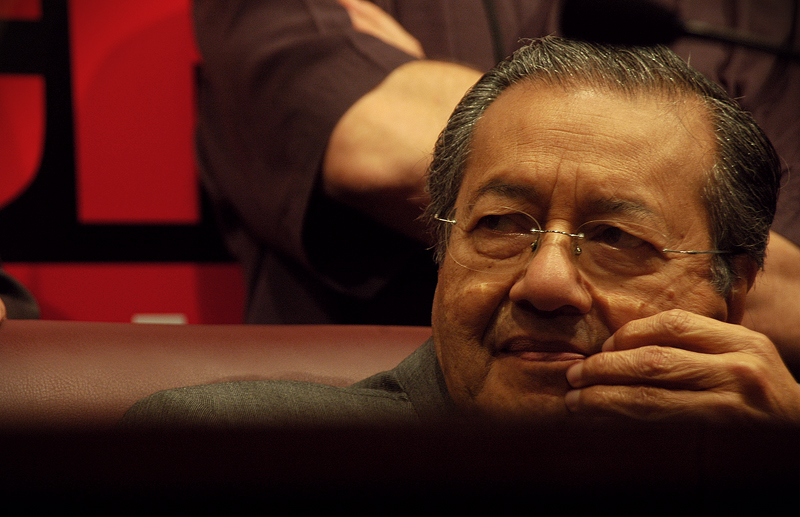

Another Monday, another statement from the popular blog of former Prime Minister Tun Dr Mahathir Mohamad. This week, Mahathir has come out to say that he no longer supports the administration of current Prime Minister Datuk Seri Najib Tun Razak.
Mahathir frames the arguments in his latest blog post with the allegory of the Emperor having no clothes, and that leaders who do not receive critical input from people around him will lead to policies that are detrimental to the people. He also adds that Malay culture doesn’t encourage people to criticise their leaders, but that Malays tend to resort to backbiting.
He also mentions that there is a history of Malaysian Prime Ministers resigning after receiving criticisms. Although he concedes that his own criticism of first Prime Minister yang Teramat Mulia Tunku Abdul Rahman’s performance in office played a very small part in his eventual relinquishment of office, Tunku did step down after being accused of not doing enough for Malay interests.
Mahathir’s direct (and hand-picked) succesor Tun Abdullah Ahmad Badawi, Mahathir says, was the same. He writes that Abdullah stepped down as PM after he received criticisms and after faring poorly in the 2008 12th General Elections. Mahathir writes that even he himself resigned in 2003 as grumblings over his 22 years in office were mounting to become increasingly loud shouts.
That he jumps from these anecdotes straight into his commentary on the Najib administration, and his rescinding of supprt for the current PM, is a not so subtle hint.
He writes that Najib was his personal choice to carry on as Prime Minister, but that over the course of his administration Mahathir’s confidence in the Najib government has waned. Mahathir considers Najib’s performance during the 13th General Elections last year to be worse than Abdullah’s in 2008, and that in the time since, Najib has not made any significant changes in his leadership style to improve on his government’s performance.
Mahathir lays out a lundry list of Najib policies he disagrees with, and thinks are harming the country: draconian laws such as the Internal Security Act (ISA) and the Banishment Act were abolished to appease the political opposition, who would never acknowledge the policy change as a positive. This led, Mahathir writes, to an increase in organised crime follwoing the release of gang leaders from prison.
He also accuses Najib of kowtowing to regional neighbours to the point where even domestic policy is beholden to the interests of other nations. However, the same accommodation is not afforded to the “people and party” who have long supported the sanctity of the ruling government. Mahathir is probably referring to the sidelining of ethnic Malay and UMNO interests in favour of more merit-based, open market policies.
Mahathir is still considered a kingmaker within UMNO and Barisan Nasional ranks, and is currently the patron of controversial Malay-Muslim rights group Perikatan Pribumi Perkasa Malaysia (Perkasa).
Mahathir decries the recent innovation of handing out 1Malaysia People’s Assistance (BR1M) cash to the people, and calls it a naked general election campaign ploy. Cash handouts, he writes, causes the people to be more dependent on the Federal Government, and erodes their motiviation to work hard.
He objects to Najib’s consumer-centric economic policies, where imports are encouraged at the expense of local businesses trying to maintain viability. Mahathir has long championed preferential treatment for Bumiputera-owned corporations, and is currently the chairman of national car manufacturer Proton.
Lastly, he chides Najib for his addition of too many public holidays, while “arbitrarily” raising the minimum wage, policies that he argues will harm the national economy and its global competitiveness.
He couched all these arguments by saying that national leaders need to be criticised if they stray too far from the public’s interests … or at least, Mahathir’s view of what the public’s interests are. He contends that he does not love the Malaysian leadership less, but that he loves his people and country more: a paraphrasing of Brutus’s infamous speech after assassinating Julius Caesar.