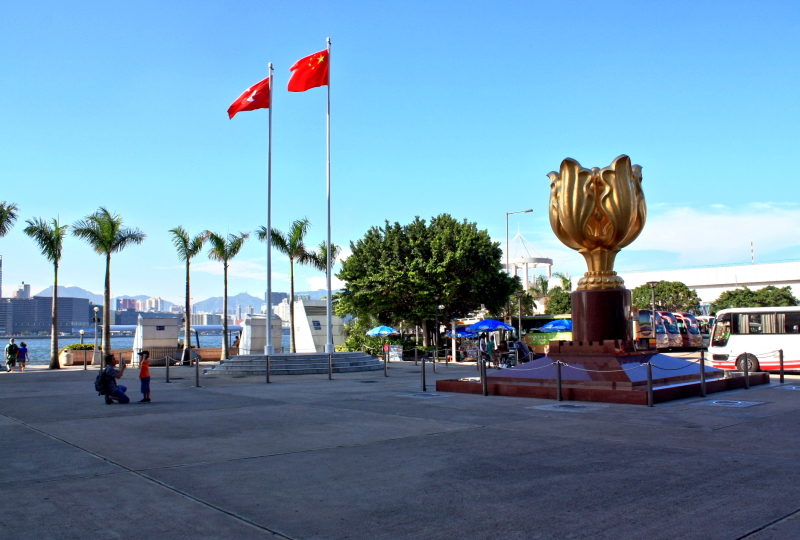

Hong Kong’s Home Affairs Department is attempting to scale back the size of an annual flag-raising ceremony on July 1 commemorating the 1997 handover, as plans spread online calling for disruptions amid ongoing protests over a controversial extradition bill.
Next Monday is the 22nd anniversary of Hong Kong return to China by its British colonial rulers. The annual July 1 flag-hoisting ceremony in Bauhinia Square is typically attended by both past and present top government officials, and embattled Chief Executive Carrie Lam is expected to turn up on Monday morning.
But with netizens calling for actions like “surrounding the square” as part of the ongoing civil disobedience movement against the extradition bill, the Home Affairs Department had decided not to arrange student groups and so-called “uniform teams” — such as girl and boy scouts — to join this year’s event due to “safety concerns”.
According to Ming Pao, the government is working on reducing the scale of the ceremony, and fewer attendees will be invited. A number of uniform teams, including the Auxiliary Medical Service Cadets and Hong Kong Red Cross Youth Unit, have received notice that team members are no longer expected to participate.
They were told that there had been a “change in arrangements,” but no reasons behind the change were disclosed.
The chairman of the Democratic Party, Wu Chi-wai, told RTHK that the changes to the arrangements illustrated the government’s fear that large-scale protests — including from the “uniform teams” themselves — could embarrass the government at an event meant to foster national pride (which is currently at an all-time low).
“It reflects that the government is under a situation of non-governance,” said Wu. “The government is so scared that, even though you have uniformed youngsters to patrol at the ceremony, they may be afraid of some demonstrations coming from the uniformed units.
“This may be the main reason for them not to have uniformed units to patrol at the ceremony.”
Such guerilla-style protests have become commonplace over the last week, with largely leaderless demonstrators using online platforms like Telegram and the forum LIHKG to organize participants quickly and anonymously.
Recent actions like the siege of the police headquarters a week ago and the protest at the offices of the Department of Justice yesterday — which featured far smaller crowds than other, more conventional demonstrations — were similarly organized online.
But with the scale of the protests so difficult to predict in advance, it remains to be seen how many people will show up on Monday morning.