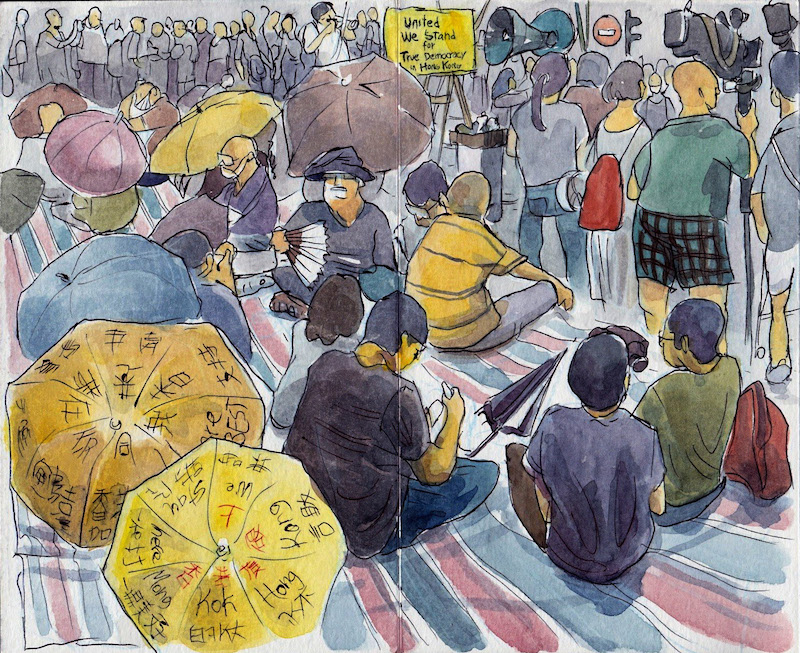

Sketching is an odd choice of a medium for someone who wants to document a historical event. It lacks the convenience of photography, the movement of film, and the scope of the written word. But nevertheless, it is through putting pencil on paper that Luís Simões has an urge to create, to record, to show.
 Simöes at the protests in Admiralty.
 Simöes at the protests in Admiralty.
“I just want to capture the emotions, the moment, whether the people are happy or not when they walk past me,” says Simões. “I want to tell the story with my sketches, so when you look at my pictures you have to feel something.”

Simões, 35, hails from Portugal, where he was a graphic designer until he left in March 2012 to embark on a “world sketching tour”. He sketched his way through Europe – where, in Barcelona, he got his sketchbooks stolen – then went eastward on the trans-Mongolian railway to Asia. He then travelled onto Mongolia, mainland China, Japan, South Korea, and now, Hong Kong.
This city has, unexpectedly, become the longest stop on his tour so far. Having been here for ten months, he can barely be considered a tourist anymore.

Unexpected paid opportunities, his desire to sketch the protests, and his new friendships have, for the moment, kept the artist in the Fragrant Harbour. But Simões isn’t worried that the extended stay, with no end date as of yet, will derail his world tour.

The artist in action in Admiralty.
The artist is blessed with an enviably carefree demeanor and lifestyle: “Eventually I know I will feel the kick in my butt, but for now I don’t feel it yet… So I think I can still do something here. And I like that in my life I’m free to choose.”

That zen disposition comes in handy when he’s sketching on-site, which requires a certain amount of patience and inner calm.
First, Simões does a quick pencil sketch. He outlines what he wants to draw, making snap decisions on the people, the angle, the moment in time and the mood that he wants to capture. Then he goes over the strokes with a ballpoint pen. Finally, he colours the pieces with watercolour using a portable water-filled brush.

His sketchbook against real life. (Photo: Luís Simões)
It sounds fairly straightforward, but add in the fact that he’s in the middle of a clash between demonstrators and the police in the biggest Chinese protest since 1989, and things get a bit more difficult.
“There was this moment when they blocked [Lung Wo] tunnel, and I’m sketching, and there’s the barricade, and the kids blocking the tunnel, and there’s the police on the other side, and I’m in the space in between,” Simões recalls.

“I’m afraid they’re going to do something, but […] it’s important for me to express myself right at that moment, because I cannot speak the same language – I cannot do anything but sketch,” he says.
The confrontation produced one of his favourite pieces, which are made when he’s “thinking of nothing and just hearing”.

His best work thus comes out of artistic urges that are accompanied by an almost meditative state.
But an endeavour that was once so personal has taken on new, larger meaning. Slowly, but surely, Simões’ sketches depicting the Umbrella Movement are receiving more and more attention.

“People will take photos with me, they will ask me why I’m sketching, if I work for a newspaper, if they can buy my work. People have put food in front of me, to say thank you,” Simões retells.
The reaction extends beyond the confines of the protests: “People from around the world comment on my Facebook page saying, ‘Thank you for your vision and for your eyes.. We watch one thing [on TV] and see another thing in your sketches.’”

He didn’t realise he was, in fact, supporting the movement with his art until he saw these messages.
“I became part of [the protests], and I thought, for whatever reason, I should keep going.”

Simões believes that his sketches provide something different to a protest that may be one of the best-documented movements in history, with a constant stream of photos, videos, art and text being churned out every day.
“I give you the freedom to interpret. I’m not telling you everything, and you are free to pick what is the important thing in the sketch. I’m just giving you my side of watching it and for that, it brings freshness.

His tools.
Though Simões tries to make sure his sketches are as close to reality as possible, they are mostly a composite of his memories over a short duration of time. “It’s like a photo with a 10-minute exposure, or a time-lapse,” he explains.

Through this unique way of storytelling, he hopes to raise awareness about Hong Kong’s protests, and is working on a book that will include his art and a deeper look into the movement’s background.
“I just want people to think about it, to not ignore it… I’m passionate about stories, and this is exactly what I would like to do more often.”
Photos/text: Laurel Chor