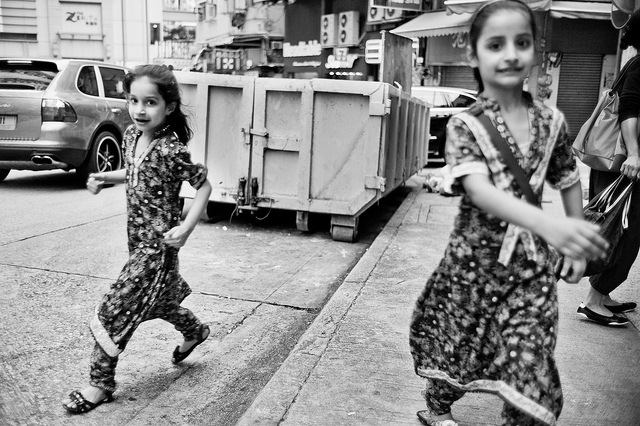

NGO and registered charity Hong Kong Unison has been fighting for the rights of the territory’s ethnic minorities since 2001. Here, in a translated version of an open letter recently submitted to the city’s Chinese language media, the group outlines the government’s perceived sidelining of ethnic minorities in their policies, specifically the sister schools and mainland exchange schemes.
Mainland exchange programmes: a government that excludes and discriminates against ethnic minorities
Chief Executive CY Leung announced in the 2015 Policy Address that the Education Bureau will subsidise every student to join at least one Mainland exchange programme in both the primary and secondary stage. On page 120 of the Policy Agenda published together with the Policy Address, the government stated that “the exchanges can enable students, as Chinese nationals, to gain first-hand experience of our country’s development…”
Although the Chief Executive claims that Hong Kong is a “happy and harmonious family for 7 million people” including ethnic minorities, it seems he lacks cultural sensitivity; he is narrow-minded and arrogant as to think that all Hong Kong students are Chinese nationals.
To take ethnic minority residents as an example, there were 25,000 or so ethnic minority students from kindergarten to Secondary 6 in Hong Kong in 2013/14, many of whom are born and raised in Hong Kong and are second- and third-generation residents.
They are diverse in terms of their sense of identity and nationality. Many of them see themselves as Hongkongers although some of them choose to seek naturalisation as Chinese nationals while some choose to retain their nationality of origin.
However, when some ethnic minorities apply for naturalisation as Chinese nationals, they are often rejected with unknown reasons or dissuaded by the Immigration Department.
On one hand the government says that all Hong Kong students are Chinese nationals, and on the other hand it does not allow some ethnic minority residents to be naturalised. Does this mean that in the government’s mind, ethnic minority residents are not Hong Kong students?
In addition, on the “Clean the Air” webpage of the Education Bureau where the Bureau explains all its policies, there are two articles explaining the mainland exchange programmes and sister schools programme, which are available in Chinese but not in English. The other 40 or so articles on the webpage are all in Chinese except one.
Much of the other official information of the Bureau, including reports on individual kindergartens’ quality and videos about the study on free kindergarten education, is only available in Chinese. Furthermore, the Education Bureau referred to non-Chinese speaking students (students whose spoken language at home is not Chinese) as non-locals in its paper to the Legislative Council in 2014.
Chinese and English are both official languages of Hong Kong, yet it seems that the Bureau does not have in mind those students who cannot read or write Chinese when they formulate policies. The Education Bureau is in effect treating ethnic minorities as non-locals and excluding them.
Language has a close connection with race, ethnicity and descent. Chinese is not the mother tongue of the vast majority of members of the ethnic minority communities in Hong Kong.
Most schools did not teach ethnic minority students Chinese until a decade ago, resulting in a situation that the majority of ethnic minority students in Hong Kong, although born and raised here, are unable to read or write Chinese.
Although the Chief Executive finally announced the implementation of the “Chinese Language Curriculum Second Language Learning Framework” in his 2014 Policy Address in response to the decade-long advocacy efforts of Hong Kong Unison and other organisations, many details, such as the teaching targets, pedagogies, curricular content and teaching materials, are lacking.
Without adequate support, most schools still cannot effectively teach ethnic minorities Chinese in a manner accessible to this group of students.
The Education Bureau does not have polices in place to effectively teach ethnic minorities Chinese on the one hand, yet they provide much official information only in Chinese on the other. It even considers non-Chinese speaking students as non-locals.
If our government excludes and discriminates against ethnic minorities in this way, what sense of identity is the government seeking to promote or, it may be said, trying to impose on both Chinese and non-Chinese students in these exchanges to the Mainland?
If the government continues to exclude ethnic minorities from its policies and fails to promote genuine racial inclusion in Hong Kong, no matter how many exchange programmes it organises, there is no chance of the government achieving its stated objective of broadening the horizons of students and making our city more open-minded.
The government’s blatant violation of the universal values of equality and inclusion will only lead to the decline of Hong Kong, and “Asia’s World City” will just be an empty slogan.
Words: Phyllis Cheung, Executive Director of Hong Kong Unison