
After more than 20 months of planning and preparations as well as unexpected challenges, the Occupy Central movement – the much talked about sit-in at the city’s business district in an effort to push for genuine universal suffrage in Hong Kong by 2017 – is finally going ahead on Oct. 1.
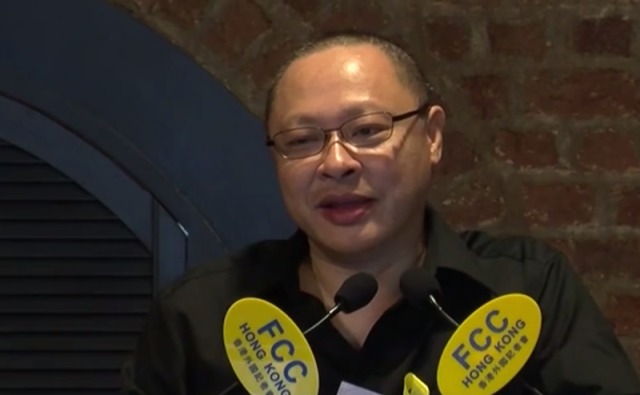
Benny Tai, one of the key organisers of the “democratic banquet” (another name for the protest) expects around 10,000 occupiers on Wednesday. As guest speaker at the Foreign Correspondents’ Club yesterday, the legal scholar from the University of Hong Kong said the event will hark a new era for the city’s democratic development, adding that further civil disobedience schemes lie ahead.
These include efforts to establish a possible Hong Kong charter, a platform that would let Hong Kong people elect their own (unofficial) leader. After the protest, deliberative meetings will be held with civil society groups, academics and political parties to draft a charter on social welfare, environmental protection and the systems of government, among other policy issues, said Tai. He added that the charter would be ratified through a public vote.
“If the charter is accepted by thousands and thousands of Hong Kong people, this will be the platform that can be used by a Chief Executive election by the Hong Kong people through a civil referendum.” The “shadow chief executive” won’t be running society per se, but act as a civil disobedience effort whilst keeping the official leadership in check, he said.
Talking on the upcoming sit-in on Oct. 1, Tai dispelled arguably two of the most common concerns over the event: fears that the demonstration would paralyse the city and have a detrimental economic impact on Hong Kong.

“Our estimation is that the occupation may last for a few days and I think the disruption will be bearable.” The academic insisted the encampment of protestors will only occur in certain parts of the city’s main financial district, and the event was specifically chosen on a public holiday (Oct. 1 is China’s National Day) to lessen its potential economic impact.
The co-founder of the grassroots movement says the gathering will be “the most organised occupation in Hong Kong.” The organisers have made extensive preparations to ensure it proceeds non-violently, although Tai hopes there’d be an appropriate level of civil disruption to spark a “social awakening” in the city.
A trained team will be present to maintain order of the demonstration; a group of lawyers will also be there to provide legal assistance; around 200 medical staff will provide humanitarian support, plus there will be social workers to council the protest participants. There’s even a team of pastors that will be present to provide spiritual advice to Christians in attendance.
The activist urged the business community to support to a democratic system in Hong Kong, insisting their stance will influence how Beijing sees the matter. Conversely, he called out the delegation of city’s business elite that flew to Beijing to meet China’s President Xi Jinping on Monday: “I hope they can see someday that the red capital is coming, that someday the political privileges they are now enjoying will have to be shared or even given to the red capital.”
Tai says it’s only a matter time before people in the mainland also aspire to these democratic goals. “China’s leaders are far-sighted enough to see that there may be a chance China needs to introduce some form of election reform into its own system.” Tai thinks the mainland would pilot-test these ideas in some territory within the nation.
“Throughout the whole of China, we will be the best place for this pilot test of electoral reform. I cannot think of any other place except Hong Kong.”










