
Hong Kong police have edited out parts of the history related to the 1967 leftist riots on its website, with sensitive language depicting the pro-Beijing rioters removed.
The current version, edited sometime after the end of June, has seen many references to the riots removed, such as “little red books and slogans”, anti-government “struggle committees”, and makeshift bombs being “made in classrooms of left-wing schools”. A reference to public transport workers being threatened by pro-Beijing rioters for going to work was also removed.
The original passage also mentioned that pro-China businessmen, who supported the riot, chose to send their children to “much-disparaged” western countries during the civil unrest.
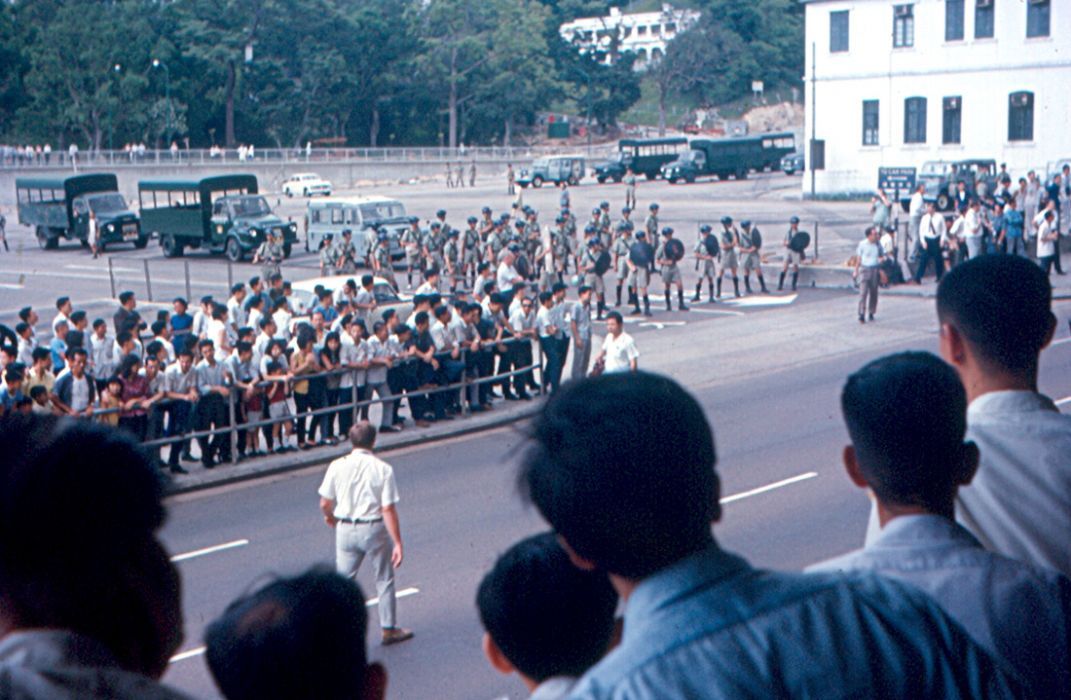
This brief flurry was but a rehearsal for the following spring. In China, the political turmoil spread and eventually lashed Hong Kong. Inflamed by rhetoric, fuelled by misplaced ideas of nationalism, huge mobs marched on Government House, waving aloft the Little Red Book and shouting slogans. Ranks of police faced crowds hurling insults, spitting, sometimes throwing acid. Never have strict discipline and stringent training paid such dividends. Staunchly, the thin khaki line held firm. Those early days in May 1967 were the start of a torrid, worrying summer. The mass protests tapered off, to be replaced by a campaign of terror and bombing. Bus and tram drivers were threatened, sometimes attacked if they went to work to keep Hong Kong on the move. Bombs were made in classrooms of left-wing schools and planted indiscriminately on the streets. Struggle committees were formed to foment strife against the government, although it was swiftly apparent none of the leaders to go to China to participate in the nationwide strife that was taking such an appalling toll, and the wealthy businessmen who had blessed the troubles, the “red fat cats” dispatched their children to universities in the much-disparaged United States and Britain.
Another alteration saw Maoist militia from mainland China – who killed six policemen during a shoot-out at the Sha Tau Kok border town – called “gunmen”.
In the most serious single incident of that year of violence, communist militia gunmen opened fire from the Chinese side of the border border area in Sha Tau Kok. Five policemen were cut down shot dead in the hail of bullets, nine others were injured.
A spokesperson from the police told Hong Kong Free Press that the changes were to “make the contents more concise and to correct sentences”. The spokesman stressed “other factors are not involved”.
The violent riots erupted in the city in from May to December 1967, when thousands of pro-Beijing activists staged a series of protests in Hong Kong in opposition to British colonial rule. Pro-Beijing rioters placed makeshift bombs throughout the city centre during their so-called “anti-British struggle”.
In all, 51 people, including women and children, lost their lives, and thousands of police and British Army personnel were deployed to restore law and order. The police force was granted the Royal prefix by The Queen in 1969 for its service during the unrest and was renamed the Royal Hong Kong Police until July 1997.
Yeung Kwong, the riot’s ringleader and a pro-Beijing activist, later served as a local deputy to China’s National People’s Congress from 1973 and 1987. In 2001, he was controversially awarded the Grand Bauhinia Medal, Hong Kong’s top honour, by then-Chief Executive Tung Chee-hwa for his “outstanding contribution to the labour movement and labour welfare in Hong Kong and for his dedicated community service”.