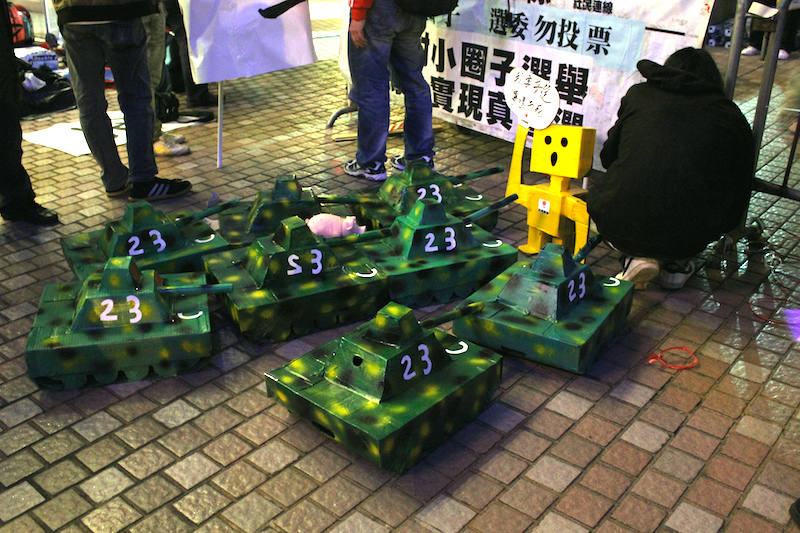

The night before CY Leung was elected, people protested Article 23. (Carmen Bat via Flickr)
Tung Chee-hwa, Hong Kong’s first chief executive and currently the vice-chairman of Beijing’s most important advisory body, said yesterday that mainland China has the legal power to introduce national laws to Hong Kong.
Such laws would include those that Hongkongers fear the most, like those related to security, subversion and sedition – more than enough to make your average yellow umbrella wielder start wrapping cling wrap around their face.
Tung was speaking in response to remarks by Stanley Ng, a local politician and a deputy for the National People’s Congress, who suggested that Beijing should implement such laws, according to the Standard.
The politician said the people of Hong Kong should stop behaving like “outsiders” in their own country and understand the importance of national security, reports the SCMP.
This is no small statement, particularly in the delicate post-Umbrella Movement political climate.
In 2003, hundreds of thousands of people protested Article 23, a section of the Basic Law that enables the city to have its own laws against “any act of treason, secession, sedition, subversion against the Central People’s Government”.
But to this day, no laws have been enacted under Article 23.
“Whether it’s important to legislate, I think the day will come when it will be necessary,” the former chief executive stated, according to Channel NewsAsia.
Tung at least acknowledges that since he’s not “running Hong Kong”, he doesn’t know when this will happen.
“I just have this feeling.” (So do the Black Eyed Peas, Tung.)
He also voiced his support for Chief Executive CY Leung, saying that his criticism of an article published in a university magazine was on point:
“It was necessary […] because national sovereignty cannot be infringed, and national security cannot be compromised”.
CY Leung made a statement to counter the brouhaha over national security laws, insisting that the Hong Kong government has no plan to introduce such legislation.
Secretary for Security TK Lai re-iterated Leung’s point as well.
“Article 23 of the Basic Law has a very clear guideline for the Hong Kong Special Administrative Region to enact the law,” Lai conceded.
“But up to now, we do not have any timetable to enact such piece of law.”
Meanwhile, members of the Basic Law Committee have stepped in and said that such a move would in fact be overkill.
Albert Chen, a committee member and a law professor at HKU, said there was no need for national security laws on top of Article 12.
“Mainland China’s national security laws, like secession and treason, are rather stringent and were probably deemed not applicable to Hong Kong when the Basic Law was being drafted,” Chen told a DBC radio programme on Tuesday.
Elsie Leung, the vice-chairwoman of the Basic Law committee, said today that because Hong Kong’s legal system is so different from the mainland’s, a national law wouldn’t be of much use here.
“The national laws are more constitutional and concern more about principles; whereas comparatively Hong Kong’s legal system needs more solid and clearer [provisions] to define its area and ways of application,” Leung said.
Maria Tam, another committee member, said today that national security laws are only implemented in “extreme” cases like during wars.
In conclusion? Yes, China probably could implement national security laws. But it probably won’t happen… for now.