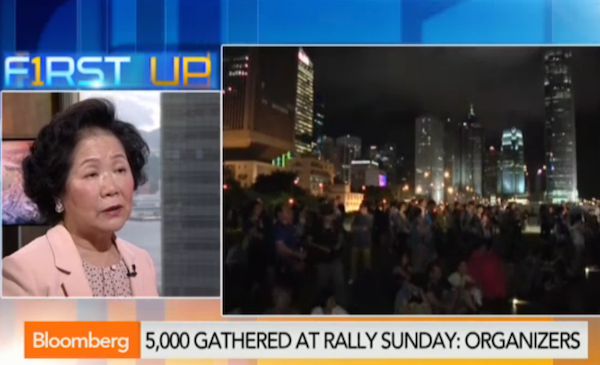

Full transcript of Anson Chan’s interview on Bloomberg Television’s “First Up” show with Angie Lau.
Angie Lau: Anson Chan, she’s former HK chief secretary, one of the most popular figures here in Hong Kong politically and otherwise and really a voice in this movement.
Ms Chan, thank you so much for joining us. What is your feeling on where Hong Kong stands on the precipice of re-joining China, its one country two systems, and yet wanting to fight for democracy.
Anson Chan: I think this latest decision from Beijing is bad from all points of view. For the SAR government, I’m afraid it means that this decision, this ultra conservative decision will only radicalize public opinion, there will be more opposition, more non-cooperation, which will make governance even more difficult. For the Hong Kong public there is a deep sense of betrayal and a sense of no more hope. And from Beijing’s point of view I think it should be worried because the clear message they’re sending to the Hong Kong people is that ‘we don’t trust you, therefore we must pre-screen all the candidates standing for election’. So the world should see this for what this is, that is, a Beijing who is determined to have its way with Hong Kong people.
Lau: Now Hong Kong people have taken a look at their chief executives that are elected by 1200-strong body of not necessarily the average Hong Kong person but everybody from tycoons to business interests and the like and they have not go on so well with the sentiments of the average Hong Kong person. Now many have said that with full suffrage, universal suffrage, that this would change. Do you think so?
Chan: There is no point in having a so-called popular vote if you have no free choice. If all the candidates are screened by Beijing, they are all Beijing’s puppets. And then Beijing says to Hong Kong people: you go and vote. What’s the point?
Lau: But here’s the thing, this is still China, this will revert back into Chinese hands at the end of 50 years. That is a fact. At the end of the day, the person in charge does need to work with China, so a lot of people saying that for the pre-approval process to happen it’s in concert with being able to work with China.
Chan: It comes down to trust. There is absolutely no evidence to suggest that by allowing HK people to choose its leader that his leader cannot work with Beijing. I have no doubt that tomorrow if you allow us to elect our chief executive we will elect a chief executive who on the one hand can work with Beijing but enjoy credibility and support from the Hong Kong public, which is crucial. Nobody in his or her right mind in that post will choose to oppose Beijing at every turn, because the political and socio-economic reality suggests that that will just not work nor will it be supported by the public at large.
Lau: Why does Hong Kong have such a fervent desire for democracy?
Chan: First of all because it’s been promised by Beijing. We’ve been waiting around for nearly 30 years. Now we’ve been handed this ultra conservative decision which rules out the possibility of any democratic candidates being able to obtain the required number of votes. Even if you look at the last selection on with the 1200 committee, CY Leung barely managed to get 57% of the vote. So what chance does any democratic candidate stand? None!
Lau: On a broader view, if you take a look at just what Hong Kong desires, there’s a lot of anger on the ground right now, there is a lot of wealth disparity. What do you fear about the future of Hong Kong and why is democracy a possible solution here?
Chan: I fear that Hong Kong people will just feel that they will just feel they have to take extreme action, they will take to the streets, the will oppose the government at every turn. And furthermore Beijing is mistaken in thinking that anybody elected though this pre-screening will enjoy credibility. This person will not. In the longer term future, the best way to ensure stability in Hong Kong, to win the hearts and minds of Hong Kong people, is to give and to deliver on Beijing’s promise, which is genuine universal suffrage, which means choice and no pre-conditions, unreasonable preconditions set to prevent people from standing. This is what Beijing has promised. It’s failed to deliver.
Lau: Now your group Hong Kong 20/20 is working towards democracy in Hong Kong. Have you heard from business leaders, have you heard form tycoons, have you heard from people who disagree with you as to what they fear Occupy Central movement or protest movement in Hong Kong will mean?
Chan: The business sector is concerned above all about good governance about the ability of the government to make decision, both the popular decision and the not-so popular decisions. For the people at large they want to feel like they are living in a fair society where the concerns of the average man in the street are being addressed and not just the protection of vested interest. It is really ironical for communist party person, an academic, to stand up in public in aspect at the Foreign Correspondents’ Club saying that our prime purpose is to protect business interests. So no change to the election method for the LegCo election and a very conservative set of proposals for the so-called popular election of the CE. It’s just not acceptable.
Lau: When you take a look at just what the democracy movement means in Hong Kong, for the average Hong Kong person, to be able to have once voice one vote and to vote for the candidate of their choosing. Will they stand up? They were about more than 100,000 people who took the streets, there’s millions who live here.
Chan: They definitely will not give up. This time round they feel that the road ahead is going to be even more difficult but I do not think any of us will give up because too much is at stake. We are fighting for our children’s future. We want to maintain our core values and our lifestyle, particular the maintenance of the rule of law and the protection of the rights and freedom that we currently enjoy and that re supposed to be protected by the Basic Law.
Lau: How have you gauged the international reaction? You’ve heard of support from the United States but the British…
Chan: The British I’m afraid have been very disappointing. After all it is the cosignatory to the joint declaration, which they signed with China. So in the light of this set of conservative proposals from Beijing we’re all waiting to see what attitudes, what stance the British government will take. Will it stand by Hong Kong, will it ensure that that the provisions on the joint declaration will be implemented or not?
Lau: But why should anyone care about what happens to Hong Kong?
Everybody should care about what happens to Hong Kong. We are an international city. We have nationals foreign nationals living here, considerably foreign investments, Hong Kong has signed in its own right a whole raft of bilateral agreements with other countries, anything ranging from law enforcement, prevention of narcotics, human trafficking, etc, all these have been signed on the basis that we have a system that is very, very different form the system prevailing in the mainland.
If “one country, two systems” can no longer be relied upon, it places at risk Hong Kong’s ability to honour those treaty obligations. And the rest of the would should also care because if China chooses to walk way from its promises under the joint declaration and international treaty., what does this ay about China’s commitment to all the other bilateral agreements that they’ve signed with other countries.
Lau: And so the fight goes on.
Chan: It will certainly.
Lau: Anson Chan thank you so much for joining us live in our studio today.
Screenshot/Interview: Bloomberg