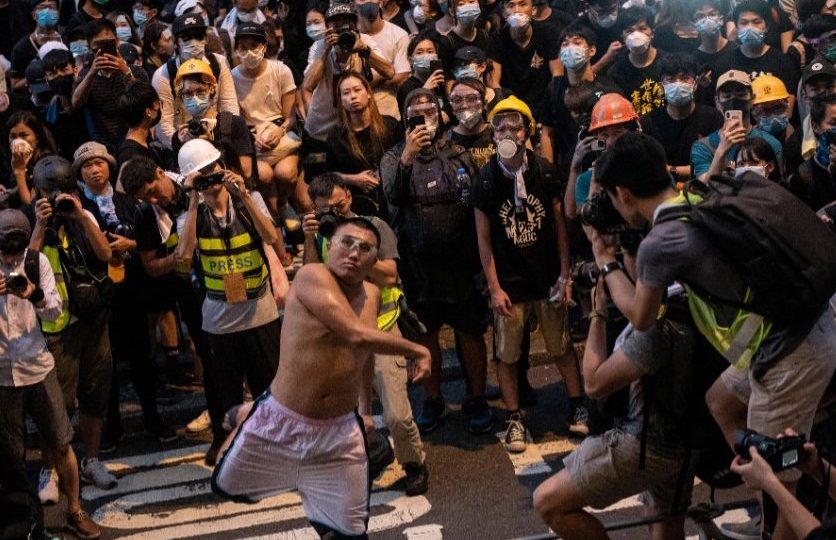

A Hong Kong street artist was charged today with assaulting a police officer and criminal damage, the first prosecution against an anti-government protester since the start of the unprecedented demonstrations that have rocked the city.
Amid widespread concerns over a law that would have allowed extraditions to mainland China, the city has witnessed several huge peaceful rallies, as well as a campaign of civil disobedience, and sometimes violence, from a largely leaderless contingent of younger protesters who have besieged the police headquarters twice and stormed the Legislative Council on Monday.
Authorities have vowed to hunt those behind the unrest that has plunged the city’s Beijing-backed government into crisis.
Pun Ho-chiu, 31, appeared in court on Friday over his alleged involvement in the blockade of the city’s police headquarters on 21 June.
He was also charged with disorderly behavior for throwing eggs at police outside the headquarters during the six-hour siege.
A well-known activist nicknamed “Painter” for his street art, Pun was remanded in custody and faces up to 10 years in jail if convicted.
He was one of the only protesters during the police siege to show himself unmasked.
In court his lawyer said he was assaulted by police, who spoke to him in Mandarin — the predominant language on the Chinese mainland.
The judge said the court could not investigate the claims and directed him to the police complaints procedure.
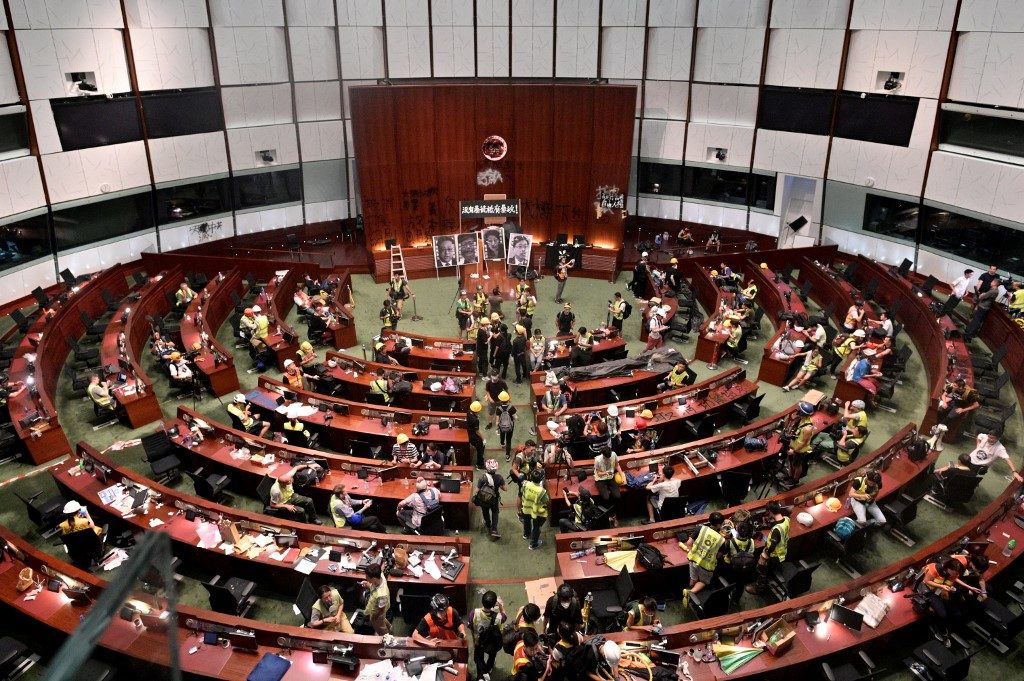
Forensic investigators have been combing through the trashed parliament for fingerprint and DNA evidence to help identify protesters who stormed the building and left its walls daubed with slogans such as “HK is not China” and a colonial-era flag pinned to the legislature’s podium.
Police have yet to release a full tally on how many have been arrested during the month of protests, but dozens have been detained so far.
The unrest presents the most severe challenge to Beijing and Hong Kong’s leaders since the city’s handover to China.
Critics say Beijing has ratcheted up control over the city in recent years, clamping down on dissidents and refusing calls for universal suffrage.
While the current protests were sparked by huge public opposition to the extradition bill, they have since morphed into a broad anti-government movement. City leader Carrie Lam has postponed the extradition legislation but has failed to quell public anger.
Protesters have demanded she withdraw the bill entirely, launch an independent inquiry into police use of tear gas and rubber bullets, and for her to step down.
Meanwhile, university student groups have rejected a request by Lam’s administration for closed door talks, saying they would only meet if the government granted an amnesty to those arrested and held the dialogue in public.
Protests appear set to continue, with activists circulated plans for a new protest on Sunday in Kowloon — an area of the city popular with mainland Chinese tourists who are subject to heavily censored news across the border.
Tonight, a group of Hong Kong mothers are also planning to rally in support of those who ransacked parliament.
Sealing Cheng, an academic at Chinese University and an organizer of the rally, said the young protesters were attacking a symbol of power that is stacked with pro-Beijing appointees and politicians.
“We have to ask the question, who had already destroyed the legislature?” she told RTHK news.