
The last couple of days have seen the rhetoric heating up between the UK and China as the row about how far Britain will involve itself in Hong Kong’s affairs rages on.
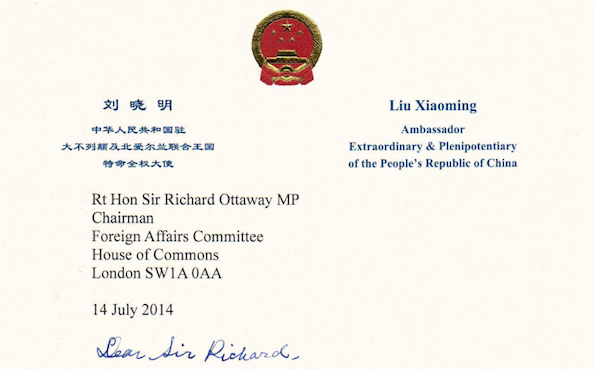
The British Foreign Affairs Committee yesterday published three letters from Chinese officials, all of which strongly urged the group to shelve its plans for an inquiry into the transfer of sovereignty over Hong Kong to China, which was launched in July.
The first letter from Liu Xiaoming, the Chinese Ambassador, says such a move would not facilitate the advancement of political reform in Hong Kong and could harm the “healthy development of China-UK relations”, which doesn’t sound like a threat at all.
He also points the finger at “some people in Hong Kong” who are “attempting to ditch the Basic Law” and have “made every effort to seek external support. If we were in any doubt as to who these “some people” are, Liu later names democracy activists Martin Lee and Anson Chan as those who are “bent on undermining the prosperity and stability of Hong Kong”, and who would ultimately benefit from the signal an inquiry from Britain would send to the world.
Erica Ng, Director-General of the Hong Kong Economic and Trade Office in London, echoed such concerns in another letter, casually mentioning the so far “cordial” relationship between Hong Kong and the UK, before asserting that “Matters such as constitutional development and domestic economic and social developments, however, are clearly internal matters for the Hong Kong Special Administrative Region”.
Finally, in a letter from the National People’s Congress of China to the Foreign Affairs Committee, the fact than Martin Lee and Anson Chan were invited by the committee to speak on the subject of political reform in Hong Kong was described as “highly inappropriate”, prompting “grave concern” in China.
The letter again asserts that the UK should mind its own business, for want of a better phrase, and claims that despite differing opinions on the exact meaning of universal suffrage, “the mainstream view” is that Hong Kong’s CEO must be a person who “loves the country”.
Beijing has since said in a statement that, although it’s not going to happen this time – sorry guys, the “the ultimate aim is the selection of the Chief Executive by universal suffrage”.
The British Foreign Office said China’s decision to have all CEO candidates vetted by a pro-Beijing committee in the 2017 elections would “disappoint democracy campaigners”, but also kind of accepted it.
“We welcome the confirmation that China’s objective is for the election of Hong Kong’s Chief Executive through universal suffrage,” it said in a statement. “While we recognise that there is no perfect model, the important thing is that the people of Hong Kong have a genuine choice and a real stake in the outcome,” it added.
And although this may seem like a TOTAL a climb down, Chairman of the Committee Sir Ron Ottaway did confirm that the inquiry will go ahead, although apparently without any focus on “internal affairs”.
“What we are investigating is the FCO’s ongoing assessment of the implementation of the 1984 Sino-British Joint Declaration, under which sovereignty over Hong Kong was transferred to China. That is part of our role in oversight of the Foreign and Commonwealth Office, and it is an entirely legitimate interest of the Committee,” it said in a statement.