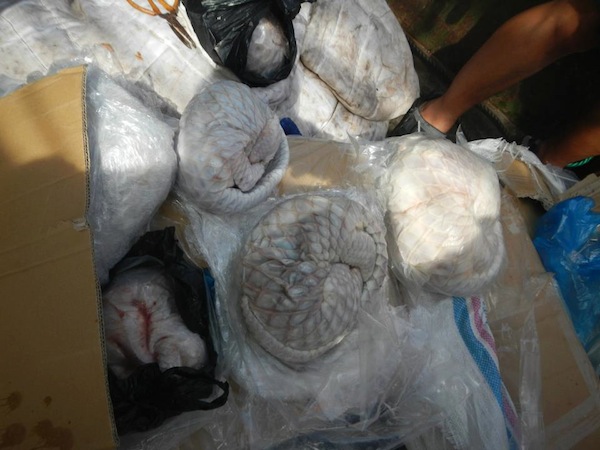

Thousands of poached and frozen pangolins were found on an illegal Chinese fishing vessel near Palawan, Philippines in 2013. Photo: Friends of Tubbataha Facebook page
Eating rare species is now a criminal offense in China. Last week, members of China’s top legislature body passed a reinterpretation of the country’s criminal law, publicly announcing that eating and trading rare animals will result in up to 10 years jail time.
This is an unprecedented step in a country where bear bile, pangolin soup, tiger bone and rhino horn are ingested widely as both delicacies and traditional medicine.
Following its bi-monthly meeting last Thursday, The Standing Committee of the National People’s Congress (NPC), voted in favor of the new interpretation, which protects 420 species, including: giant pandas, pangolins, Asian black bears and golden monkeys.
Official state media mouthpiece Xinhua reported the news shortly after the meeting quoting Lang Sheng, deputy head of the Legislative Affairs Commission of the NPC, who acknowledged that consuming endangered species is bad social conduct and is a main reason illegal hunting has not been quelled. The government news agency also said that “up to now those involved in these practices went unpunished”.
This is the latest in a series of government conservation efforts that echo a change in public sentiment in China, spearheaded by informational campaigns featuring celebrities and wildlife organizations. Basketball star Yao Ming, for example, has been publicly denouncing the long-standing tradition of serving shark fin soup at important banquets, and actress Li Bingbing has done the same for the ivory trade. As a result, the Chinese public has taken to Sina Weibo — the country’s version of Twitter — and other social media outlets to express their qualms with the country’s consumption of endangered animals.
As a result, last year the government pledged not to serve shark fin soup at official functions, and in January burned a portion of its ivory stockpile. The decision to publicly reinterpret the law may also be a product of China attending the first ever World Wildlife Day United Nations General Assembly conference in London on March 3, and signing a declaration to protect endangered species.
This story originally appeared on the website for Annimiticus, an educational nonprofit organization which is working to stop the economic exploitation of endangered species.
Story: Alexandra Andersson
RELATED:
1,600 pandas at 10 Hong Kong landmarks to promote conservation
Philippine Coast Guard finds frozen pangolins on grounded Chinese vessel
Chinese fisherman may face increased charges for trafficking pangolins