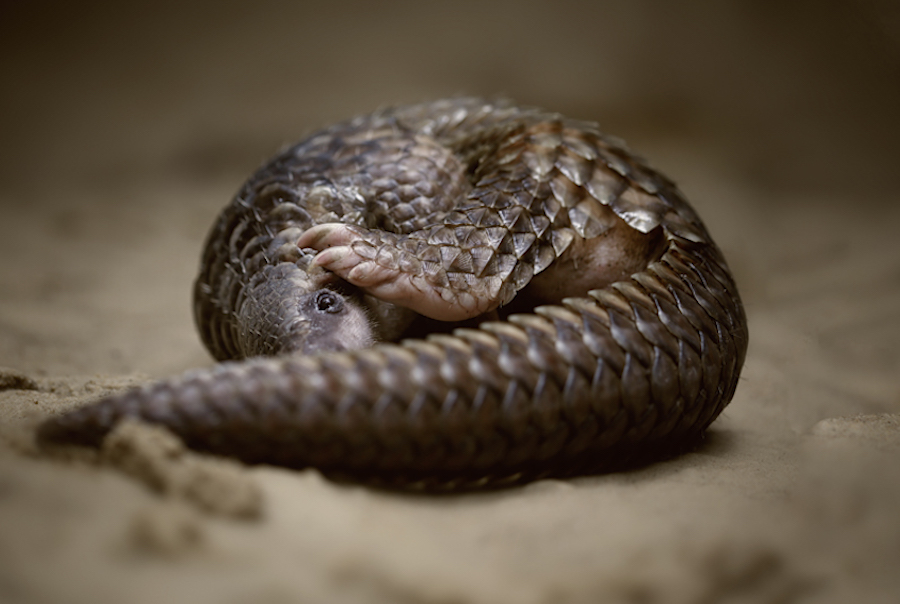

Don’t know what on earth a pangolin is? You’re not alone.
It’s a small, adorably weird anteater with scales covering its body – and it’s quietly being consumed into extinction. While the world’s eyes are trained on elephants and rhinos, the pangolin may well become extinct before most people even knew it existed.
To rectify this, a pangolin awareness campaign, spearheaded by Humane Society International (HSI), was launched on Saturday in Mong Kok. To add to the streets’ colourful characters, a seven-foot pangolin named “Pan Yao” spent the day getting to know people, distributing fliers and lying down in a pool of fake blood (you know, for dramatic effect).

Pangolins are the world’s most traded mammal, with well over one million traded in the last decade, according to the International Union for the Conservation of Nature (IUCN) Pangolin Specialist Group. That’s far too many for a creature that is very solitary and only reproduces about once a year. Much like many wild animals being traded into oblivion, the body parts of pangolins, particularly the scales, are thought to have medicinal properties in traditional Chinese medicine.
Around 85 percent of Hong Kong people believe pangolin scales have healing qualities, and they are thought to cure a wide array of ailments, including rheumatism, eczema, cancer and impotence, according to the results of a market survey conducted by HKU and HSI. Of course, Western science has yet to prove that the scales made of keratin – the same substance as your fingernails and hair – have such properties.

Confusingly, four out of the eight pangolin species found around the world are legally traded. The four Asian species however, are protected, since there are pretty much none left.
Sunda Pangolins, found in Vietnam, Thailand, and Indonesia are classified critically endangered by the IUCN, as is the Chinese Pangolin, found in China and Hong Kong (yup, you may encounter one on your next hike!).
This muddied legal landscape has opened up vast opportunities for wildlife trade criminals to establish a thriving black market, as seen in the regular seizures of vast illegal shipments of smuggled pangolin. Hong Kong Customs has intercepted over 5,000 kilos of pangolin scales in the last 18 months – that’s a lot of pangolins when you consider that their average body mass is only 2-30 kilos.
The HKU survey also shows that over a quarter of the public (27 percent) are unsure or think it is legal to consume pangolin meat (it is totally illegal, people!), and almost half (49 percent) are undecided or think it is legal to purchase scales.
The campaign hopes to inform, educate and empower people across the region to make responsible consumer choices – and save this unusual species before it’s too late. Campaign leaders (which include local group Hong Kong for Pangolins) also launched a petition to ban the pangolin trade completely, in order to eliminate the loopholes that the current dual-market system leaves wide open.
“Since Hong Kong Customs intercepts huge hauls of scales on a regular basis, and we actually have a native population in the country parks, I think it is important that the plight of the pangolin gets more publicity – before its too late,” said Alexandra Andersson, the Hong Kong rep for HSI.
Coconuts TV is also championing the cause of this charming critter, with a documentary on its plight in the works this very moment – stay tuned!
Header photo: Simon Jenning
Body photos: Humane Society International