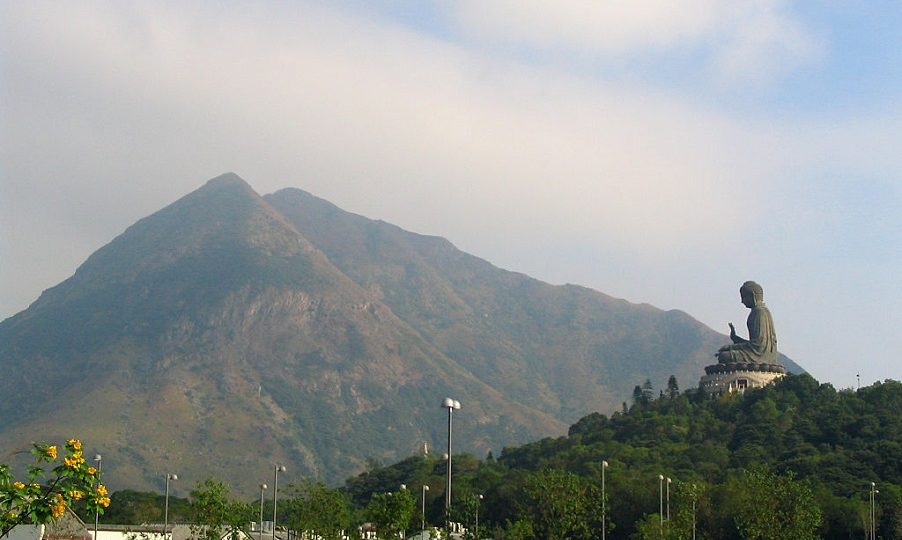

An outbound Air China flight narrowly avoided crashing into a mountain on Lantau Island after veering off-course yesterday night.
Flight CA428 made an early turn towards Lantau Island two minutes after departure at an altitude of 3,400 feet, deviating from the normal path (pictured in pink). Air traffic control immediately ordered the aircraft to turn away to avoid crashing into the 2,519-feet-high Big Buddha statue and 3,066-feet-high Lantau Peak ahead, Apple Daily reports.
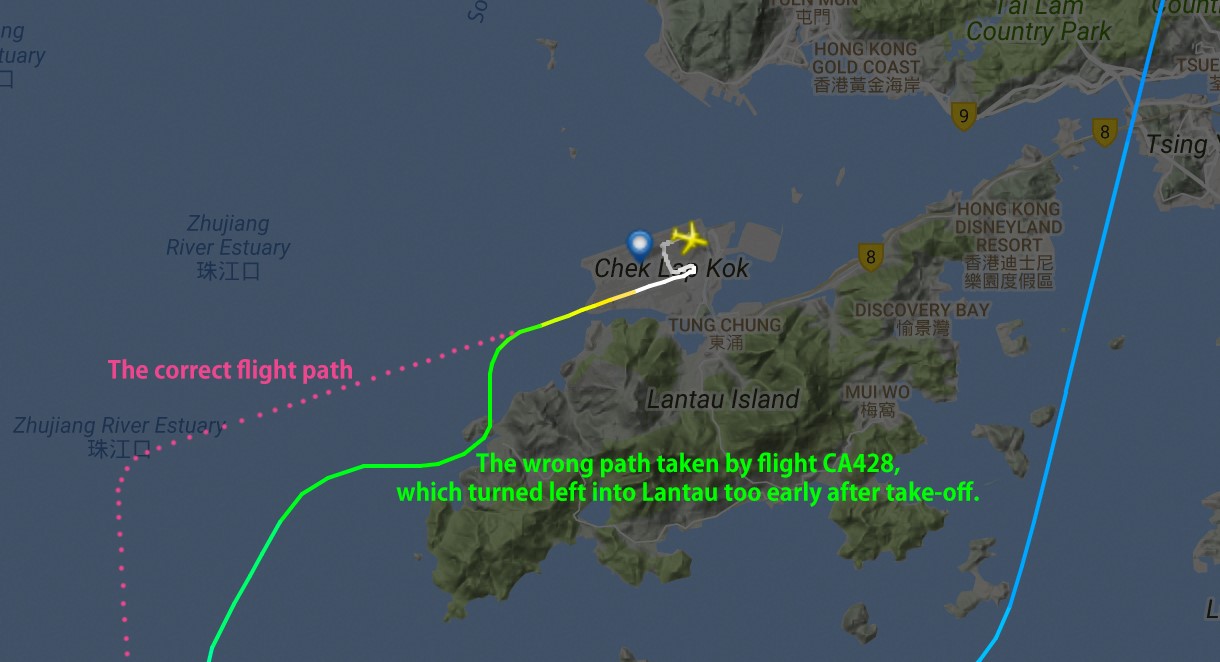
Plane-tracking site Flightradar showed that the Chengdu-bound flight turned left towards Tai O and the Big Buddha statue at around 9.30pm. In audio between the airport’s control tower and Flight CA428 that was obtained by Apple Daily, an air traffic controller can be heard saying, “Air China flight 428, expedite climb, terrain ahead, terrain alert – expedite climb passing 5,000 feet – expedite”.
The aircraft managed to make a right turn at 3,650 feet and eventually landed safely in Chengdu at 11:21pm.
According to Civil Aviation Department (CAD), aircrafts making the same journey as Flight CA428 should fly straight ahead upon leaving the airport and only make a left turn midway into the Pearl River Estuary, roughly 7 nautical miles from the runway.

Under CAD regulations, the minimum safe altitude requires planes to fly 1,000 feet above the highest terrain within a 46 kilometer radius, meaning that the minimum safe altitude above Lantau is 4,300 feet. In layman’s terms, Flight CA428 was not at a safe altitude.
Civic Party lawmaker and licensed pilot Jeremy Tam told the SCMP that the incident could have been “quite serious” if the plane had been flying at a lower altitude. “If the frontline air traffic control officer had not corrected the pilot in time, the plane would have kept flying towards the Big Buddha and Lantau Peak.”
Tam told Ming Pao that the incident highlights the importance of a functioning and “precise” Air Traffic Control System, and referred to occasions when the ATCS temporarily lost information on the positioning and altitude of flights as “serious”. The current ATCS has notably suffered multiple glitches since its debut in November 2016.
Last June, a Shenzhen Airlines flight took a “detour” of sorts while approaching the runway at Hong Kong International Airport, and unexpectedly veered off course to fly over the Big Buddha at about 3,000 feet. It narrowly escaped a collision with a departing plane which was also at 3,000 feet.