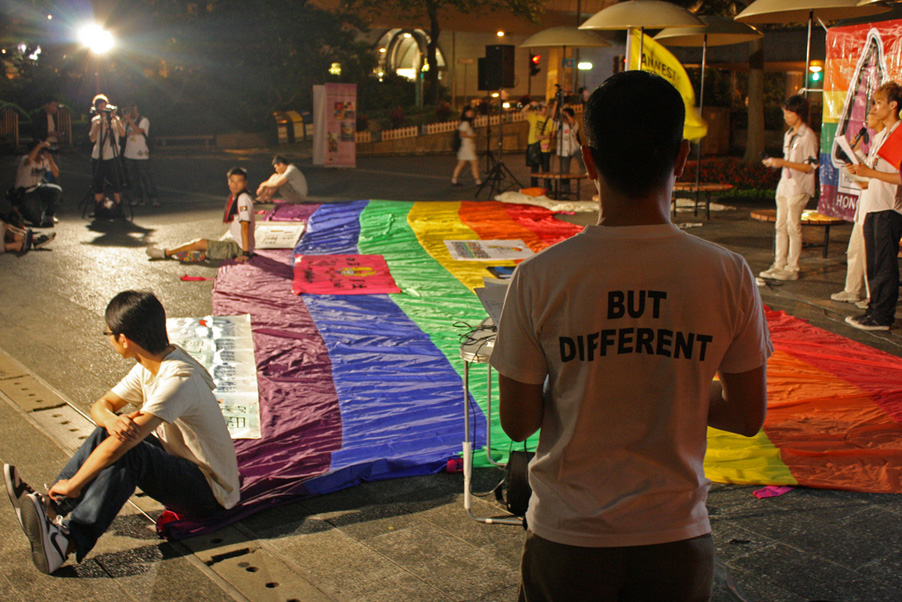

The ruling by the United States Supreme Court on June 26 that legalised same-sex marriage was significant for a variety of reasons. The landmark moment in civil rights history somewhat set the world on fire, or rather painted it in a cascade of rainbows.
The conversation has inevitably drifted here to Hong Kong, where polarised commentators continue to debate about Hong Kong’s future with regards to marriage equality.
Recently, the head of Hong Kong’s Equality Opportunities Commission Dr. York Chow stated that the issue of addressing same sex marriage in Hong Kong is inescapable, and that more discussion is required to make this elusive civil right a reality.
It’s easy to think that Hong Kong’s LGBT community may be able to capitalise on the Supreme Court’s landmark decision considering that the U.S. is one of the most influential countries in the world. But Hong Kong is not the United States.
The city’s politics are unique unto themselves, and with an issue such as LGBT rights, it is of paramount importance that equality comes not simply as a knee-jerk reaction to international good vibes. The city’s history, culture and people must all be considered when debating this issue and making future decisions.
LGBT rights are a divisive issue in Hong Kong, and have been for quite some time. Homosexuality, specifically sexual intercourse between men, was historically referred to as “buggery” in legal codes, such as in the Offences against the Person Act of 1861, under English Law. Buggery was a crime that carried with it a potential penalty of life imprisonment, and left openly gay couples vulnerable to suspicion and possible prosecution.
These laws emerged in part due to a strong cultural aversion to homosexuality from the local Chinese populace, writes Carole J. Petersen in her paper “Values in Transition: The Development of the Gay and Lesbian Rights Movement in Hong Kong.” The local culture lent support to the laws implemented by the British government.
From that point until the handover in 1997, controversial issues have marred this city’s history with LGBT rights. In response to a high profile sexual misconduct case involving a well-known English solicitor, the Hong Kong police force established a Special Investigation Unit in the 80s, primarily to investigate homosexual activities. The effort was dubbed “Operation Rockcorry” and led to several arrests.
In 1980, police inspector John MacLennan committed suicide amid alleged persecution from the police hierarchy over charges of indecency and homosexuality. Despite the body being discovered with five bullet wounds, a government inquiry concluded that MacLennan did indeed kill himself, as he was fearful of his impending arrest.
Even the major landmark of decriminalising homosexuality in 1990 was achieved in part because the government threatened potential opponents of the bill with intensified enforcement of buggery law and possibly instituting a witch hunt to identify those who didn’t enforce it.
Although 1990 might seem like eons ago, anti-gay sentiments in Hong Kong are not something we can yet look back on and shake our heads at. Less than a decade ago in 2006, a survey conducted by the Home Affairs Bureau showed that it was still a contentious issue among the public. Forty-nine percent of respondents said that homosexuality conflicted with family values, and almost 40 percent insisted it conflicted with community values.
Seven years later in 2013, an article published by Rebecca Stotzer and Holning Lau on the subject of sexual orientation-based violence in Hong Kong showed that almost 70 percent of LGBT respondents had experienced this in some form. The authors urged the government to do more to address this type of violence across all levels of society.
Go beyond the statistics and you will find real human cases that show how much further the city has to go, both culturally and in the courts.
In 2013, the Court of Final Appeal ruled that a transgender woman could marry her boyfriend, concluding that she should be treated as a person of her chosen sex.
However, the Marriage (Amendment) Bill, submitted in March 2014, which would legalise transgender marriage, was full of holes and legal ambiguity, and was voted down by the Legislative Council in October of the same year.
Three months ago a gay woman challenged the government in a legal case after her U.K. civil partnership was not recognised, meaning she was unable to get a dependent visa to work or access basic medical services in Hong Kong. In the end, the woman was offered a dependant visa by an immigration officer but only due to “humanitarian concerns”.
And just last month, two women verbally savaged openly gay lawmaker Ray Chan on the MTR. The widely circulated video of the incident is explicit and troubling, a startling and extreme reminder that discrimination and hate still exist today.
Hong Kong’s LGBT residents “continue to face alarming levels of discrimination and harassment in society”, insists Tommy Chen, a spokesman for Rainbow Action Hong Kong, in an article by CNN.
However, by no means does this represent the majority opinion of Hongkongers today. Rather, this city has made remarkable progress over the last 20 or so years to become more tolerant and accepting.
What is different now is that despite the existence of prejudice and discrimination, there is a strong pro-LGBT movement in Hong Kong. A survey conducted by the Equal Opportunities Commission in 2013 showed the public demonstrated a general positive attitude towards equal opportunities, with at least 60 percent supporting the implementation of legislation against discrimination based on sexual orientation.
Last year, a paper published by the Centre for Comparative and Public Law from the Faculty of Law at the University of Hong Kong showed that the majority of Hongkongers hold generally favourable views of homosexuals, with only 20 percent disagreeing with the idea of adding discrimination legislation.
A modern wave of gay-rights activism has also taken root, spurred by groups such as Rainbow Action, which works towards raising public awareness and pushing for equality legislation. And since 2008, Hong Kong Pride Parade has organised an annual march, which drew close to 9,000 people last November.
So here is where we stand now. Hong Kong is a city in which a wave of pro-gay sentiment has done its part to help smooth over our troubled past. However, the controversial and taboo nature of the subject matter continues to stall lawmaking.
The government has attempted to tackle transgender marriage and workplace discrimination in government employment, but the situation in the private sector remains pervasive and unregulated, and the potentially momentous marriage bill is yet to be seen.
It’s an unsettling dichotomy that will no doubt boil over into open conflict in forums or the courts at some point, when one side makes a sizeable push to advance their agenda.
While we must consider the cultural reality of the city in which we live, we must also consider the legal reality as well. Equality is indeed something that is enshrined in Hong Kong’s Basic Law, and in this modern age, the passing of LGBT legislature seems more like an inevitable certainty than a far off fantasy.
At the end of the day, a decision will have to be made.
Those who fight for gay rights must respect the traditional culture and values that people who disagree with them hold, but those who oppose gay rights must also respect the principles of equality and love – the concept that every Hongkonger is entitled to live as freely as their neighbour.
Photo: Marco Repola via Flickr