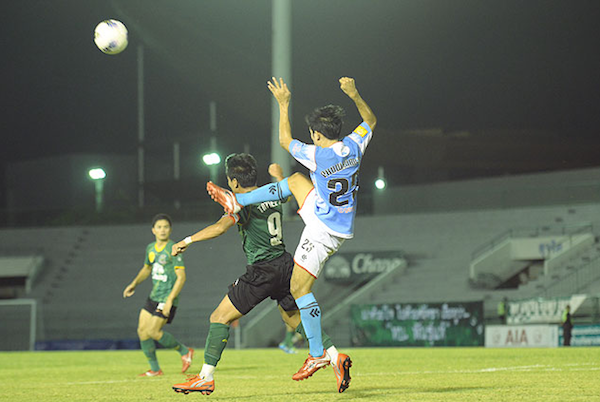

Army FC plays a match in front of an empty stadium.
The huge rise in attendances at provincial clubs in the Thai Premier League has masked the apathy, at best, felt towards the beautiful game in Bangkok. To put it in perspective, the combined average attendance of three capital Thai Premier League clubs – Police, Bangkok United, and Army United – is over a thousand less than that of struggling and coachless provincial club Chiang Rai United.
Last season BEC Tero had a perfectly placed Thephasadin Stadium 200 metres from a Skytrain station and next to huge shopping and eating venues. Their crowds flatlined and, partly as a result, they moved to the suburbs in the hope of attracting a support base. But choosing a traffic vortex with little housing has seen a good team rattling around in a twelve thousand capacity stadium that is rarely even half full. It worked well for SCG Muang Thong United who, ironically, moved from the current Tero neighborhood of the infamous Nong Jork (no, the Futsal arena is still not finished) to an increasingly populated suburban area. They showed how fan bases can grow exponentially combining the heady brew of success, finance, and stability. Ironically, less than two kilometers from the Quillins’ base in the Impact Arena complex, TOT (the Telephone company of Thailand ) have very poor support; but that is partly due to their name.
TOT’s problem is shared with other clubs like Army United, Police United and Air Force United. Either the names have no local connection or are too localized. Added to TOT’s marketing issues, they are known as “The Hello Boys,” which seems geared to attract a very niche football market. When thinking of what to call Bangkok Glass, Chairman Pawin Bhirombhakdi decided against calling themselves Pathum Thani (the northern Bangkok area where they are based) as it was too parochial. Army, based nearer the centre of Bangkok, have a loyal but relatively small crowd ( their average attendance this season is just under 4,000, making them the tenth best supported TPL team) whereas Police, exacerbated by their beautiful but cavernous (and often cavernously empty) Thammasat Stadium get less than 3,000 fans on average, leaving 22,000. For anyone stopped at traffic lights by Bangkok’s finest in order to extort a spurious fine, it’s also difficult to go on to support them on the football field.
Considering this is a football crazy country, the lack of marketing in The Big Mango is disappointing. The national meccas of shopping malls would be perfect platforms to promote the game. Individual savvy clubs like Bangkok Glass have their own media companies who work independently, but there is no overarching profile for Thai football. They have some excellent assets of charismatic players who speak English that they fail to utilize. A meet and greet session with Bangkok Glass captain Leesaw, Suphanburi’s Welsh and Thai Mika Chunuonsee and national goalkeeper Kawin Thamsatchanan at the mecca of Siam Paragon would set young female hearts aflutter and enormously raise the profile of the game.
Like any major city, there are a huge range of things to distract the potential fan. But that is also the case in London. Whilst you are more likely to forgo The Tate Modern for Tottenham than the Temple of Dawn for TOT, there is a high percentage of potential fans that simply don’t know about how to follow the game here. Of course there is also the huge pull of watching the EPL and the burgeoning Bundesliga, but a failure to address the quality of match officials, poor player discipline, and an acceptance of time wasting, diving, and fake injuries mean that, like any consumers, fans vote with their feet. Thai football seems to run by different rules, where quick free kicks are forbidden, players can take elective time outs on stretchers and diving is rarely punished by sanctions. These do not attractive Unique Selling Points make.
None of these issues mattered when we watched the game five years ago. We were a splinter group enjoying the trappings of a match day and time with our friends. We laughed at the ineptitude on display, we shrugged off turning up to games only to find the time and venue had changed without warning. But, if the sport in the capital city is to be taken seriously, it has to take itself seriously first. Thais love their soap operas and even the biggest matches still cannot knock them off their scheduling perch. To do so, Thai football needs to act less like the screeching stereotypes and pantomime villains of a soap and provide something different, more meaty. Otherwise, the free farce on the TV screens will always trump the same experience seen live.
This story originally appeared on Thai League Football.