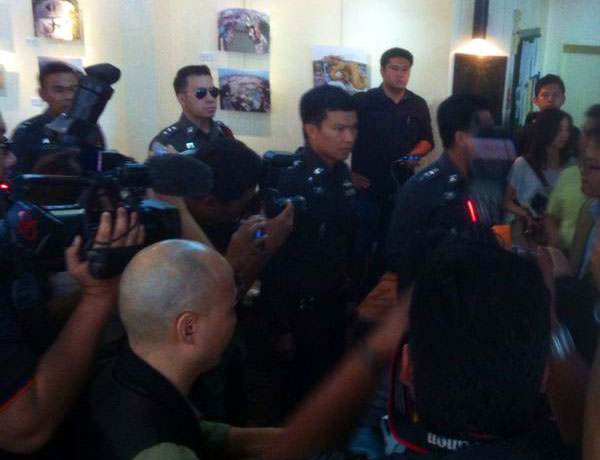

ABOVE: Police enter Foreign Correspondents Club of Thailand on Tuesday, Sept. 2 to request the cancelation of a human rights panel discussion. Photo: @Steve Herman
The United Nations said Wednesday it was “seriously concerned” about growing restrictions on human rights activists in Thailand after a string of curbs on freedom of expression in the junta-ruled nation.
Since seizing power from the elected government in May, the Thai army has stifled dissent by hauling in anti-coup protesters, muzzling the media and threatening those found in breach of martial law with trial in a military court.
The UN Human Rights Office for South-East Asia (OHCHR) pointed to “a deteriorating environment for human rights defenders” a day after activists said they scrapped a debate about access to justice since the coup due to pressure from the junta. “(The OHCHR) is seriously concerned about increasing restrictions on human rights defenders in exercising their rights to peaceful assembly and expression in Thailand,” it said in a statement, calling on the country to honor its international human rights obligations.
On Tuesday, authors of a report on rights in Thailand since the coup said they received phone calls from military officers warning them against holding a discussion at the Foreign Correspondents’ Club of Thailand on the subject, as it could be in violation of a ban on public gatherings. Authorities also issued a letter in which they “asked for our cooperation” in canceling the talk as “the situation is still abnormal,” said Pawinee Chumsri of The Thai Lawyers for Human Rights, who organised the event alongside Amnesty International Thailand and the Cross Cultural Foundation.
Anti-coup protesters have been detained, arrested and in some cases charged for opposing army rule. Symbolic public readings of George Orwell’s anti-authoritarian novel 1984 and the three-fingered salute from the Hunger Games movies were common in the weeks after the military takeover. But public acts of resistance have since become more sporadic.
Junta chief Prayuth Chanocha, who was endorsed as prime minister two weeks ago, said he was forced to take power after months of protests against ex-premier Yingluck Shinawatra’s government left 28 people dead and hundreds more wounded. He has ruled out holding new elections before October, 2015, despite international appeals for a return to democracy, vowing first to oversee reforms said to be aimed at cleaning up politics and society.
Story: AFP
Police came to @FCCThai to request organizer cancel human rights report release/panel. pic.twitter.com/YDDCijyZTE
— Steve Herman (@W7VOA) September 2, 2014