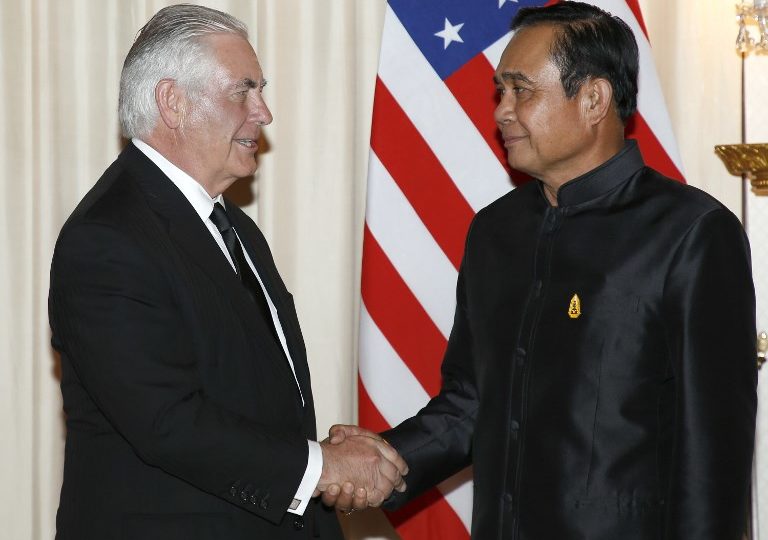

U.S. Secretary of State Rex Tillerson landed in Bangkok on Tuesday with a plea to the kingdom to curb business ties with North Korea, as Washington rounds up allies for its bid to halt Pyongyang’s nuclear ambitions.
Tillerson is the highest level American diplomat to visit Thailand since a 2014 coup strained ties between the longtime friends and saw China cozy up to Bangkok with massive military sales and infrastructure deals.
Thailand is one of a raft of Southeast Asian countries that hosts a North Korean embassy and enjoys valuable bilateral trade with the reclusive regime.
In 2014, the two countries shared trade worth USD126 million (THB41 billion), according to Thailand’s Ministry of Foreign Affairs, nearly a threefold increase since 2009.
America’s top diplomat will press Thailand to crack down on North Korean firms that open fronts in Bangkok and use the capital as a trading hub, said acting U.S. Assistant Secretary of State for East Asian Affairs Susan Thornton.
He will also lean on the kingdom to tighten visa requirements for North Koreans entering Thailand and squeeze its diplomatic mission, Thornton added.
Tillerson’s one-day visit follows a regional forum in Manila, where the former ExxonMobil CEO hailed a tough new UN sanctions regime on North Korea over its growing nuclear arsenal.
Those sanctions could cost North Korea $1 billion a year.
They were levied — with the agreement of North Korean lifeline China — in response to the launch of two intercontinental ballistic missile tests last month.
Ups and downs
The U.S. envoy will also urge Thailand to take in more North Korean refugees, said Thornton.
The kingdom has long been a transit route for defectors who make the arduous journey through China, then into Laos or Cambodia and Thailand, where they seek sanctuary at the South Korean Embassy.
Thailand does not grant official status to refugees.
After landing in Bangkok Tillerson, who visited Thailand often as an executive for ExxonMobil, told U.S. embassy staff he wanted to “grow” the relationship between America and its oldest Asian ally, “even in its ups and downs.”
President Donald Trump’s administration is reshaping America’s approach to the Thai junta after relations hit the buffers following the 2014 coup.
The U.S. condemned the takeover and distanced itself from the regime, trimming back military aid.
But relations are on a better footing under Trump, with the U.S. president extending an invitation to junta chief Prayuth Chan-ocha.
The thaw also comes amid Washington’s growing concerns over rival superpower China’s clout in the region.
Beijing entices its smaller neighbors by offering massive investment decoupled from human rights concerns, which appeals to leaders weary of U.S. pressure.
Thailand is a lynchpin country in China’s massive trade and infrastructure “One Belt, One Road” strategy.
It was not immediately clear how firmly the former oilman would push the junta government on its crackdown on political rights.
“The U.S. wants Thailand to emerge as a strengthened democracy that respects and guarantees human rights and fundamental freedoms,” said U.S. embassy spokesperson Steve Castonguay.
Tillerson is also due to pay respects to Thailand’s late King Bhumibol Adulyadej, who has been lying in state at the Grand Palace since his death in October 2016.
Later he will travel to the Malaysian capital.