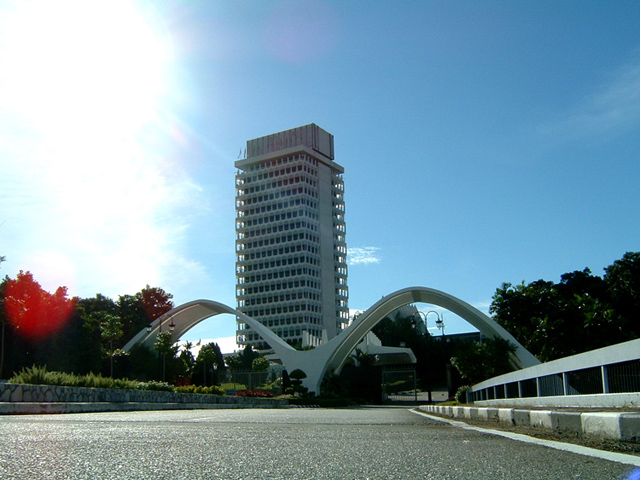

Malaysia’s Houses of Parliament
It was billed as a possible watershed in Southeast Asian politics, the moment when a generation of twittering youths and affluent cosmopolitan voters would flex their collective muscle and boot the tired old incumbents out of office.
This past Sunday, Malaysians collectively headed to the voting booths to cast their ballots in a countrywide general election. Stakes were high. The Barisan Nasional (BN), the ruling coalition of political parties which has run the country for 56 uninterrupted years, seemed at dire risk of finally seeing its stranglehold on Parliament give way to the upstart People’s Alliance (Pakatan Rakyat), led by the charismatic and controversial Anwar Ibrahim. In the run-up to Sunday, analysts were pegging it as the closest and most consequential vote in Malaysian history.
The underlying rationale for such contentiousness is fairly self-evident. Despite strong economic growth over the past few years, turns out (shockingly!) that a lot of Malays are fed up with high levels of income inequality, rampant corruption and a heavily rigged political system. With the opposition expertly deploying new forms of social media (Facebook, Twitter etc. etc.) to get out the message and build up grassroots support, more and more Malays looked set to turn against the ruling coalition, potentially ushering in an historic change.
Well…with due apologies to Malaysia’s youthful digital demographic, it didn’t exactly turn out that way.
Late Sunday night, news broke that the ruling BN held its majority in Parliament, returning incumbent PM Najib Razak to yet another term. Amidst the inevitable heartbreak, disappointment and bitterness, here are a few key takeaways in the aftermath of the 2013 general election.
The Great Divide
Despite prevailing in a hotly contested campaign, the BN inherits what may well be a poisoned chalice, with the country looking ever more polarized along geographic and socio-economic lines. While the opposition failed to win control of the government, it did improve on its position from the last general election, finishing with 89 Parliamentary seats against 82 in 2008.
In yet another positive development for the opposition, amidst 84% voter turnout, Anwar and his allies managed to win the overall popular vote. This has never happened before in the history of Malaysian elections and bodes ominously for the BN going forward. Electoral shenanigans aside, it is an undeniable fact that more Malaysians now prefer the opposition to the ruling party.
And while there are certainly no medals for second place in Malaysian elections, the People’s Alliance must be commended for performing quite strongly against a well oiled political machine built up over multiple decades via a combination of rigged elections, a heavily pro-regime mainstream media, periodic repression and corrupt cronyism. Unless the BN can fight its way back into contention amongst the growing mass of digitally wired middle class urbanites, it could be an even bumpier ride in the next general election.
The Chinese Tsunami
The Barisan Nasional operates as a tripod, composed of three ethnocentric political parties (representing Malays, Chinese and Indians respectively) working together in a Machiavellian alliance. The largest and most influential leg of the pod is unquestionably the United Malays National Organization (UMNO), who have built their core political platform around a system of preferential treatment for ethnic Malay “bumiputera” (sons of the soil).
While many rural Malays love and loyally support the system as it exists, the Chinese and Indian minorities are less than thrilled with this unfair (read overtly discriminatory) state of affairs and are increasingly making it known. The Malaysian Chinese Association (MCA), the Chinese leg of the BN tripod, has been hemorrhaging support to the opposition Democratic Action Party (DAP) over the past several years. That development only magnified on Sunday, turning into what PM Razak described as a “Chinese tsunami” of opposition votes.
Events on the ground may get ugly real fast
Long renowned as the consummate political showman, Anwar went on record before the poll stating this would be his final campaign. Now, after coming up a bit short, he is not going down without a fight. The opposition is alleging massive fraud took place on voting day and Mr. Anwar yesterday announced he will be contesting the final outcome in over 30 electoral districts, claiming that “the government has lost its legitimacy.” As an added bonus, the opposition also plans on holding mass rallies in hopes of pressuring the government into handing over power.
This is hardly surprising, seeing as the whole of the democratic process in Malaysia has never been regarded as terribly “free” or “fair.” The problem now is how the government responds to pressure from the street. PM Najib has been sworn in for yet another term and many rightwing Malay nationalists would be more than happy to crack a few opposition heads in the hopes of getting their point across.
By now it is pretty well established that the government is no big fan of large-scale opposition protest movements calling for a comprehensive overhaul of the existing political system. In fact, the recent precedent here is more than a bit troubling. When democracy activists got a little too uppity in 2011, mobilizing in mass under the Bersih movement for clean and competitive elections, they were systematically tear-gassed and beaten by the state security apparatus. If the opposition keeps making a big stink about Sunday’s outcome, a repeat of 2011 is possibly in the cards.
So, while the election may be in the books, its outcome is still very much in dispute.
Stay tuned, as this drama may still be in its early stages.