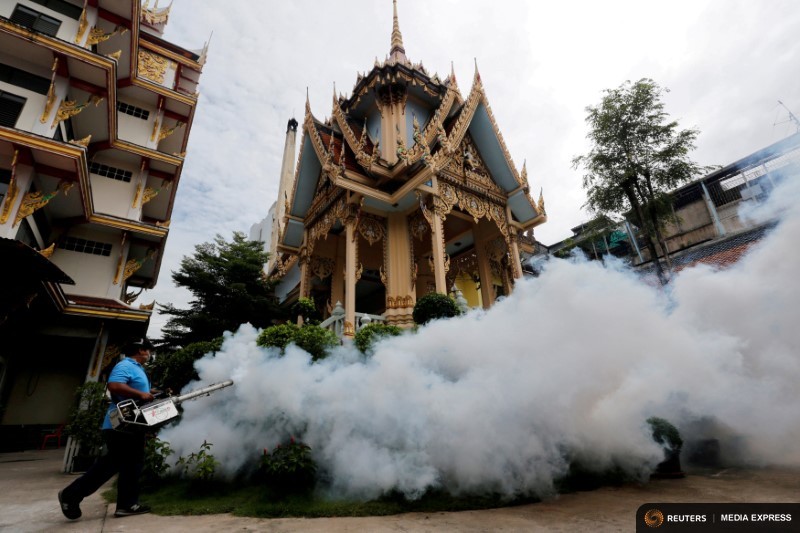

Predominantly Buddhist Thailand will relax its strict rules against abortion to cover fetuses with birth defects linked to Zika, health officials said yesterday, allowing the procedure up to 24 weeks.
Thailand last week confirmed its first known cases of microcephaly linked to the mosquito-borne virus. The two cases of the birth defect marked by small head were the first seen in Southeast Asia, following Zika outbreaks in the Americas.
Health experts concluded that abortions can be carried out at up to 24 weeks in cases of serious birth defects.
“The difficulty with Zika is to determine microcephaly. It is usually found later in pregnancy,” said Pisek Lumpikanon, president of the Royal Thai College of Obstetricians and Gynecologists, adding that legal medical abortions can be done up to only 24 weeks as babies have a good chance of survival after that.
Abortion is illegal in Thailand, except in cases of rape or to save a woman’s life or preserve her health, and if carried out within 12 weeks of pregnancy. Beyond that time, hospitals must decide on a case-by-case basis.
There are no specific tests to determine if a baby will be born with microcephaly but ultrasound scans can identify it in the third trimester of pregnancy, the World Health Organization says. Thailand said it is considering testing all pregnant women for Zika.
The country has confirmed 392 cases of Zika since January, with 39 pregnant women among them, while Singapore has recorded 401 cases, including 16 pregnant women.
Thailand remains largely conservative and Theravada Buddhism, the form of religion practised by up to 95 percent of its people, regards abortion as a sin. That might lead some doctors to decline to terminate pregnancies, Pisek said, adding: “Buddhism won’t affect the law, but some doctors might refuse.”