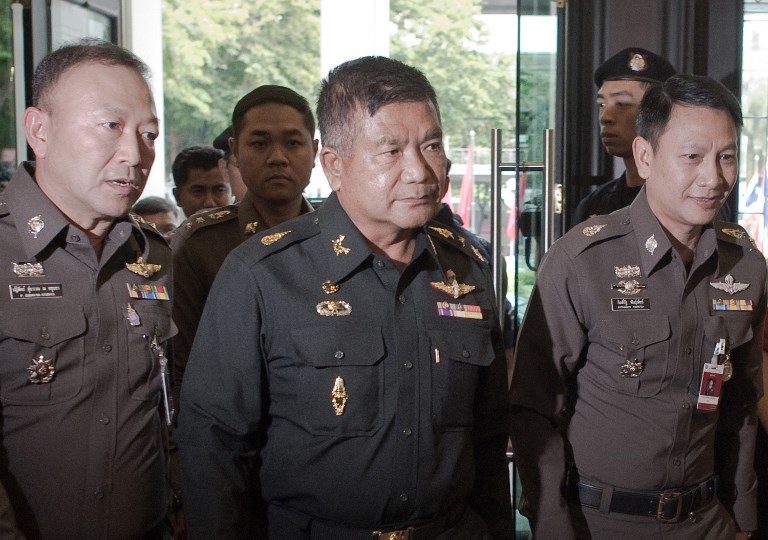

A Thai general, police officers, and local politicians were among dozens jailed for human trafficking yesterday, many handed decades-long sentences, at a mass trial exposing official complicity in the grim trade in Rohingya and Bangladeshi migrants.
Starting in 2015, military leaders cracked down on a suspected network of corrupt officials and gang leaders thought to be making a fortune by transporting migrants through Thailand and Malaysia. Some of these desperate people were even kept for ransom in jungle camps.
The investigation revealed a web of Southeast Asia traffickers that had abandoned their human charges in filthy camps that led to hundreds of deaths from starvation and malaria. Out at sea, even more overcrowded boats ran like ferries between Thai, Malaysian, and Indonesian ports.
The most senior government figure among the 62 people convicted on Wednesday was Lieutenant-General Manas Kongpan, who received 27 years for multiple human trafficking charges and other offenses.
A judge at Bangkok Criminal Court said he was also guilty of complicity in a “transnational organized crime” network and “worked with others to facilitate human trafficking”.
It is extremely rare for such a senior military figure in Thailand to see the inside of a courtroom, let alone a jail.
Others received even more severe punishments. One Myanmar national who helped run the jungle camps got 94 years in jail, at least 17 others got terms more than seven decades long. Under Thai law, however, the maximum sentence a prisoner serves is 50 years.
Manas was a top figure in the security apparatus covering Thailand’s south — a key transit zone in a trafficking trail that stretched from Myanmar to Malaysia.
The court heard he received bank transfers from trafficking agents worth THB14.8 million (USD440,000).
But the police investigation found he also used his position to guide trafficking gangs around checkpoints after their arrival on remote beaches as they headed to the jungle camps.
In 2013, he was promoted to head the Internal Security Operations Command (ISOC) for the entire south. Current junta leader Prayuth Chan-ocha was army chief at the time.
Before the crackdown rights groups had long accused officials of ignoring — and even conducting—the trade in humans through Thailand’s southern provinces.
The trial revealed a lattice of military, police, local political and mafia figures acting as traffickers, agents and logistics men, all soaking up cash from some of Asia’s poorest migrants.
Behind closed doors
Some reporting restrictions were placed by judges citing national security and Manas was allowed to give his testimony behind closed doors.
Pajjuban Aungkachotephan, better known as Ko Tong or “Big Brother Tong,” is a well-connected kingpin also convicted on Wednesday.
Police accused him of using private islands, close to tourist spots such as Koh Lipe, as a shifting point for migrants headed to the mainland, where they were packed into smaller vehicles for transport to camps near the Malaysian border.
Pajjuban was found guilty of human trafficking and links to organized crime with judges giving him 75 years.
Throughout the marathon sentencing hearing dozens of people, including two police officers, were convicted of various offences, ranging from guarding the squalid migrant camps to trafficking and negligence.
Some 40 defendants were acquitted including an army captain and a senior police officer while one died awaiting trial.
Big business, big money
Thailand’s role as a key trafficking route spilled into full view after officials found dozens of shallow graves in the hidden camps dotting the steep, forested hills of the Thai-Malaysian border in May 2015.
They revealed the horrors endured by some of the migrants, who were starved and held in bamboo pens by traffickers who demanded over USD1,000 for their release.
The verdict is being closely-watched inside Thailand and around the world. The government is desperate to dispel the kingdom’s notorious reputation for human trafficking.
Earlier on Wednesday Junta chief Prayuth angrily denied the case reflected deep corruption in the nation’s security offices.
“Manas alone will not make the entire military collapse,” he told reporters.
Critics say the case was prematurely concluded and describe a trial marred by witness intimidation, secret evidence hearings and restrictions on media reporting.
The senior policeman who initially headed the investigation, Major General Paween Pongsirin, fled Thailand under threats to his life.
Days before he left, he told AFP the case had been ordered closed before he could delve any further into the complicity of officials.