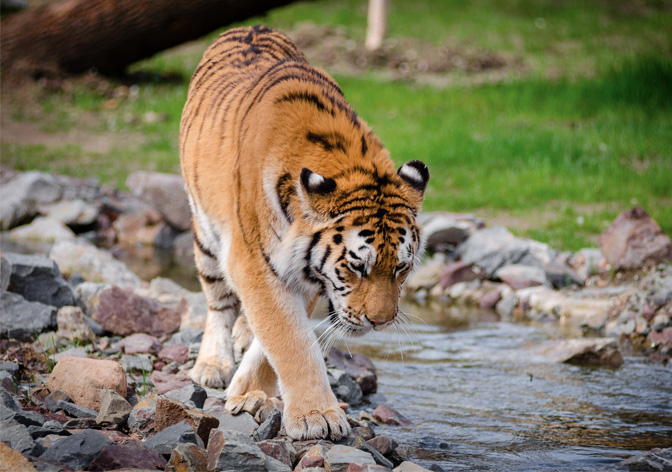

Even though there is an international ban on trade in tigers and their products, new reports from the world’s largest wildlife trade meeting that happened in South Africa, Reduced to Skin and Bones Re-examined, shows that there seems to be an increase in tiger trafficking across Asia rather than the decrease they had hoped for.
With only about 3,900 tigers left in the wild, the report from WWF and TRAFFIC says that an average of more than two tigers are being seized per week, and about 801 recorded seizures of tigers and tiger products across Asia since 2000.
The increasing number of seized tigers is believed to have originated from captive breeding operations.
As of this moment, India seems to be the country with the largest number of overall seizures. However, evidence shows that the traffickers are still exploiting a trade route that stretches from Thailand to Vietnam and through to Laos. These three countries are slowly increasing their number of tiger farms as well.
Steven Broad, the Executive Director of TRAFFIC, says, “This analysis provides clear evidence that illegal trade in tigers, their parts and products, persists as an important conservation concern. Despite repeated government commitments to close down tiger farms in Asia, such facilities are flourishing and playing an increasing role in fuelling illegal trade.”
Some measures have been taken to combat the increase in tiger trafficking. Representatives from more than 180 countries have come together to meet at the 17th Conference of the Parties (CoP17) to the Convention on International Trade in Endangered Species of Wild fauna and flora (CITES) and conservationists.
They plan to urge countries with tiger farms, including China, Vietnam, Thailand, and Laos, to provide a timeframe for the phasing out and final shut down of tiger farms.
Laos has already announced plans on finding ways to phase out tiger farms, but only because CITES pointed them out for for their lack of regulation and control over wildlife trade.
Thailand has also taken measures of their own to counter these illegal trafficking operations such as cracking down on the infamous Tiger Temple, and making a promise to investigate all tiger breeding facilities in the country.
With the increase in trafficking captive bred tigers around Asia, WWF Head of CITES Delegation Ginette Hemley worries that tigers may go extinct if something isn’t done soon.
“Tiger range countries must rapidly close their farms or wild tigers will face a future only as skin and bones,” said Ginette.
“Laos and Thailand have announced steps in the right direction but they need to act now and other countries should swiftly follow the same path marked ‘close all tiger farms.”
Like human fingerprints, a tiger’s stripe pattern is unique, and could be used to identify poached tigers and trace their origins. Thus, India is asking over governments at CoP17 to share photographic evidence of the poached tiger skins, so that it could be compared with camera trap images of wild tigers held in a database.
This could hopefully be used to combat the poaching of tigers.
“Critical decisions cannot be put off until the next CITES meeting in three years’ time or we risk undermining recent important gains in tiger conservation,” said Hemley.










