
In early March, The New Yorker ran an extremely interesting (and long, but worth it) piece about Victor Bout, the Russian arms dealer who was arrested at the Silom Sofitel Hotel in Bangkok in 2010.
We won’t wade into the politics of the whole affair and whether Bout is guilty. (He says he’s not, Russia says he’s not, the US says he is and convicted him, he’s now awaiting sentencing.)
We will however share with you a few excerpts from the Bangkok parts of the story. Bout traveled to the Thai capital 2010 to meet what he thought were Columbian FARC rebels (but were actually US DEA informants) to arrange an arms deal.
The nearly 10,000 word piece by Nicholas Schmidle is on The New Yorker website and we highly recommend reading it.
Here are a few tasty tidbits:
Shortly after 10 A.M. the next day, Bout stepped out of the terminal at Bangkok’s Suvarnabhumi Airport, with a Lonely Planet guide to Colombia in his suitcase. The air was humid and sticky; he wore an orange polo shirt, khakis, and sneakers. He hailed a cab and headed toward the Sofitel.
D.E.A. agents and their Thai partners arrived at the hotel throughout the morning; they came by ones and twos, to deflect suspicion. They converted a room on the twentieth floor into a command center. Presuming that Bout had indeed worked for the G.R.U., the agents thought that he would detect traditional surveillance techniques, so they didn’t follow his taxi. Instead, an informant observed near a toll booth, and another crouched beside a disabled car on the highway. Bout didn’t seem concerned about being spotted; he submitted legitimate documents to airport immigration officials. Was he being reckless? Or did he have deep connections in Thailand?
At the Sofitel, Bout found Smulian, Carlos, and Snow at the mezzanine bar. “Mucho gusto,” Bout said to Carlos, who was wearing a wire. Bout ordered a hot tea with lemon. “I’m very sorry to what happened a few days ago,” he said to Carlos—a reference to a Colombian military attack that had killed Raúl Reyes, a top FARC commander. Losing friends, Bout said, is “very serious.”
He, Smulian, and Carlos took the elevator to the twenty-seventh floor, where they were joined by Ricardo. The four men entered a conference room with a floor-to-ceiling window, and sat around a long table with an arrangement of lilies at the center. Bout reached for a pen and pad. “Let’s make a list of your needs,” he said.
…
Moments after Bout and Carlos stood up to shake hands and close the deal, Thai policemen and D.E.A. agents burst through the conference-room door, weapons drawn. “Hands up!” the Thais commanded. “You’re under arrest!” Bout raised his arms and was shoved against a wall, his legs spread.
A few minutes later, Tom Pasquarello, the D.E.A.’s regional director in Bangkok, walked into the room and found Bout sitting calmly at the table. Pasquarello introduced himself and asked him if he knew what was going on. “The game is over,” Bout said. Pasquarello paused, unsure whether Bout was talking about his own career, the undercover charade, or something else. “I’ve seen people in these situations many times before,” Pasquarello told me. “Sometimes they are angry. Sometimes they are combative. Sometimes they are emotional. Viktor was relaxed. It’s a memory that still plays out in my head. Everything that had just happened—the D.E.A. agents, his life going up in flames—and he doesn’t break a sweat. It was like he was just sitting down to read the newspaper.”
…
A little after 5 P.M., Zachariasiewicz and two other agents questioned Bout at a Bangkok police station. Bout sat in a chair, his legs outstretched, his lips pursed, his bound hands folded in his lap. Zachariasiewicz told him that Carlos and Ricardo were undercover agents and had taped the conversation.
“If everything is recorded, then you have everything,” Bout said. “You have all the cards on the table.”
…
While prosecutors from the U.S. Attorney’s office in Manhattan debriefed Smulian, Bout spent his days in an overcrowded Bangkok jail cell. He made a point of not learning Thai; he feared that doing so would undermine his status as a foreigner in a Bangkok courtroom. Instead, he used the time to study Sanskrit, Hindi, and Persian. Meanwhile, he fought his extradition to the U.S.
He had powerful supporters. The Russian government denounced the charges against Bout, and protested to the Thai Ambassador in Moscow. American officials became aware of more nefarious efforts to secure Bout’s freedom. In a cable released by WikiLeaks, Eric John, the American Ambassador to Thailand, wrote that there were “disturbing indications” that Bout’s “Russian supporters have been using money and influence in an attempt to block extradition.” In December, 2008, a Thai naval captain testified in a Bangkok courtroom that Bout had come to the city to assess the functionality of a submarine port. The captain, it was later revealed, had been put up to the scheme by a purported G.R.U. asset—the son of a retired Thai admiral. Facing pressure from the U.S. Embassy, the Thai Navy said that Bout had not come to the country on official business.
On December 22, 2008, nine months after Bout was arrested, he testified in court. Street hawkers squatted nearby, selling pirated DVDs of “Lord of War,” featuring a photograph of Bout, in prison garb, superimposed next to Nicolas Cage. Under oath, Bout told a Thai judge that Smulian had reserved the Sofitel conference room so that he could meet four foreigners interested in buying two of his used airplanes. About fifteen minutes later, Bout recalled, he was placed under arrest. (Bout, Smulian, Carlos, and Ricardo spoke for more than ninety minutes.) “No one clearly said that they were members of the FARC,” Bout told the judge. “There was no discussion of selling weapons.”
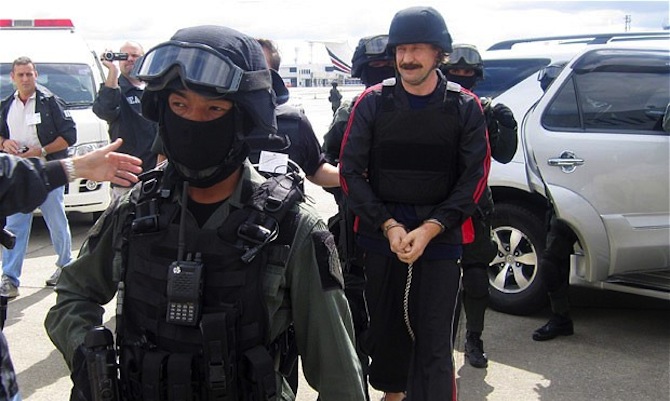
After more than two years of legal wrangling, the Thai court approved Bout’s extradition. On November 15, 2010, a team of D.E.A. agents arrived in Bangkok. Security was tight. Pasquarello, the D.E.A. agent, said, “The Russians knew we had Viktor’s laptop and knew all about his weapons-trafficking activities. And they had already spent considerable clout and resources trying to get him out of prison. Were they going to try and break him free on the way to the airport? Or try to assassinate him?”
So the D.E.A. employed a decoy. On the morning of November 16th, a motorcade of police vehicles left Bang Kwang prison, where Bout was being held, and headed to Suvarnabhumi Airport. Reporters followed. Minutes later, a second convoy, without lights or sirens, drove to Dong Muang, a military airport. Bout sat, shackled, in the back seat of an S.U.V. with tinted windows, wearing a ballistic helmet. Once he arrived inside the terminal, American officials removed his helmet. Bout’s hair had grown moppish, and his mustache was caterpillar-thick.