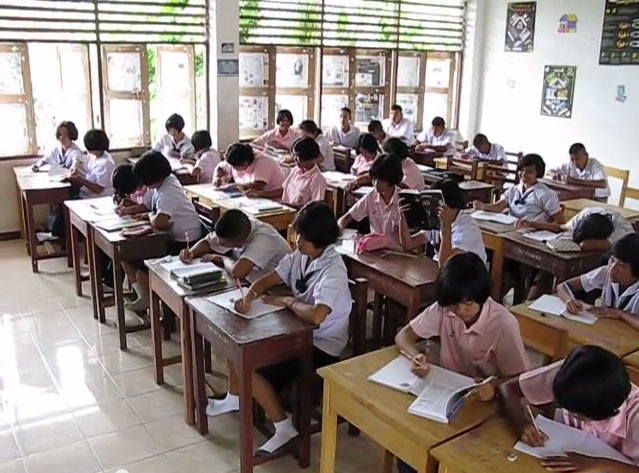

Political instability and ingrained social hierarchy continue to hinder education reform in Thailand.
That was the verdict at a panel discussion of the kingdom’s inadequate learning system featuring students and education experts from the private and public sectors last Wednesday at the Foreign Correspondents’ Club of Thailand.
“Thai education needs curriculum reform, but we believe that there are too many reforms without any obvious change in the subjects students need,” said high school student Nattanan Warintarawet.
Panelists said money isn’t going to fix the problem. Despite an Education Ministry budget of 19.35 percent – compared to 4.23 percent for public health – Thailand still suffers from educational inequality and inadequate schooling.
A government representative from the Ministry of Education who braved the critical crowd said there was a will to change things – and indeed money to be spent – but was forthright about the political challenges to doing so.
Frequent changes in political leadership mean there’s no steady hand at the top and a lack of accountability, making it difficult to steer long-term changes, said Pumsaran Tongliemnak, a policy analyst at the Ministry of Education. Those who do try to implement change never stay around long enough to see it implemented.
“The Ministry of Education is the only ministry in Thailand that changes ministers very frequently,” he said. “In the past 15 years, we have had 16 ministers. Each stays for about 10 months.”
The THB498.16 billion allocated for next year will probably be spent on reinforcing archaic attitudes, rather than promote critical thinking and individuality among the students. The money is simply thrown at the problem rather than used to reconstruct the long overdue curriculum.
Other challenges have deep cultural roots and are unlikely to be solved by policy.
In the classroom, traditional power relationships born of social hierarchy are another barrier against educational progress, panelists argued. The top-down approach where respect for teachers is inviolable, and students don’t have a voice prevents them from engaging, said Joshua Russo, a consultant whose firm helps prepare students for higher education. Though Thai students are capable of expressing emotions, Russo said, they must bury their thoughts and feelings in the classroom.
“Students are seen but not heard,” said Nattanan Warintarawet, a high school student and co-founder of a student advocacy group called Education for Liberation of Siam.

Since 1991 “Children’s Duty” has long been sung in the classroom.
The oppressive climate of Thai education destroys student identity, creativity and potential, Nattanan argued. From haircuts and uniforms to daily, nationalist rituals such as flagship undermine student individuality and expression, he added.
While the session gave voice to many valid criticisms, little in the way of solutions were suggested. But that frustration is understandable, especially given that Thailand falls behind its less economically developed Laos and Cambodia to rank seventh among the 10 members of Asean, according to the World Economic Forum.