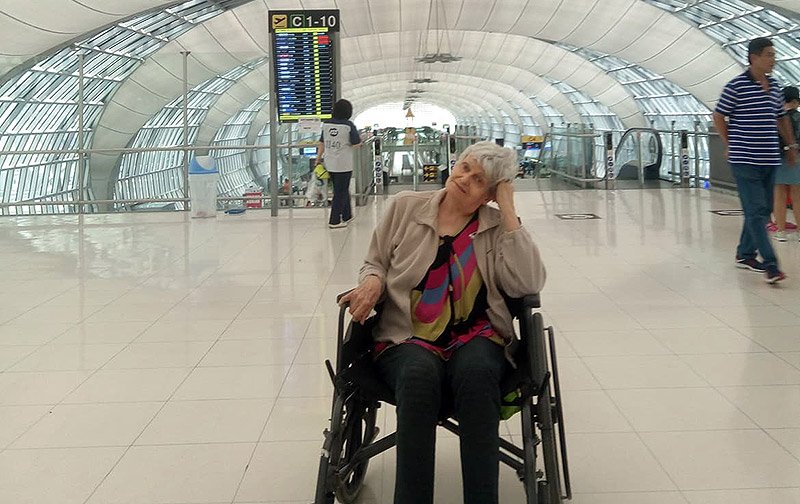

Deanna Denis played by the rules. When advanced Alzheimer’s meant her mother needed around-the-clock care, the American did everything Thailand required to bring her here to live legally. That was two years ago.
On Tuesday she was bidding an unhappy farewell to the kingdom after immigration authorities changed those rules. Speaking to a reporter just after noon from Suvarnabhumi Airport, 57-year-old Denis said she hoped her story might help others.
“It’s too late for us, we’ve already put the wheels in motion and have been planning this for months,” she said, just two hours before their flight was to depart for Manila.

As of March 1, retirees were suddenly required to show either minimum monthly incomes of THB65,000 (US$2,050) or Thai bank account balances of THB800,000 (US$25,200). The balance had to be maintained for months before and after the application was filed, meaning nearly half of the year. At other times, it had to be kept at a minimum of THB400,000.
There’s no ready data of how many other foreigners have been likewise affected, but anxiety has spread among older expats who’ve sounded off their complaints and fears in online forums.
Numerous attempts to reach immigration bureau authorities to inquire about the rationale behind the changes, the evaluation of their consequences and future considerations were unsuccessful.
Denis was paying THB85,000 for her 77-year-old mother Anna’s care at Care Resort Chiang Mai, she said, which she and her husband could just cover and still make ends meet.
“Oh my gosh, it’s great, it’s a beautiful resort, and we were really happy with the care,” she said. “It was expensive, but we were managing.”
She said they could have gamed the system and found a way to funnel that monthly expense through bank accounts to make it look like income, but doing so would have gone against her values.
Denis, 57, said that while they are “not wealthy,” they were managing to get by okay on their finances.
“My husband and I have enough residuals from our company and savings to show for us. But the problem is that we’re taking our money and paying for my mom,” she said. “Immigration wants to see 800,000 baht in the bank.”
She said her mother has lived with Alzheimer’s for 15 years, and without other family, there was no way to afford 24-hour care for her in the United States.
The problem became apparent several months ago after the rules changed and it was time to get her mother’s retirement visa squared away. Just understanding the changes was complicated by officials who seemed uncertain of what they were and indifferent to reason.
“One thing we’ve noticed with the officials and workers we’ve dealt with is … they don’t deviate, they don’t understand. There’s no critical thinking. They can’t imagine how to do anything differently.”

She said they were given conflicting information by immigration offices in Chiang Mai, Koh Samui and Nakhon Sri Thammarat, where she and her husband were staying.
Ultimately it’s the uncertainty created by ever-shifting rules that forced the decision to leave. Had they found a way for her mother to stay, Denis said she feared another change would occur down the line after her health had deteriorated to the point relocation was no longer an option.
“If they want people to come here and spend money on medical tourism, then they need to keep the rules consistent. They can’t change them without grandfathering in the people already here,” she said.
Thailand has issued a raft of new policies fortifying financial requirements to remain in the kingdom. Earlier this month, it extended health insurance requirements to all retirement visa applicants.
Update: This story was updated to reflect that Immigration Bureau officials were unable to be reached for comment despite numerous attempts.