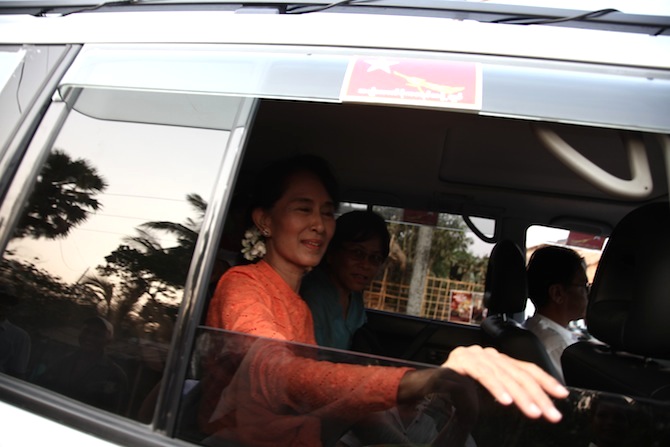

On a dusty road in an impoverished corner of the Irrawaddy delta, locals line the road expectantly. And like a Mexican wave, a ripple of hysteria moves down the road following a convoy. As it turns off the main road it reaches fever pitch – the Lady is here.
The city of Rangoon the largest city in Burma and its former capital has been transformed since the last time the country went to the polls in 2010, a time when openly displaying images of the Lady – Daw Aung San Suu Kyi – could land you in jail. Now the flags of her party, the National League for Democracy, are everywhere, seldom does a taxi not have one in some form or another.As the results of Sunday’s by-election, which was for some 45 seats in the country’s parliament, Suu Kyi has joined the political mainstream after nearly quarter of a century of struggle. It is a result which was confirmed by the state run New Light of Myanmar on the ninth page, her name appeared in small letters in official gazette style – no frills or pictures just a list – but recognition in black and white that something tumultuous happened on April 1, 2012.
[[{“type”:”media”,”view_mode”:”media_original”,”fid”:”16388″,”attributes”:{“alt”:””,”class”:”media-image”,”height”:”447″,”typeof”:”foaf:Image”,”width”:”670″}}]]
On election day, Ko Mye Mye was out on streets for the NLD. A taxi driver by trade, he has been an NLD member for some 15 years. In the mid 90’s he said his brother was picked up by the police for membership of the party: He would never emerge alive from the jail. Mye Mye does not know what happened to his brother but has been an avid member of the NLD ever since.
The scale of the NLD’s victory surprised the President’s chief political adviser, Ko Ko Hlaing. Both he and his boss, Thein Sein are former military men. What surprised most people was more the lack of cheating by the military party, the Union Solidarity and Development Party (USDP) which was widely believed to have rigged the 2010 elections.
[[{“type”:”media”,”view_mode”:”media_original”,”fid”:”16389″,”attributes”:{“alt”:””,”class”:”media-image”,”height”:”447″,”typeof”:”foaf:Image”,”width”:”670″}}]]
However like Ko Mye Mye people were not voting for policy. This was not an election in the classic sense of the word. This was a vote to shake a life time of struggle and fear for many. The scenes outside the NLD’s headquarters were testimony to that on the 1st of April, as crowds built all afternoon. As the sun set, both sides of the road were packed with red clad supporters of the party, with insatiable enthusiasm the crowd danced and cheered, leaping with excitement to pop songs as the results were announced on an led screen. The atmosphere was more reminiscent of a celebratory rock concert helped on by Burmese versions of Johnny Cash.
Suu Kyi noted on Friday at her house that the party believed “irregularities” were widespread: incidents such as cutting the power on their offices, intimidation and fraudulent polling lists. The fear that came from the 2010 election of “advanced votes” was also strong, one foreign election observer noted. This was practice of votes being cast by government workers in advance because they worked away from home. In 2010 these were “counted” after the regular votes and came in to thwart candidates not in the military party.
This by-election was only for a small number of seats in the parliament but confirmed the stature of the party, and especially that of its leader Aung San Suu Kyi. Wandering the streets it appeared that someone had been made a saint or that Saigon had just fallen to the NLD as supporters on decrepit vehicles draped in the red party flag, like an army of newly weds liberating a city. They await the next general election in 2015.
[[{“type”:”media”,”view_mode”:”media_original”,”fid”:”16390″,”attributes”:{“alt”:””,”class”:”media-image”,”height”:”447″,”typeof”:”foaf:Image”,”width”:”670″}}]]